
 Riiffs Freeze in Flames: Ice and Flames Illuminate Warsaw
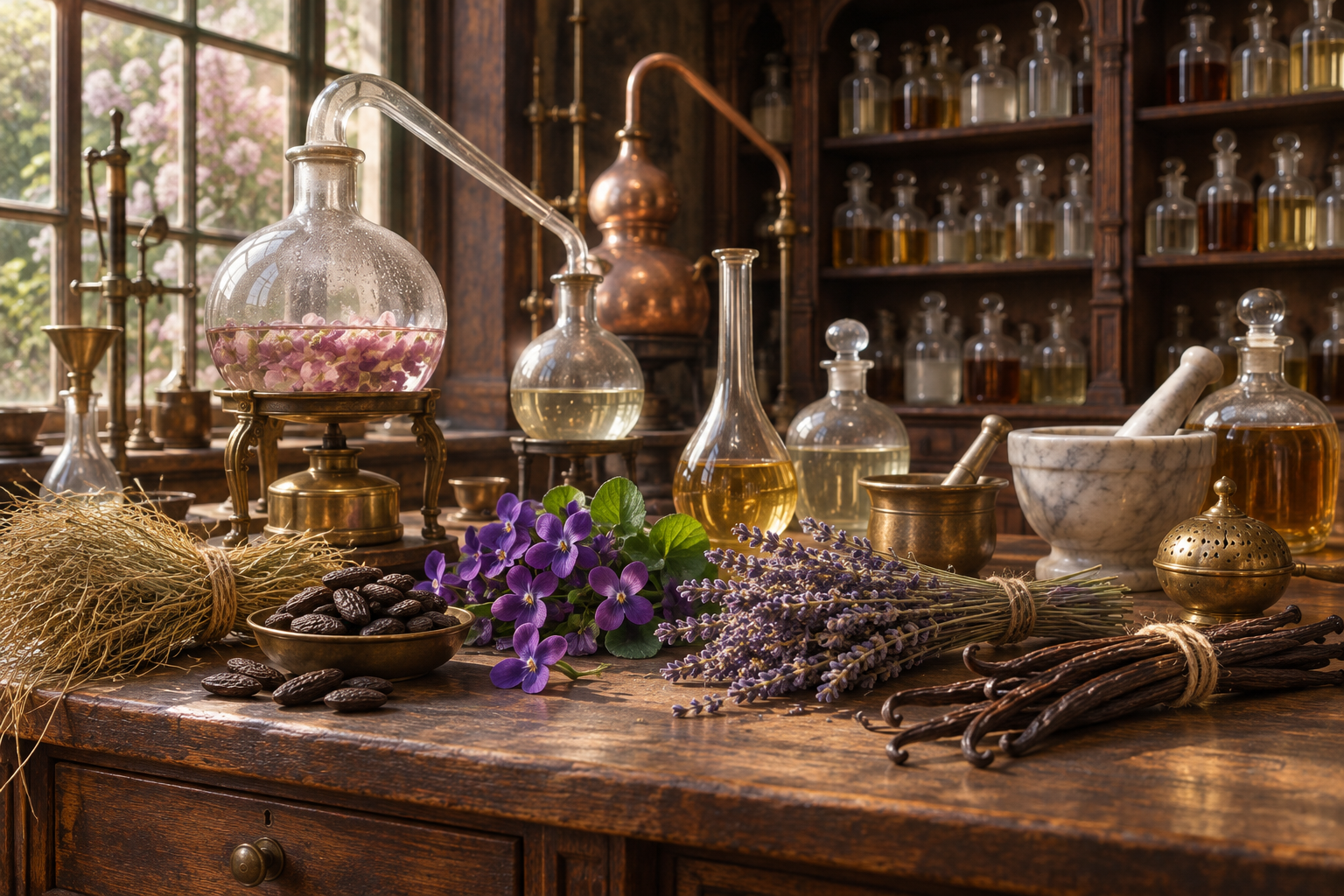
In the seventh installment of The History of Fragrances series, we find ourselves at the end of the 19th century, when chemistry first fully entered the world of perfumery. Discover how the first synthetic molecules were created, why Fougère Royale smells like fern, which doesn't have a scent, and how Jicky heralded modern perfumery.
Part Seven: Perfumery on the Brink of Chemistry
The series "History of Fragrances" has already guided you through millennia during which fragrant substances transformed from sacred offerings into a part of everyday life. We began in ancient Egypt with incense and scented ointments, passed through the baths and banquets of ancient Rome, and paused with Arab scholars who perfected distillation. Then we headed to the Provençal Grasse, peeked into the fragrant halls of Versailles, and lastly observed how Eau de Cologne introduced a fresh citrus style that Europe quickly embraced as its own.
Today, we move into the second half of the 19th century. Europe is changing before our eyes – factories are rising, railways are shortening distances, and cities are expanding. However, perfumery at that time still relied on the same foundation as centuries before: natural raw materials.
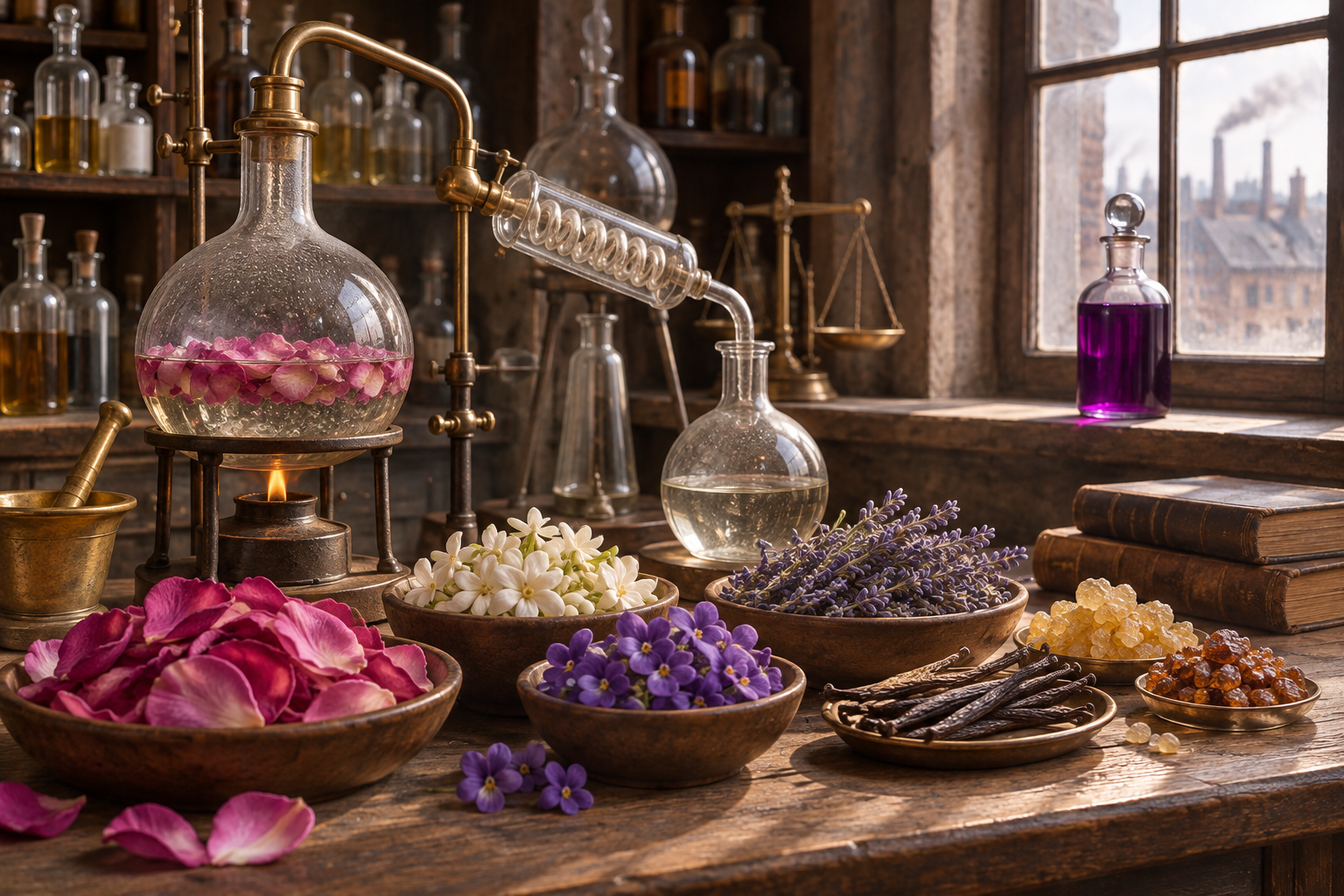
The palette of a perfumer back then consisted of substances that needed to be grown, harvested, or imported from afar:
- flowers – rose, jasmine, tuberose, or violet, whose scents were captured through laborious processes such as distillation or enfleurage in fat,
- citrus and herbs – bergamot, lemon, lavender, or rosemary,
- resins and spices – incense, myrrh, benzoin, or vanilla pods,
- animal raw materials – musk, ambergris, or civet, which added depth and longevity to compositions.
None of these raw materials had a stable price or guaranteed availability. A frosty spring or rainy summer could decimate the flower harvest, while war or unrest could disrupt trade routes through which spices and resins flowed into Europe. Perfumers had to account for the fact that the same formula could be easily achievable one year and barely possible the next. Moreover, some scents that are well-known from nature could not be derived from their source at all – for example, the lily of the valley does not provide a usable fragrant oil.
At the same time, a new science was being born in laboratories. The Industrial Revolution brought not only machines but also a number of by-products, such as coal tar left over from the production of coal gas. Chemists discovered a range of substances in it and learned to separate, examine, and combine them into new compounds. Organic chemistry became one of the most dynamic fields of its time within a few decades. In 1856, a young English chemist, William Henry Perkin, prepared the purple dye mauveine and demonstrated that a substance with great commercial potential could emerge from the laboratory.
This raised a fundamental question for perfumers. If a chemist can produce a color that was previously supplied only by plants or animals, why couldn't they create a fragrance as well? Scientists gradually searched for the molecules responsible for the characteristic scent of individual raw materials and explored whether they could be artificially obtained – in consistent quality and independent of weather or trade.
In this part, we therefore enter the era when perfumery first encounters the chemical laboratory. What happens when a fragrance is created not only by nature but also by the laboratory? And how will perfumers, accustomed to working only with what was grown in the garden or brought by ship, respond to such a novelty?
Coumarin, Vanillin, Ionones – The First Synthetic Molecules
In the second half of the 19th century, substances began to make their way into perfumery workshops that were not born in fields or greenhouses, but in chemical laboratories. Initially, there were only a few molecules, but their impact was long-lasting. Three of them – coumarin, vanillin, and ionones – are now commonly cited as the first synthetic raw materials that truly changed the way perfumes are composed.
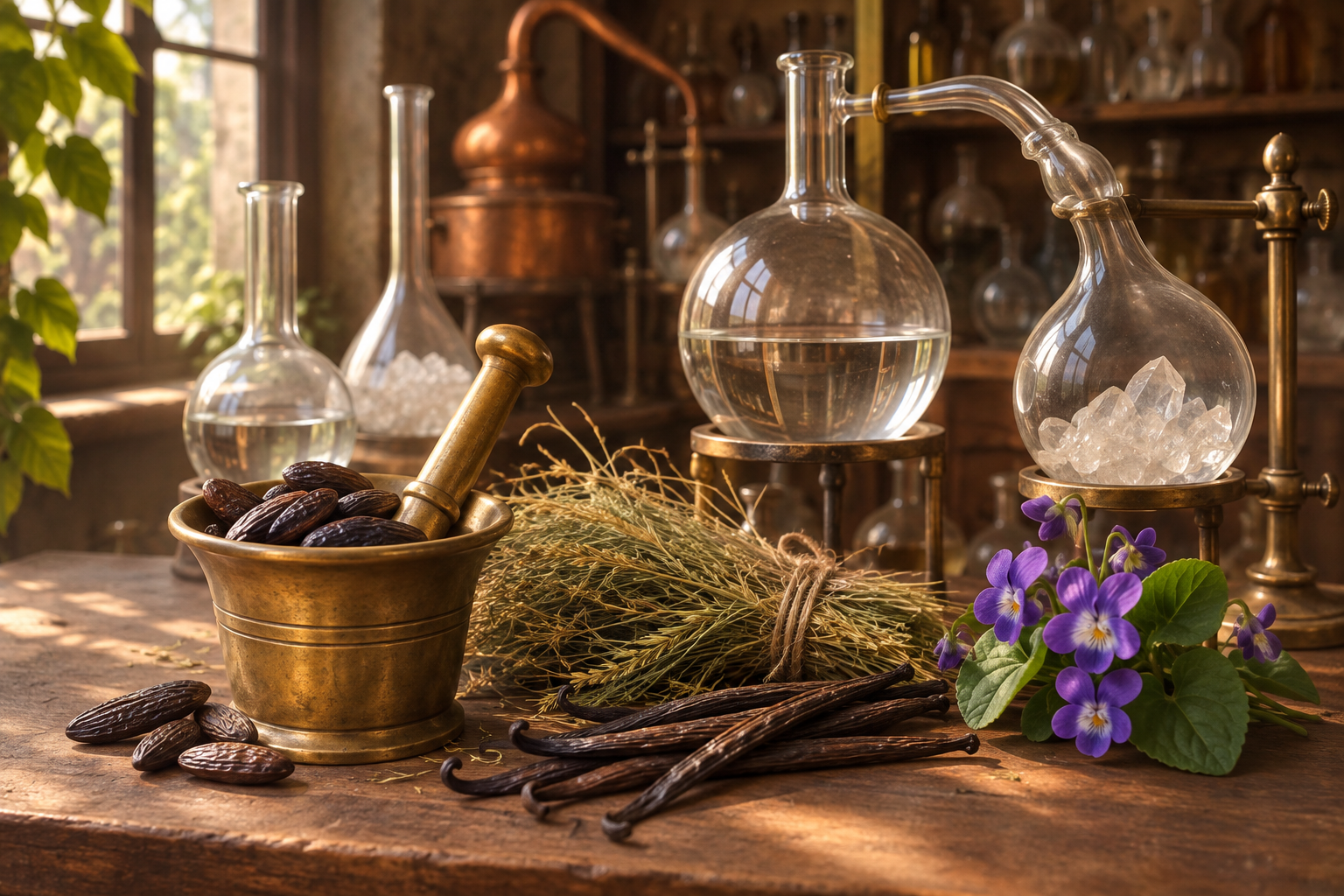
Coumarin smells like freshly cut hay, with a sweet, slightly almond and tobacco undertone. In nature, it is found in tonka beans, from which chemists isolated it as early as the first half of the 19th century. Laboratory synthesis is usually attributed to the English chemist William Henry Perkin and is dated to the late 1860s, most often to the year 1868. For perfumers, it was the first time they had access to a raw material that could be obtained without relying on the import of exotic beans.
Vanillin is the main fragrant component of the vanilla pod. Its synthesis is associated with German chemists Ferdinand Tiemann and Wilhelm Haarmann and dates back to the mid-1870s – sources most often cite the year 1874, though they differ on whether the breakthrough was the discovery itself or the start of production. Lab-made vanillin does not smell exactly like the whole pod, as natural vanilla contains a range of other substances that give it depth. Nevertheless, it allowed sweet, creamy tones to appear much more frequently in compositions.
Ionones resemble the scent of violets with a powdery and slightly woody hint. Their discovery is placed at the beginning of the 1890s and is again usually associated with Ferdinand Tiemann and his collaborators. They held special significance for perfumery: the fragrant substance from violet flowers is very difficult to obtain and in very small amounts, so violet scent was rather rare until then.
However, synthesis did not just mean cost reduction. It brought perfumers three main advantages:
- Consistent quality – a laboratory molecule smells the same every time, whereas natural raw materials vary according to variety, weather, and processing.
- Independence from harvests – crop failures, import fluctuations, or long journeys from the tropics no longer threatened the finished composition.
- New fragrance notes – some scents, like violet, could only be captured from plants with great difficulty, or not at all. The laboratory made them accessible in a form that could be worked with.
It's important to remember that new molecules did not initially replace natural raw materials. Perfumers added them to tried-and-tested essences, absolute oils, and tinctures, and only gradually explored what they could do with them. A synthetic substance often acted as a bridge between natural tones – adding clarity, strength, or longevity to the composition. This collaboration between nature and the laboratory has been maintained in perfumery to this day, and traces of coumarin, vanillin, and ionones can be found in many contemporary perfumes, from aromatic fougère to gourmand scents and powdery floral compositions.
Fougère Royale: The Fern That Never Smelled
When the house of Houbigant launched the perfume Fougère Royale, it demonstrated that perfumery doesn't have to merely mimic nature. The launch year is most commonly cited as 1882 (though some sources mention 1884), and the creation is traditionally attributed to Paul Parquet, the perfumer and co-owner of the house at the time. The name promises a "royal fern" – yet ferns themselves have almost no scent.
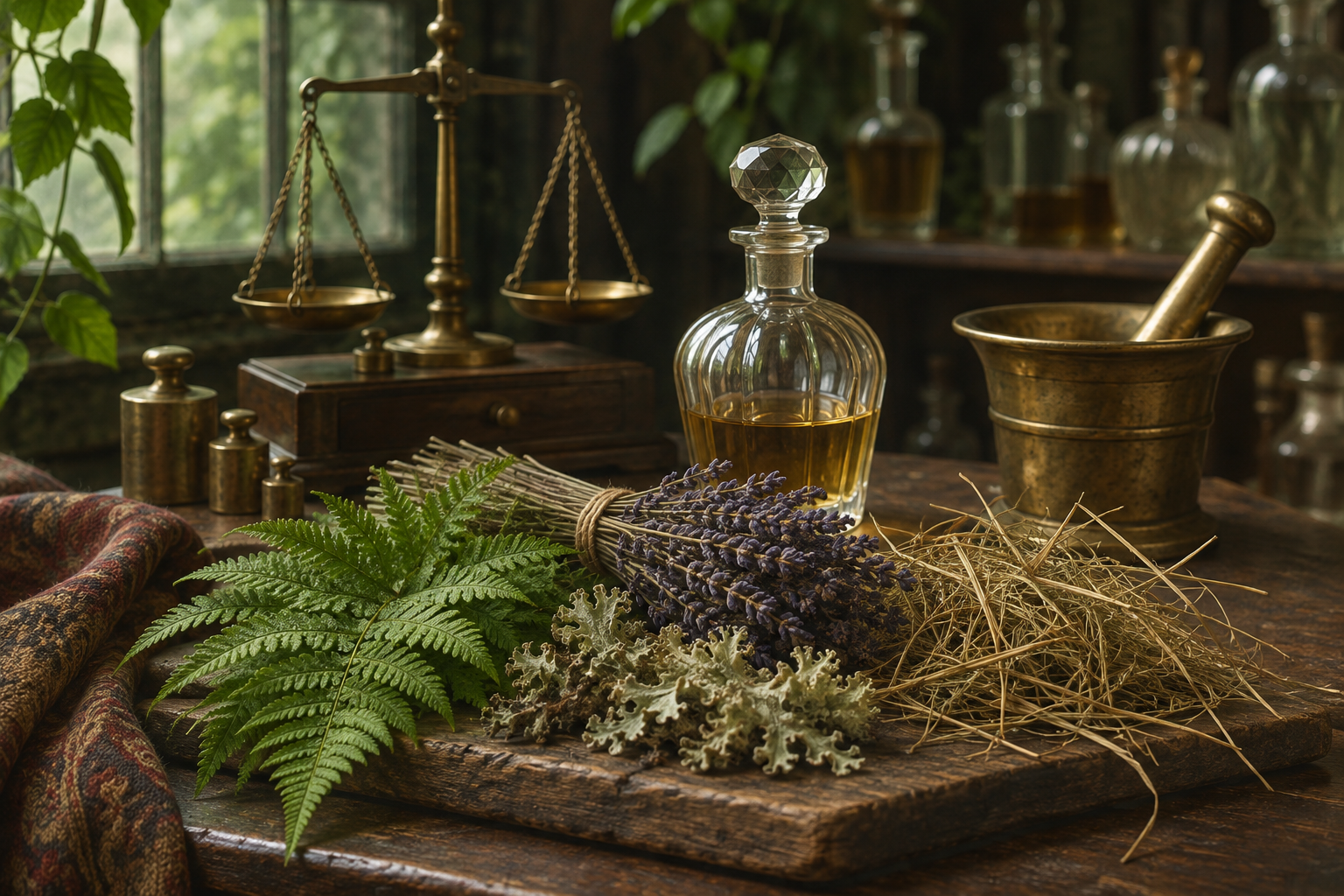
This is where the magic of the paradox lies. Fern leaves don't have a distinctive fragrance that can be captured and bottled. Parquet didn't replicate a specific plant but instead created an idea of how it might smell – fresh, green, slightly shady, and earthy, like a damp forest undergrowth. Fougère Royale thus became one of the first prominent examples of an abstract fragrance, which doesn't depict a single ingredient but rather a mood and a place.
The structure of the composition, according to preserved descriptions, was built on a trio of components:
- Lavender – aromatic, clean, and slightly herbal, it added freshness and clarity to the fragrance.
- Oakmoss – earthy, slightly sweet, and with a damp forest tone, it anchored the fragrance and gave it depth.
- Coumarin – a warm note reminiscent of freshly cut hay and almonds, which linked both opposites together.
Descriptions also mention other additions, such as bergamot or geranium, but their exact proportions cannot be reliably documented today. Fougère Royale is often cited as one of the first perfumes to use synthetic coumarin, and for this reason, it became a symbol of a new era where the laboratory began to expand the perfumer's palette.
From one perfume, an entire fragrance family gradually emerged. The term fougère (French for fern) is now used by perfumers for compositions built on a similar contrast of aromatic freshness and an earthy, warm base. This signature can be found in many classic and contemporary perfumes, especially men's, where spices, woods, or citrus may be added to the original trio. So when you come across a perfume described as "aromatic fougère," it is a direct descendant of the idea from the 1880s.
With historical perfumes, however, caution is advised. Fougère Royale was reintroduced in the 20th and 21st centuries in new forms, and these reissues can differ significantly from the original version – partly due to changes in the availability of ingredients and partly due to later regulations that limited the use of substances like oakmoss. If you want to get a sense of the original scent, consider the modern version more as a tribute than a faithful copy. What exactly the original from the 19th century smelled like is known today primarily from period and later descriptions, not from firsthand experience.
Jicky: Guerlain's Bold Move of 1889
The year 1889 is remembered in Paris for the World Fair and the newly constructed Eiffel Tower. However, in the world of perfumery, a quieter yet profound change occurred the same year. Aimé Guerlain, the son of the founder of the family business, introduced the perfume Jicky—a composition often regarded by perfume historians as one of the first modern perfumes. It wasn't just about being the first to use a synthetic substance; it was the way he used it that was decisive.
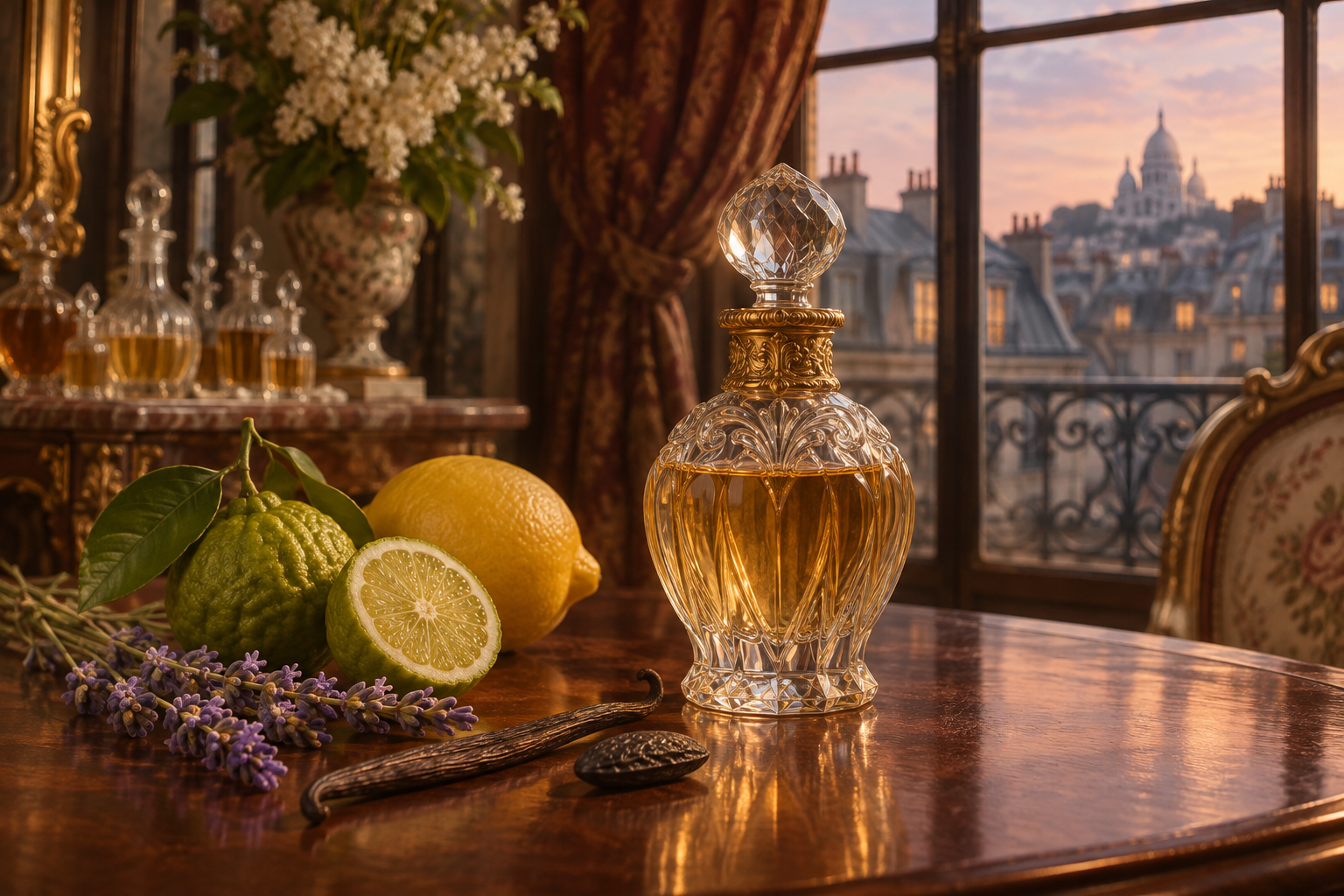
Most perfumes of that time aimed to capture a single flower or bouquet as faithfully as possible—rose, violet, heliotrope. Jicky took a different path. It doesn't mimic any specific flower but creates an impression not found in nature. The fresh opening features citrus notes, primarily bergamot and lemon, with lavender and aromatic herbal accords emerging in the heart, and the base notes are warm, sweet, and slightly animalic.
The new chemistry is evident in the base. Coumarin adds notes reminiscent of hay and tonka bean, while vanillin brings a sweet, creamy depth. Guerlain didn't use them as a cheap substitute for natural ingredients but as a full-fledged building block. Natural materials—lavender, citrus, resins, and animalic tones—form a whole with them, intentionally blurring the lines between "natural" and "laboratory." Today, Jicky is usually classified as an aromatic or oriental fragrance and is also mentioned in connection with the fougère family.
Over more than a hundred years, many stories have accumulated around Jicky, and it's good to separate them from what is documented. The year of introduction, authorship by Aimé Guerlain, and the prominent role of lavender, coumarin, and vanillin in the composition are documented. The origin of the name is less certain. The most common story is that Jicky was the nickname of Aimé's nephew Jacques Guerlain, a later prominent perfumer of the family. Another, more romantic version tells of a young Englishwoman Aimé supposedly met while studying in England. Neither can be confirmed with certainty, so consider them more as part of the legend than historical fact.
Similarly, caution is needed regarding who initially wore the perfume. It is often stated that the first reception was rather lukewarm and that Jicky was initially favored by men, with women embracing it later. Reliable data on customers at that time is scarce. What is certain is that the composition based on lavender and a warm base did not fit the contemporary notions of a "feminine" fragrance, and today Jicky is commonly perceived as a scent that does not respect gender boundaries.
Why then is Jicky, along with Fougère Royale, considered a turning point between old and modern perfumery? Both perfumes were created within a few years and both demonstrated that a synthetic molecule need not be just a cheaper copy of nature, but can open up a scent no one has smelled before. Fougère Royale did so with the concept of fern, Jicky with an abstract composition that doesn't refer to any flower. Perfumery thus moved from imitation to artistic expression, and perfume began to be understood as an independent work, not just a captured garden scent. Jicky is still produced today, although its formula has been modified over the decades.
From Family Workshop to Global Brand
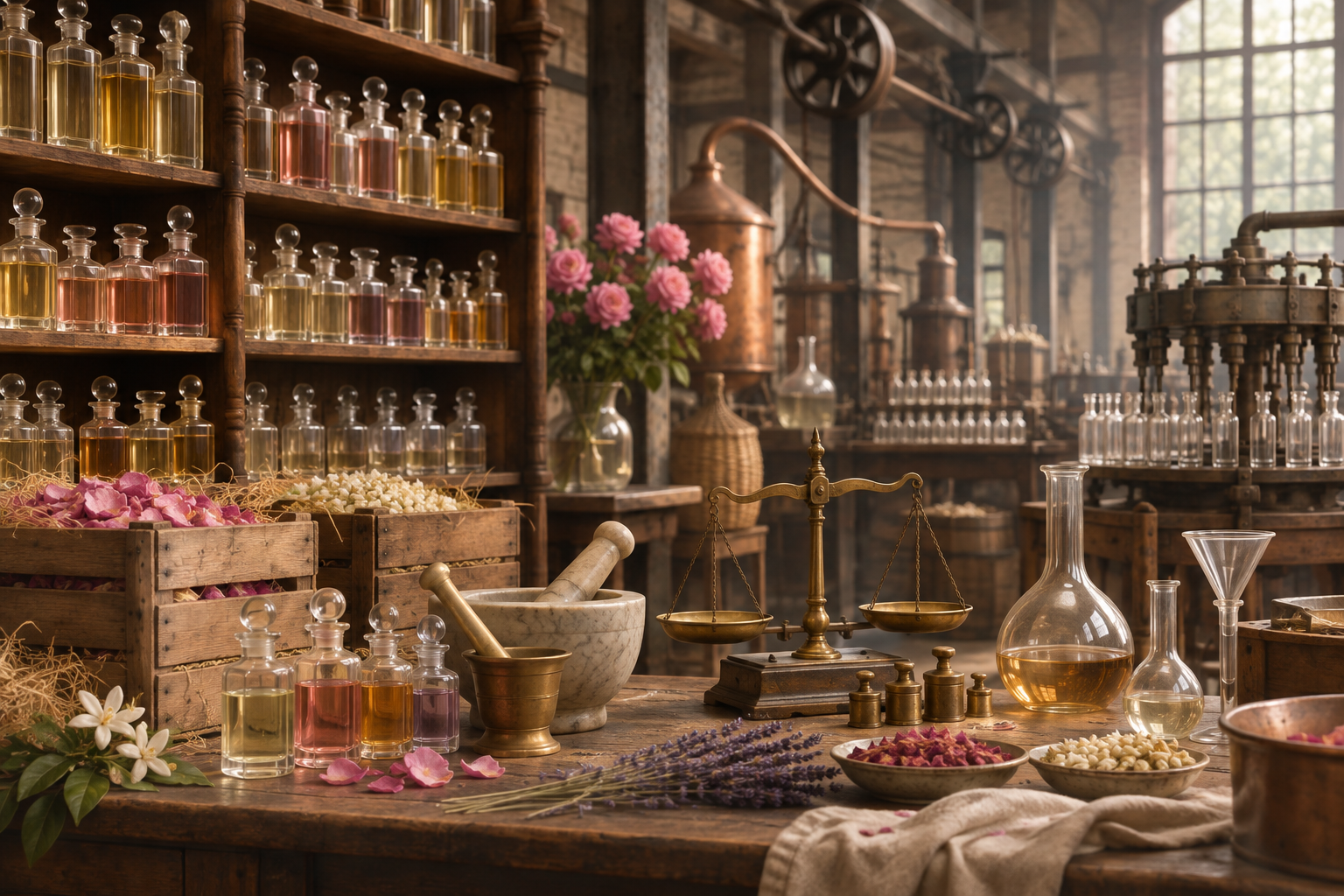
In the mid-19th century, perfumery was primarily a family craft. A master would pass down recipes to his son or nephew, the workshop was right next to the store, and customers often ordered scents directly from the perfumer. This was how houses like Houbigant, which began in Paris in 1775, or Guerlain, who opened their Parisian shop in 1828, operated for decades. Their name was associated with the owner, and their reputation spread mainly among wealthy clients.
By the end of the century, this model began to change. Perfume was no longer just the content of a bottle but a complete story – with its own name, bottle, label, and box. In France, from the mid-19th century, legal protection of trademarks was developing, and perfume houses began to use it: they protected names, unified packaging appearance, and built a recognizable identity. A family name gradually became a brand that could outlive its founders.
Collaboration with the chemical industry played a significant role in this. New molecules were not created in perfumery workshops but in laboratories and factories, which produced them in larger quantities and offered them further. Perfumers learned to work with raw material suppliers, experiment with new substances, and find ways to incorporate them into compositions alongside traditional essences. The relationship was mutual – chemists needed buyers, and perfume houses needed materials that nature either did not provide at all or only at a high cost and with fluctuating quality.
The legacy of this era is not just museum-like. Coumarin, with notes of freshly cut hay and tonka beans, and the fougère accord, combining lavender, coumarin, and mossy, woody tones, remain fundamental building blocks of perfumery. The fougère family can be found in many contemporary men's and unisex fragrances, and coumarin also appears in gourmand and oriental compositions. So when you smell a clean, herbal-soapy scent with a warm sweet base, you might be sensing echoes of experiments from the 1880s.
What did the laboratory bring to perfumery? It can be summarized in three points:
- New Scents – Molecules allowed for the creation of impressions that have no direct natural counterpart, enabling perfumers to compose abstract compositions instead of faithful floral imitations.
- Consistency – Synthetic substances have a more consistent quality than natural raw materials, whose scent varies with the harvest, allowing the formula to be repeated with the same result.
- Accessibility – Industrial production gradually reduced costs, and perfume began to reach customers beyond the wealthiest classes.
We will build on this foundation in the 8th installment of the series, where we will move into the 1920s – to aldehydes, fashion ateliers, and the creation of Chanel No. 5.
Category
Recommended articles
Riiffs Freeze in Flames: Ice and Flames Illuminate Warsaw "Give a girl the right shoes and she can conquer the world!" Marilyn Monroe
