


 Riiffs Freeze in Flames: Ice and Flames Illuminate Warsaw
The eighties were all about bold scents, while the nineties embraced pure freshness. Part nine of The History of Fragrances reveals why tastes shifted 180 degrees in just one decade.
The Loud Decade: When Perfume Entered the Room Before You Did
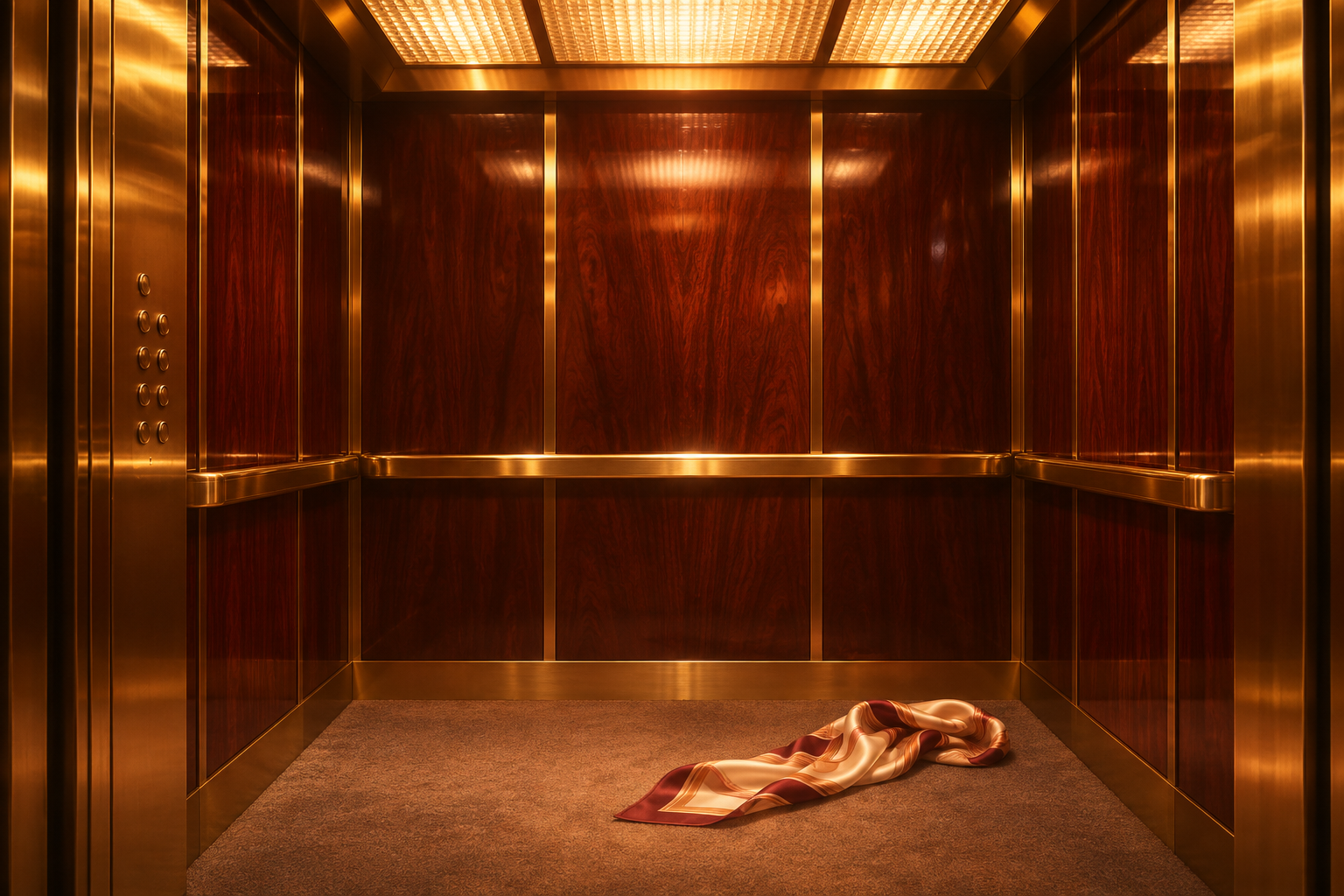
Imagine an office in the mid-1980s. The elevator doors close, the cabin moves – and you know exactly who was there before you. Not by their footsteps or voice, but by the scent they left lingering in the air. Dense, sweet, spicy, sometimes so strong that it could be smelled a floor above. This is how the 1980s are often remembered: as the decade when perfume stopped whispering and started speaking loudly.
In previous installments of the History of Fragrances series, we followed how perfumery gradually transformed – from the exclusive domain of courts and salons to elegant compositions that found their way into ordinary households. For a long time, an unwritten rule applied: perfume should only be smelled at a distance you allow someone into your personal space. Discretion was a sign of good taste.
The 1980s turned this rule on its head. Perfume became a public statement – of confidence, ambition, social status, and a willingness to be seen. The pronounced scent trail, which perfumers refer to with the French word sillage, was no longer a side effect but a goal. The fragrance was meant to fill the room and linger on a scarf, coat collar, and office chair long after the wearer had left.
And then, in just ten years, something remarkable happened. At the beginning of the 1990s, compositions began to emerge that felt like an open window: airy, transparent, reminiscent of a sea breeze, clean laundry, or a morning shower. Opulence turned into freshness, loudness into quiet comfort. The main question of the ninth installment is therefore: why did tastes shift so quickly to the complete opposite?
The answer is not only found in the laboratories of perfumers. It comprises fashion, economics, television, advertising, and the transformation of how people wanted to be perceived by their surroundings. In this installment, you can expect:
- period context – how shoulder pads, TV series, the desire for success, and what people wore on their skin were interconnected,
- anatomy of great compositions – what the scents that defined the decade were made of and why they felt so powerful,
- the turning point of the 1990s – the rise of fresh, marine, and unisex fragrances,
- legacy of both decades – what from that era's shift we still wear today, often without realizing it.
Before we dive into the individual chapters, a note: the 1980s and 1990s are not a story of "bad" and "good" taste. Both decades faithfully mirrored their times – and perfume was one of its very sensitive barometers.
Shoulder Pads, TV Series, and Fragrances as a Symbol of Success
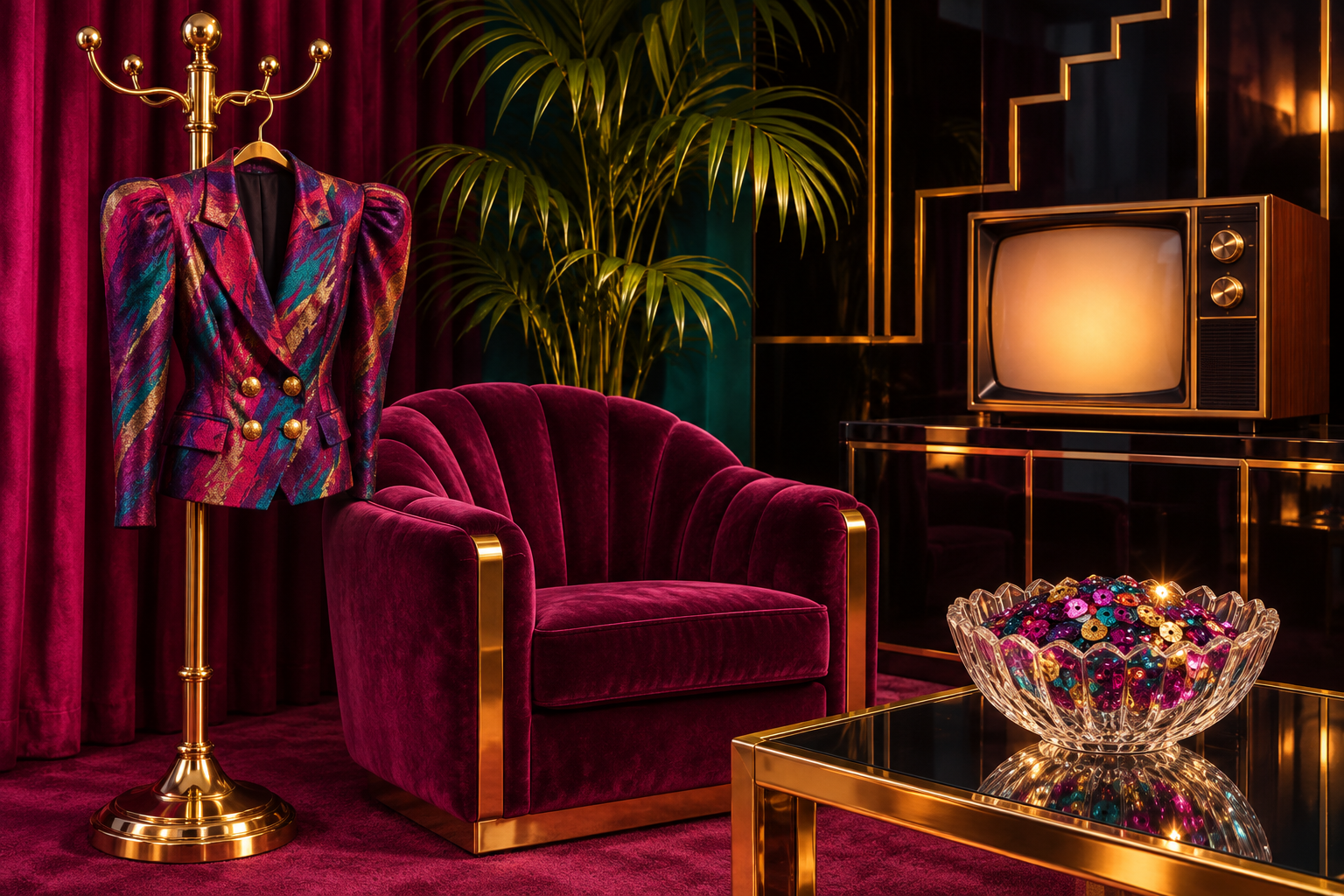
To understand the perfumes of the eighties, it's worth first taking a look into the wardrobes and living rooms of that era. In the West, the decade was marked by economic optimism, rising stock markets, and a new career cult. Success wasn't shy about being visible – on the contrary, it was meant to be displayed through clothing, cars, watches, and the way one entered a room.
Power dressing became the uniform for women who were increasingly breaking into leadership positions. Jackets with broad shoulders and prominent pads, sharp cuts, and vividly colored suits sent a clear message: here stands someone to be taken seriously. Designers like Giorgio Armani, Thierry Mugler, and Claude Montana worked with silhouettes that enlarged and reinforced the figure. Men's fashion wasn't left behind either – looser suits, bold ties, and a meticulously groomed appearance were part of the young professional's image.
This aesthetic was brought into homes by television. American series like Dallas or Dynasty showcased the world of oil magnates, family intrigues, parties, and sequin-studded gowns. Wealth in these shows wasn't discreet but ostentatious – and viewers took away from the screen an idea of what life at the top should look like. Fashion magazines, music videos, and movie posters spoke the same language.
Perfumery responded to this mood in its own way. If a designer jacket was to be seen, the perfume was to be "seen" as well – that is, smelled, and strongly so. Long-lasting scents and a strong sillage, the trail of fragrance left behind by the wearer, were highly valued. Perfume ceased to be just an intimate affair for those close by and became part of public presentation, much like jewelry or a logo on a handbag. A fragrance announced one's arrival before they even spoke and lingered in the room even after they had left.
Fashion houses played a significant role. Many had been releasing perfumes in previous decades, but in the eighties, fragrance became the main way for the average customer to buy a piece of their world. Runway dresses were unattainable for most people, but a bottle bearing the designer's name was not. Thus, perfume became a luxury within reach – a ticket to the lifestyle promised by the glossy pages of magazines.
This was reflected in advertising as well. The launch of new perfumes was accompanied by lavish campaigns in print and on television, and striking bottles designed as objects of art. A typical ad didn't sell the scent itself so much as the story: a confident woman in a suit, a seductive evening, a successful man in a suit. Perfume was offered as a shortcut to identity – who you want to become, not just how you want to smell.
From this era, perfumery carried forward several lasting habits: a strong association of fragrance with the fashion house's name, grand launches of new products, and the notion that perfume speaks to who you are. How this ostentation was reflected in the compositions themselves and why it was desirable to "smell loud" back then will be revealed by a closer look at their construction.
Opium, Poison, Giorgio: Anatomy of the Great Compositions of the Eighties
When you hear "perfume of the eighties" today, most people think of something rich, sweet, and unmistakable. But to understand why the scents of that time were so loud, it's worth taking a closer look at what they were made of and how they behaved on the skin.
Opium was introduced by Yves Saint Laurent in 1977, even before the decade we now associate with big fragrances began. Yet, it foreshadowed much of what was to come. It was a bold oriental composition where spices met resins, incense, vanilla, and a warm woody base. The perfume wasn't designed to subtly cling to the skin—it was meant to create an aura around its wearer. This approach became the norm a few years later.
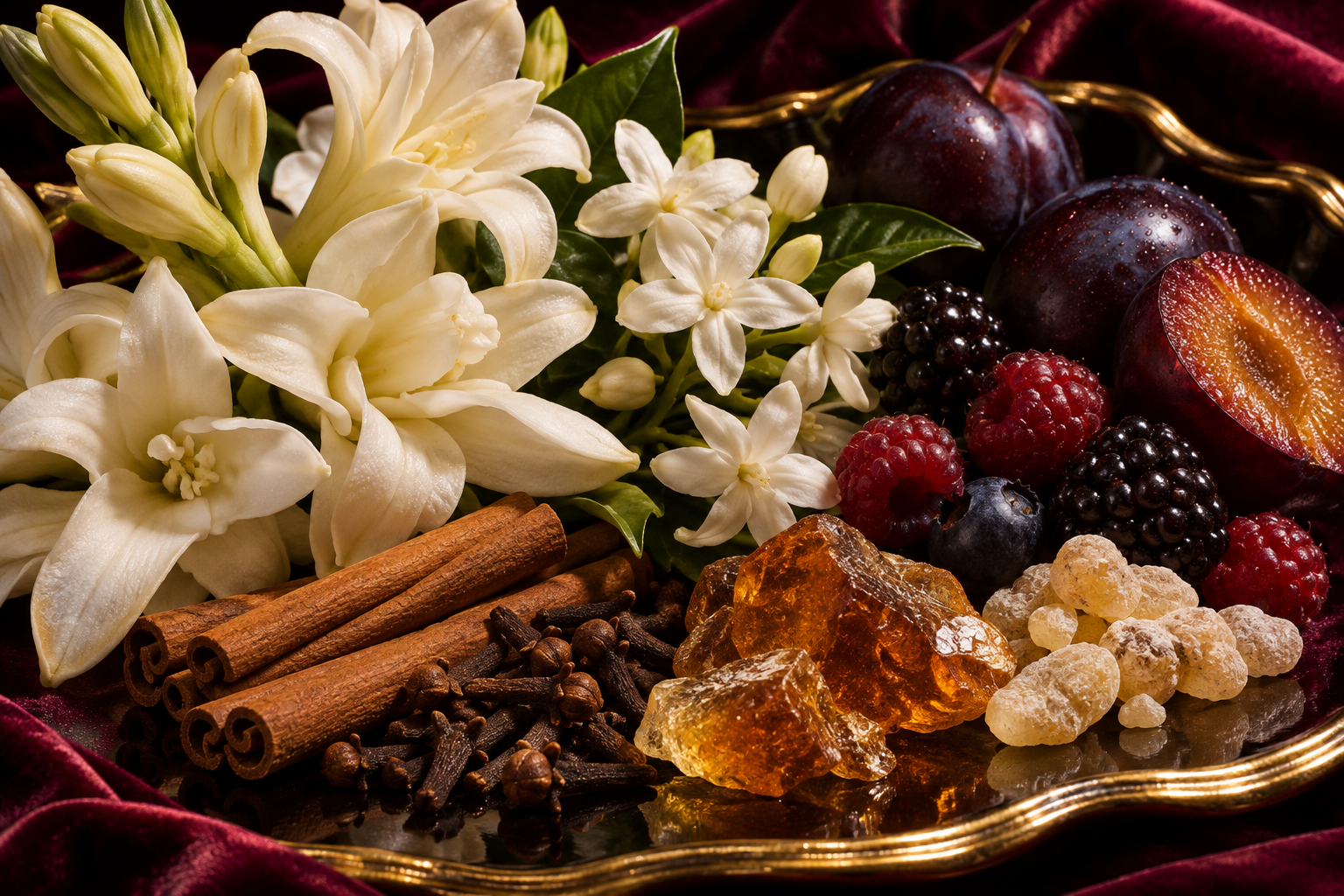
Giorgio Beverly Hills, launched in 1981, took a different approach with white flowers. Its heart was built on tuberose, orange blossom, and jasmine, complemented by fresh fruity top notes. The result was a bright, intense floral fragrance with a very strong trail. Tuberose is a material that, even in small doses, feels creamy and almost intoxicating. In high concentrations, it can fill a space long after its wearer has left.
Poison, introduced by Christian Dior in 1985, seemed to combine and push both directions to the extreme. It placed tuberose and other white flowers alongside dark, sweet fruity notes reminiscent of plums and berries, adding spices, honey, and incense. The result was a dense, almost liqueur-like sweet composition, with a name that already suggested a reputation for being dangerous and unmistakable.
What did these perfumes have in common? They can be summed up in a few features:
- Dense chords. Instead of transparent, airy structures, they built on rich, layered hearts where the individual ingredients blended into one powerful whole.
- Tuberose and white flowers. A material with extraordinary intensity became one of the hallmarks of the decade.
- Spices and resins. Clove, cinnamon, incense, or myrrh added depth and warmth to oriental compositions.
- Sweet fruity notes. Dark fruits and nectar chords gave the fragrances unexpected juiciness and sensuality.
- Longevity and sillage. The perfume was noticeable for hours and at a distance that might seem inappropriate today.
The power behind these scents wasn't just the courage of the perfumers, but also chemistry. Modern perfumery had been working with synthetic substances since the end of the 19th century, but in the eighties, perfumers had a wide range of potent molecules—musky, amber, and woody—that gave the fragrance volume, diffusion, and longevity. Some of them are noticeable even at very low concentrations and linger on skin and fabric for hours. Combined with compositions designed for maximum projection, the fragrance could literally "fill a room." The trail a perfume left behind became a distinct feature, talked about just as much as the scent itself.
These compositions are worth viewing as period documents. They weren't exaggerated by mistake—they matched the idea of perfume as a bold gesture that shouldn't go unnoticed. That's why perfumery still returns to them today, whether as inspiration or as a counterpoint from which to take a new direction.
The Turn of the Nineties: Ozone, Sea, Purity, Unisex Wave
By the end of the eighties, it became clear that loud compositions were reaching their limits. The emerging generation no longer wanted a perfume to announce their arrival across the room. They longed for a scent that evoked fresh air, sea water, or freshly laundered clothes – something that felt natural and effortless.
One of the first signals of this shift was the men's fragrance Cool Water by Davidoff from 1988. It combined aromatic freshness with a cool, almost aquatic impression, showing that even masculine scents could feel airy instead of heavy. In 1991, Dior introduced the fragrance Dune. It stands at the crossroads of two worlds: it still has the fullness and depth of the previous decade, but its mood is subdued, inspired by sand dunes, sea air, and the tranquility of the coast. It can thus be seen as a transitional composition that quietly heralds a new aesthetic.
In 1992, L'Eau d'Issey by Issey Miyake followed. The name itself – water – said it all. Transparent floral and aquatic tones acted as a counterpoint to the rich tuberoses and spices that had recently dominated perfumeries. The minimalist design of the bottle matched the designer's philosophy, which was based on clean lines.
This transformation was driven not only by fashion but also by chemistry. Perfumers had access to synthetic molecules that opened up entirely new olfactory images:
- Calone – a substance discovered in the sixties, whose scent resembles sea air, ozone, and at the same time juicy melon. It became the signature of so-called marine, aquatic fragrances.
- Dihydromyrcenol – a fresh, slightly citrusy, and metallic clean note that gives compositions the impression of cold water and laundered cotton.
- Synthetic musk – soft and clean, it became the foundation of "clean laundry" and post-shower skin scents.
The result was a new olfactory language. Instead of a heavy base of resins, spices, and white flowers, transparent accords emerged that felt like a natural part of a clean body rather than an adornment.
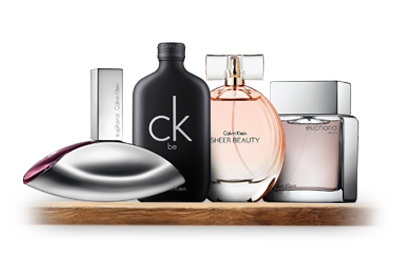
The pinnacle of this wave came in 1994 with CK One by Calvin Klein. A light fragrance with a citrus and tea character, it openly appealed to both women and men. Unisex fragrances had existed before, for example among colognes, but CK One made them a mass phenomenon. The simple matte bottle resembled an ordinary bottle, and the black-and-white campaigns featured young, unpolished faces instead of perfect stars.
This aesthetic fit perfectly with the times. Minimalist designers dressed both women and men in simple cuts in neutral colors, grunge brought worn flannel shirts and conscious carelessness, and young people defined themselves against the ostentation of their parents' generation. A perfume that could be shared by partners, siblings, or roommates thus became more than just a scent – it transformed into a cultural symbol of a decade that wanted to feel natural, equal, and without pretense.
Why Tastes Have Shifted Dramatically – A Legacy We Still Carry Today
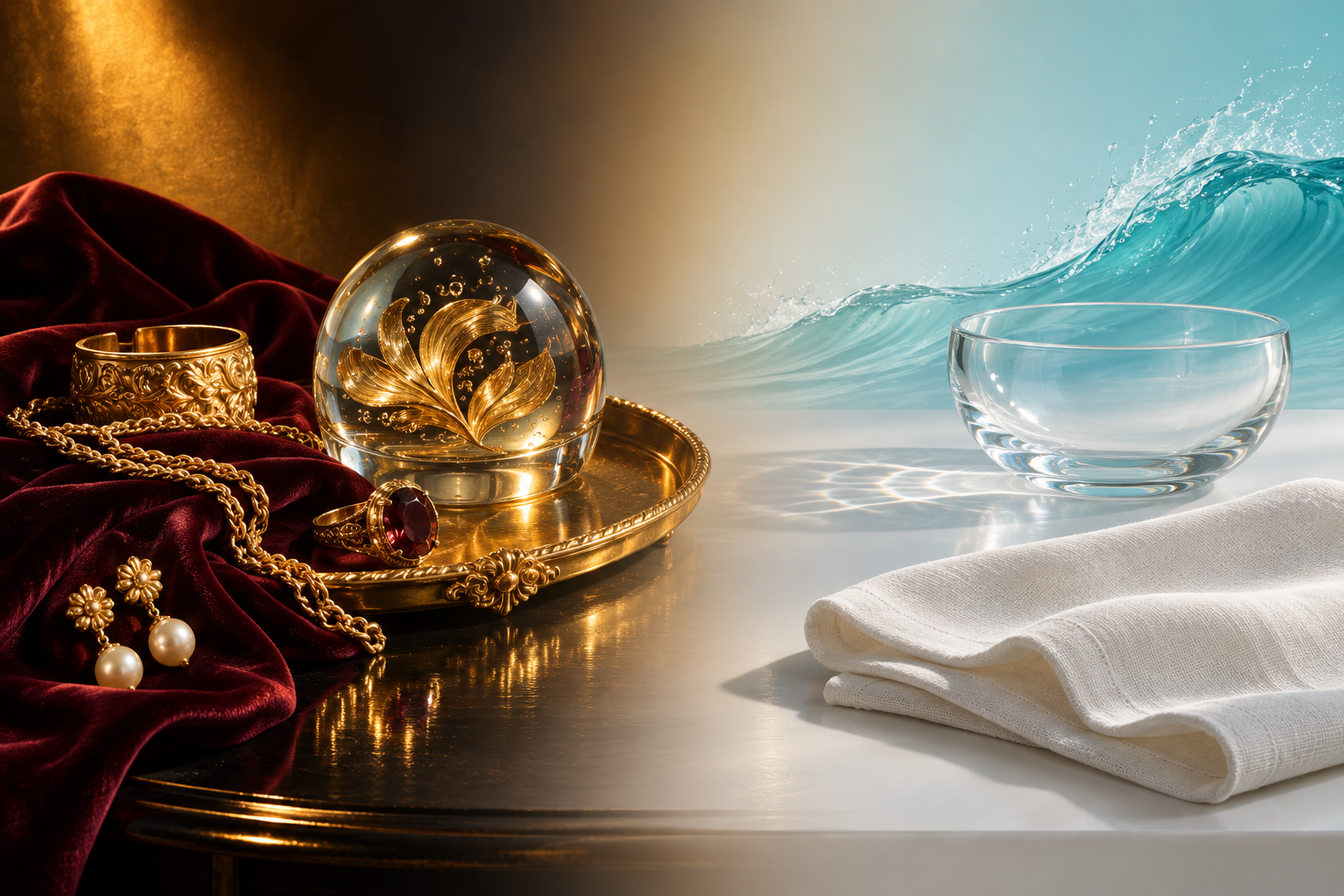
Looking back over two decades separated by just a few years, it may seem like a chasm lies between them. The loud, dense compositions of the eighties were replaced by a clear freshness, as if perfumery suddenly turned down the volume to a minimum. However, such a shift didn't happen overnight – it was the result of several influences coming together.
Four Reasons for the Major Shift
- Saturation with Extravagance. After years when a perfume announced its wearer's arrival, the intense trail began to feel rather tiresome. What was once a sign of confidence became synonymous with excess for many people.
- Change in Economic Mood. The stock market crash in the autumn of 1987 and the economic downturn at the turn of the decade cooled optimism. Flaunting success fell out of fashion, and moderation came to the forefront.
- Shift in Values. The nineties emphasized individuality, naturalness, and comfort. Perfume was no longer meant to impress but to accompany – to be clean, light, and personal. Minimalism in fashion and design only highlighted this transformation.
- New Molecules. Perfumers had access to synthetic substances that could evoke the impression of sea air, ozone, or freshly laundered clothes. Without them, the aquatic and ozonic wave couldn't have emerged in the form we know today.
Both Decades Live On
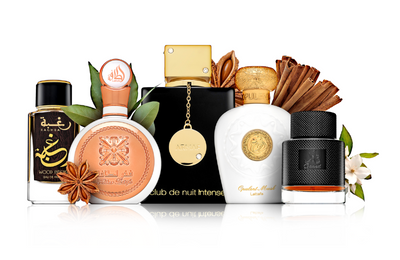
Interestingly, neither style has disappeared from the scene. Powerful oriental compositions with spices, resins, and vanilla are returning today in the form of modern amber and gourmand perfumes that build on old traditions, often with a lighter touch. Richness and longevity are also natural for many Arabic perfumes. Pure aquatic and ozonic accords have become so familiar that we now perceive them as natural freshness – in summer and sports lines as well as in unisex perfumes that directly draw from the legacy of the nineties.
How to Recognize Both Styles by Their Notes
If you want to verify which era your favorite perfume is closer to, pay attention to what you smell in the different phases of the fragrance's development:
- The Spirit of the Eighties is revealed by oriental, floral, or chypre fragrance families, prominent white flowers like tuberose or jasmine, spices, resins, patchouli, and a sweet, dense base. Such a scent is noticeable from the first spray and lingers for a long time.
- The Spirit of the Nineties is recognized by citrus, aromatic, and watery freshness, notes of melon or cucumber, an ozonic "airy" impression, and clean musk in the base notes. The fragrance tends to envelop rather than assert itself.
If you're tempted to compare both approaches on your own skin, in the Perfumes category you'll find scents that follow both directions – from rich oriental compositions to clear freshness. The difference becomes most apparent when you try them side by side.
But the story doesn't end there. The fatigue from mass-distributed fragrances opened up space at the end of the nineties for small independent perfume houses that decided to go their own way. We'll discuss how the niche revolution began and why it changed the perspective on perfumery in the 10th episode of the Fragrance History series.
Category
Recommended articles
Riiffs Freeze in Flames: Ice and Flames Illuminate Warsaw "Give a girl the right shoes and she can conquer the world!" Marilyn Monroe
