

 Riiffs Freeze in Flames: Ice and Flames Illuminate Warsaw
In the second part of the series The History of Scents, we journey to ancient Greece and Rome – to the baths where fragrant oil was applied after bathing, and to the shops of the unguentarii, the first perfume stores. Discover why Rome smelled of roses from Paestum, why this bothered moralists, and what happened to fragrances after the fall of the empire.
Greece Embraces the Art of Fragrance: Oils, Athletes, Theophrastus
In the first part, we stopped in ancient Egypt, where fragrances accompanied temple rituals and daily life, and where kyphi was created – a mixture of resins, spices, wine, and honey, burned as an offering to the gods. This time, we head further north to the shores of the Aegean Sea. The art of fragrance didn't arrive here all at once but gradually, along with traders who distributed goods from the Orient across the Mediterranean.
The Phoenicians played a significant role in this. Their ships connected the ports of the Levant with the islands and cities of the Greek world, transporting not only textiles, glass, or metals but also aromatic raw materials – myrrh, incense, and spices that traveled to the Mediterranean from Arabia and more distant parts of Asia. Thus, the Greeks became acquainted not only with rare materials but also with the idea that fragrances belong to a cultivated life. Fragrant oils, used by goddesses and heroes, are already mentioned in Homer's epics.
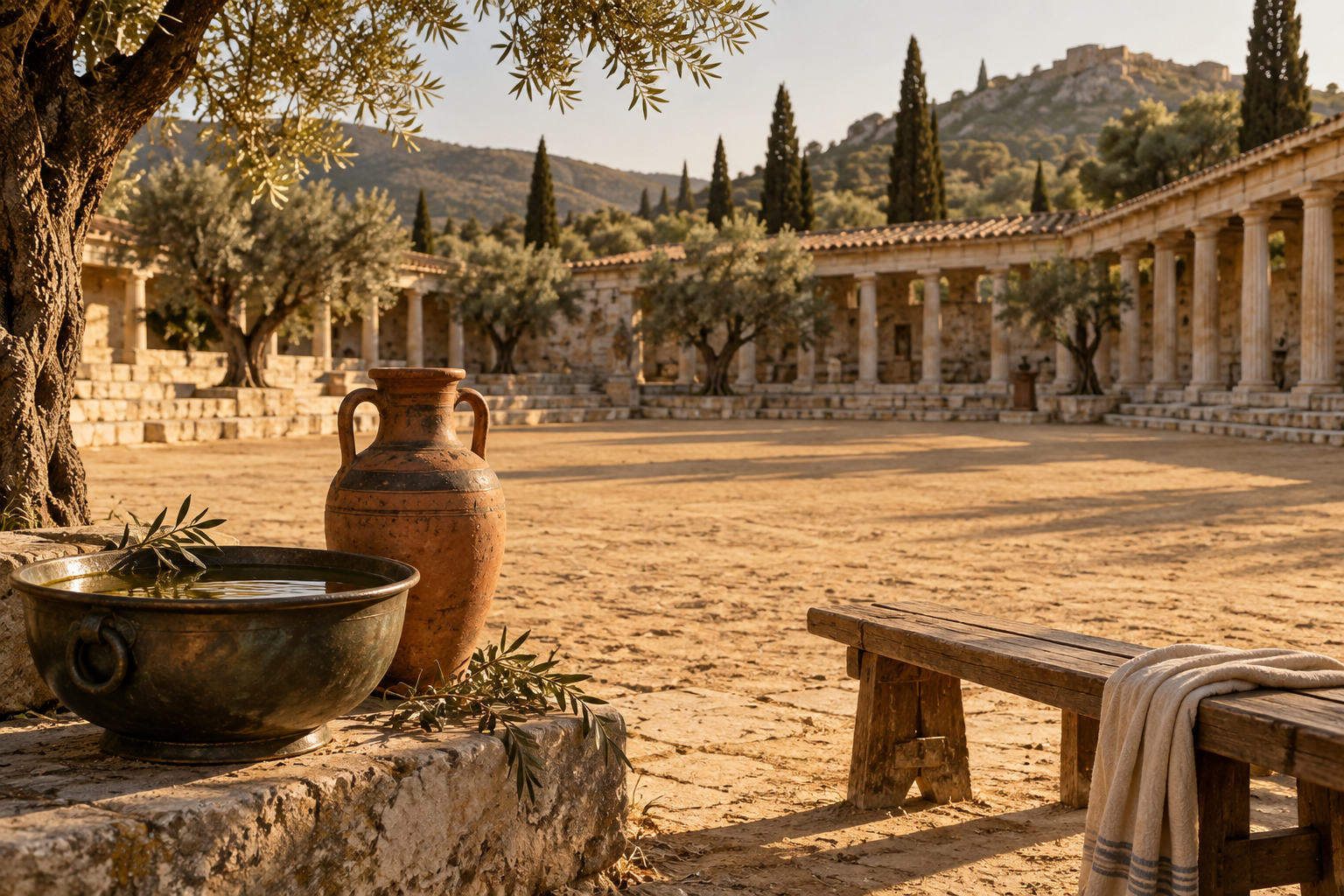
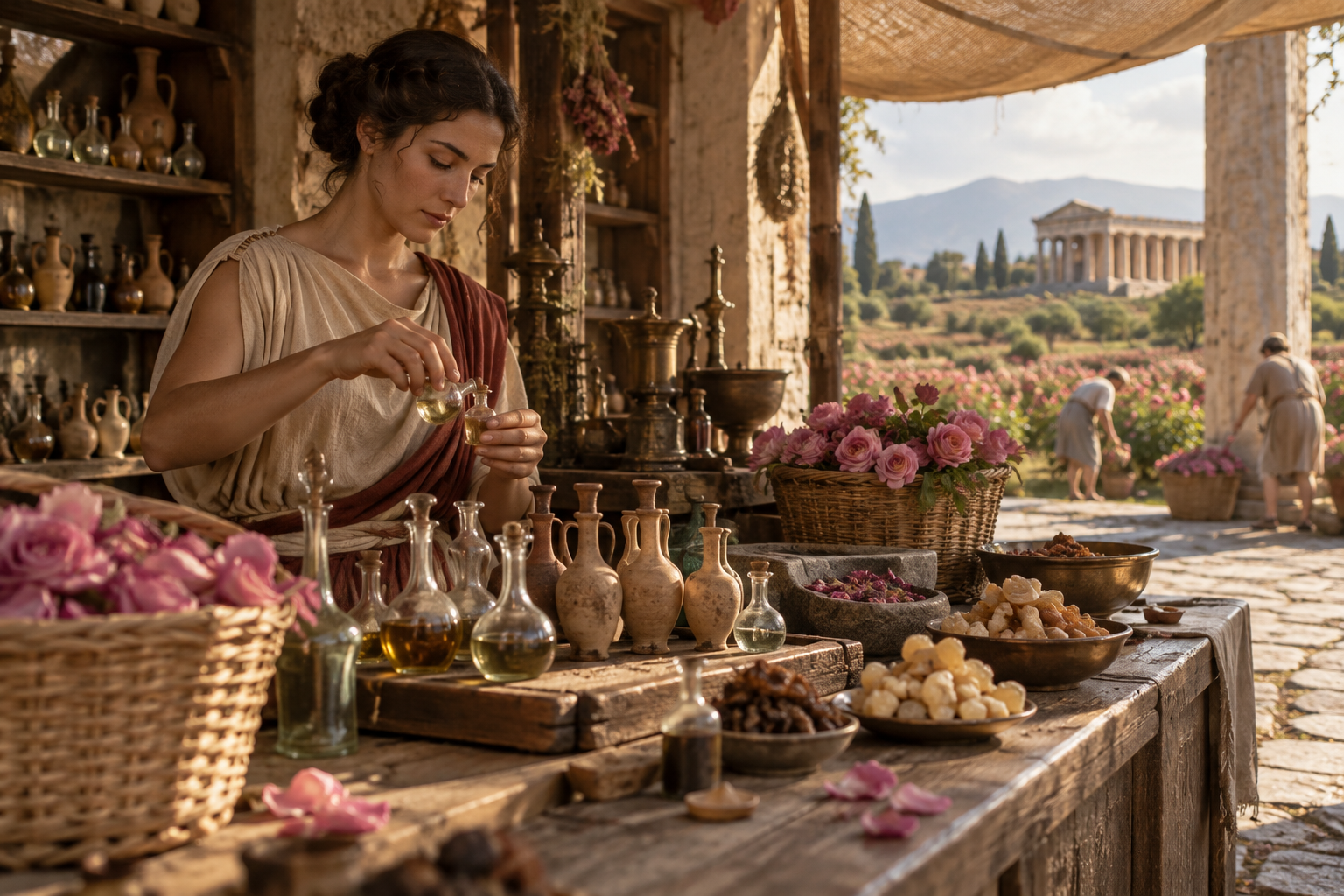
However, Greek perfume looked different from what you're used to today. Its base was not alcohol but vegetable oil, most often olive oil, in which flowers, herbs, spices, or resins were steeped. The finished fragrant oils were stored in small ceramic containers, and the Greeks applied them to their bodies after bathing, used them at banquets, and offered them to the gods as part of the cult. Thus, fragrance served several roles at once: according to contemporary beliefs, it protected the skin from the sun and drying, provided a sense of cleanliness, and expressed respect for guests and deities.
A special chapter is represented by athletes in gymnasiums. Before exercising, they would anoint their bodies with oil, which according to ancient authors, protected the skin, made muscles more supple, and also highlighted the beauty of a well-developed physique. They carried the oil in a small round bottle called an aryballos. Competitors trained naked, so during matches and running, dust and sand would stick to their oiled skin. After training, a metal scraper called a strigil came into play – a curved tool used to scrape oil, dust, and sweat from the body. Only then would they bathe. In the gymnasium, ordinary olive oil was probably used, while richly scented mixtures remained the privilege of the wealthier.
Finally, let's stop at a figure without whom the history of fragrances would be significantly poorer. Theophrastus of Eresus, a student and successor of Aristotle in the Athenian Lyceum, lived approximately in the 4th and early 3rd century BC. He is mainly renowned as a naturalist who systematically described plants and also wrote a shorter treatise On Odors. It is one of the oldest surviving texts that systematically addresses fragrant substances. In it, Theophrastus discusses which plants and their parts are used to obtain fragrances, why oils are suitable carriers that absorb and retain scents well, and how raw materials are heated and mixed. He also addresses storage: according to him, fragrant oils need a cool, shady place and suitable containers to prevent them from evaporating.
His notes show that the production of fragrant oils was already a craft with established procedures, not random mixing. These experiences were later built upon by the Romans – and it is to them that we will turn in the next part of this series.
The Ritual of Roman Baths: After the Bath Comes the Scented Oil
Imagine a Roman afternoon. The day's work is mostly done, and a large part of the city is heading in the same direction – to the baths. Public baths, known in Latin as thermae, and the smaller ones as balnea, were not just places for washing. According to historical sources, business deals and meetings were arranged there, news was discussed, and exercise was taken. The entrance fee was relatively low in large cities, so under one roof, you could find a senator, a craftsman, and a freed slave.
The visit followed a set sequence, although it varied in different baths and periods. It can be simply described as follows:
- Apodyterium – the changing room, where visitors left their clothes, often under the watchful eye of their own slave.
- Tepidarium – a warm room where the body acclimatized to the heat, allowing for a relaxed sit and chat.
- Caldarium – a hot room heated by underfloor heating (hypocaust), with hot water and steam. Here, one would sweat profusely, and the skin would rid itself of impurities.
- Frigidarium – a cold bath, often with a pool, which concluded the process and refreshed the body.
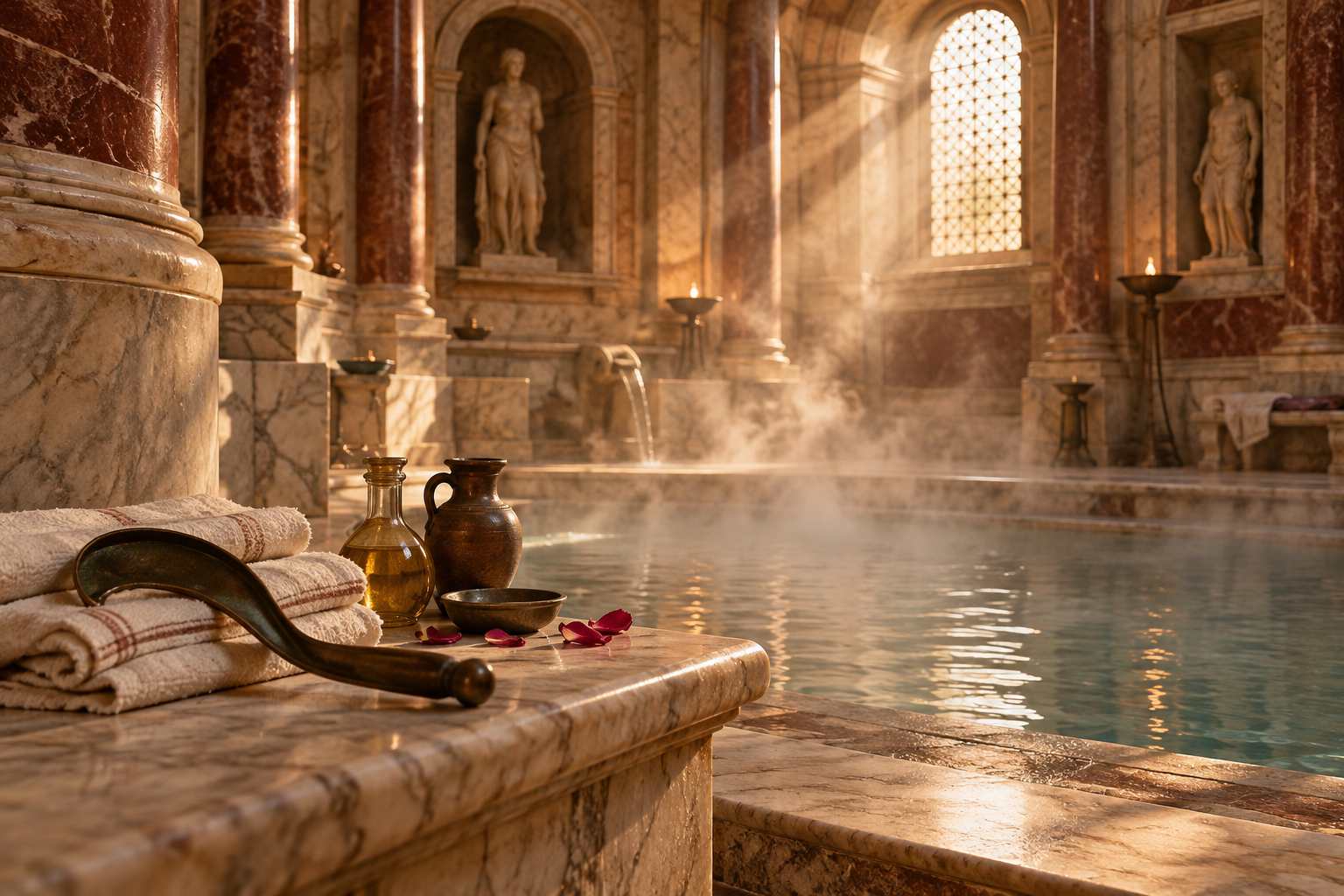
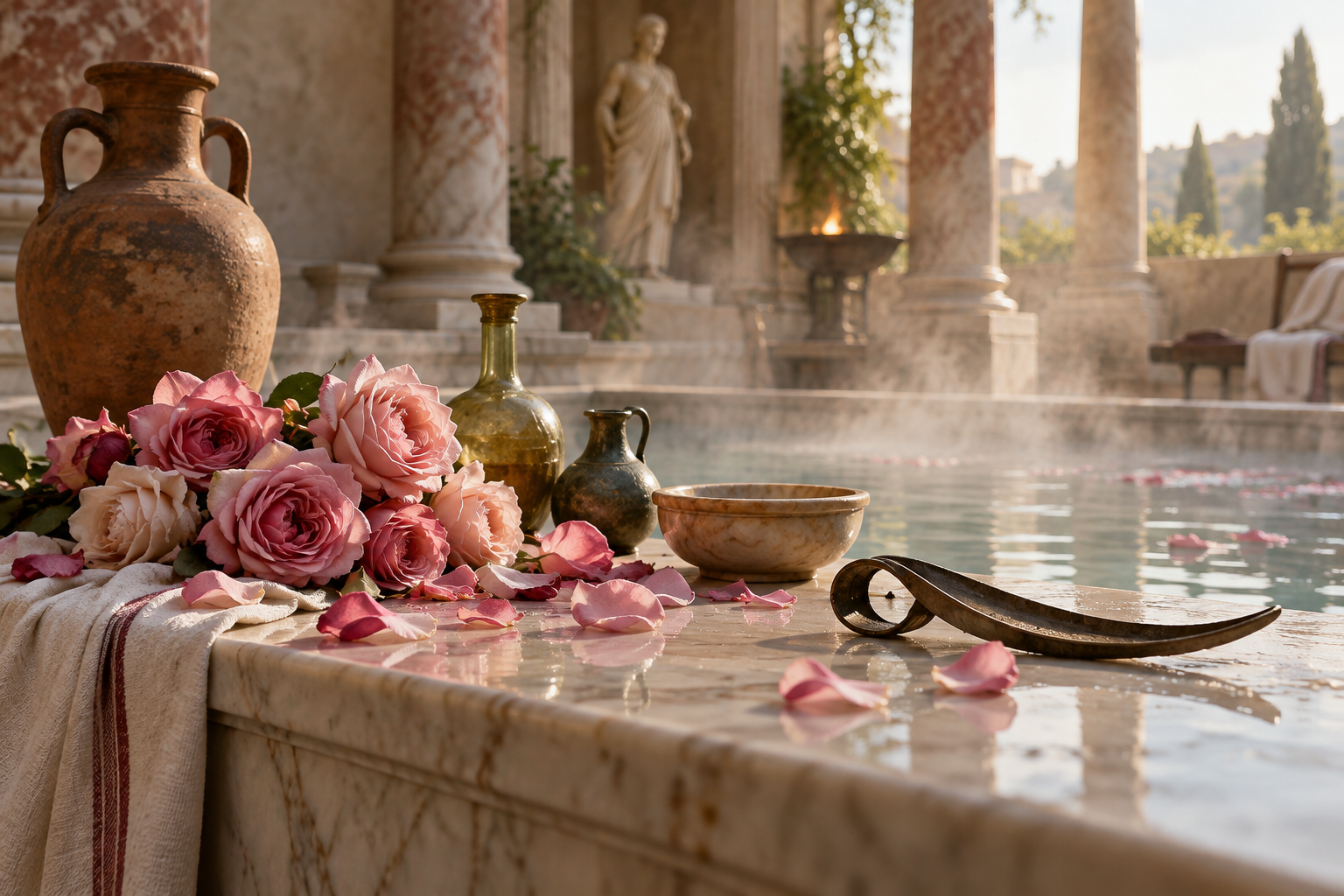
Many Romans would exercise in the palestra, a courtyard for ball games and wrestling, before bathing. Soap, as we know it today, was not commonly used – its role was taken by oil, which was applied to the skin and then scraped off along with sweat and dust using a curved metal tool called a strigil.
However, oil was not just for cleaning. After the final bath came the anointing, which was the climax of the ritual. Skin dried by heat and water was again coated with oil or ointment to keep it supple and pleasantly scented. Some larger baths had a special room for this, known as the unctorium, or a place for storing oils. The application was done by slaves brought by wealthy visitors or by attendants who were paid for their service. They spread the oil, massaged the body, and ensured their master returned to society well-groomed.
It was in this step that one's status was clearly visible. Poorer visitors made do with simple olive oil without any additives. The wealthier brought their own fragrant mixtures in small glass, ceramic, or stone containers, carried by a slave along with towels and a strigil. Inside was oil scented with flowers, spices, or resins, and from its fragrance, others could easily gauge who they were dealing with.
It's interesting how Romans thought about fragrance. It was not merely an adornment or an extra luxury for them. A clean, oil-treated, and subtly scented body was part of the image of a decent, cultured person who knew how to move in society. Conversely, the smell of sweat and unkemptness was associated with hard work, the countryside, or negligence. Fragrance was thus part of cleanliness and social conduct – much like a well-groomed outfit or manner of speech. However, the line between appropriate care and ostentatious luxury was thin, and Romans could passionately debate it.
The First Perfume Shops: Unguentarii, Capua, Roses of Paestum
The fragrant oils that Romans applied to their bodies were not typically made at home. They were crafted by artisans and traders known as unguentarii – manufacturers and sellers of scented ointments, oils, and powders. You can imagine their shops as small workshops with a street-facing counter, where ingredients were mixed, heated, and poured into small ceramic containers, later increasingly made of glass. As Rome expanded into an empire, glassblowing spread across the Mediterranean, and lightweight bottles became the typical packaging for fragrant products. In cities, this profession emerged, which can be considered a precursor to today's perfumers and perfume shops.
According to ancient authors, the most famous center of this craft was Capua in Campania. One of its streets, or rather a square, was named Seplasia and was reportedly dominated by traders of fragrant substances. The name apparently became a term: Latin authors used it to refer to fragrant goods and luxury in general. Capua had a reputation as a wealthy and indulgent city – tradition holds that the comfort there even softened Hannibal's army, which wintered there.
Campania was not just a marketplace but also a source of raw materials. The fertile volcanic soil around the Bay of Naples produced olives, which were pressed into oil as a base for fragrant preparations, and also flowers. Archaeologists in Campanian cities, such as Pompeii, have found remnants of operations that seemingly related to the production and sale of fragrant oils.
A special place among the flowers was held by the roses of Paestum, an ancient city south of Salerno, founded by Greek settlers. Roman poets, including Virgil, Propertius, and Martial, mention the roses of Paestum as symbols of beauty and abundance, often evoking the image of rose gardens that bloomed twice a year. Whether this was actual double blooming or poetic exaggeration, the reputation of Paestum as a rose region has endured for centuries.
However, local flowers could not provide the full range of scents. The most precious ingredients came to Rome from afar:
- Myrrh and Frankincense – resins from southern Arabia and the opposite African coast, which reached Mediterranean ports via caravan and sea routes.
- Nard – a fragrant root of a plant from Himalayan regions, imported through India; it was one of the most expensive ingredients of its time.
- Cinnamon and Cassia – fragrant barks whose true origin traders reportedly liked to keep mysterious according to ancient reports.
- Goods from Egypt – Alexandria served as a major transshipment point for spices and resins, and Egyptian fragrant ointments were renowned in Rome for their craftsmanship.
But how was a fragrant preparation made without distillation, which the ancient world did not commonly use for fragrance production? The basis was maceration. Flowers, herbs, or crushed resins were steeped in oil or fat, the mixture was gently heated, and over time the plant material was pressed. The process was often repeated with fresh flowers to intensify the scent. Olive oil, preferably from unripe olives, or other mild oils with the least possible scent of their own served as the carrier. Thicker ointments were created by adding fats and resins, which also helped to preserve the fragrance. The result differed from today's perfumes – it was oily, heavier, and applied to the skin rather than sprayed. Yet, you can see in it the same goal that perfumery pursues today: to capture the fleeting beauty of flowers and resins and preserve it for as long as possible.
Imperial Luxury Versus Moralists' Critique
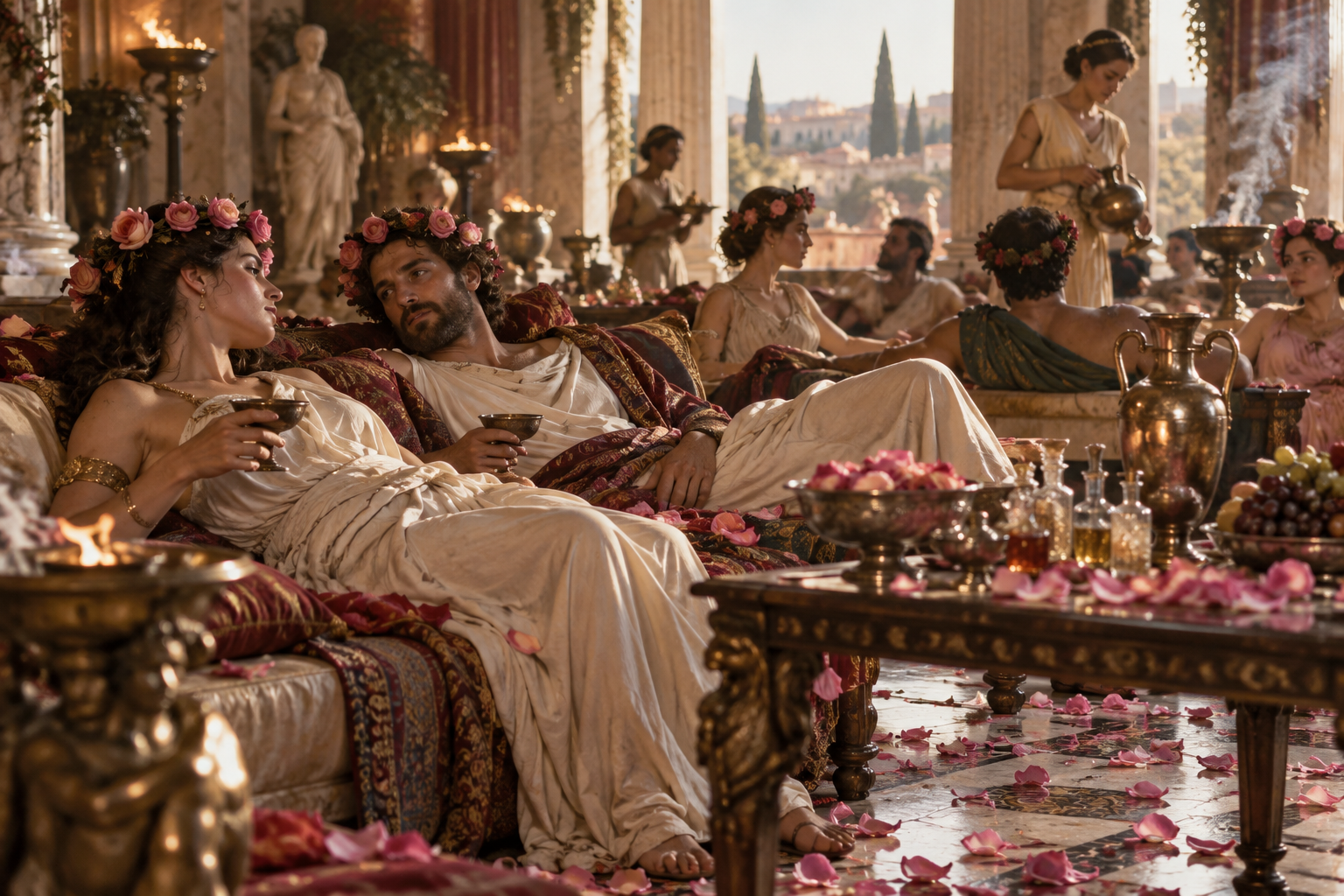
With the rise of the empire, fragrant oils and ointments became more than just a sign of cleanliness. Those who wanted to display wealth and status did so through scent – and the banquets of wealthy Romans turned into a spectacle where fragrances played a leading role. Imagine a dining room where guests recline on couches with rose garlands on their heads, the floor strewn with petals, and the air heavy with the scent of ointments, resins, and wine flavored with flowers.
In this world, the rose was not just an ornament. Garlands of its flowers were part of festive dining, petals were scattered on beds and floors, and according to contemporary reports, they were wasted so extravagantly at the most lavish banquets that the expenses became a popular topic of tales about extravagance. The scent was not limited to the dining room. Pliny the Elder recorded that some of his contemporaries even had their feet perfumed – a practice he considered the height of senseless luxury.
Nero became the symbol of this entire era. Biographer Suetonius describes dining rooms in his Golden House with ceilings of movable ivory panels from which flowers could shower down on guests, and pipes that sprayed fragrant liquids. Pliny also notes that at the funeral of Nero's wife Poppaea, more fragrant resins were burned than Arabia could produce in a year, according to his estimation.
However, it's important to know who recorded these accounts. Suetonius and Tacitus wrote several decades later and portrayed Nero as a cautionary example of a ruler. The late antique collection of imperial biographies known as the Historia Augusta takes even more liberties with facts. According to it, Emperor Elagabalus had so many rose petals showered on his guests that some suffocated under them. Historians consider this story more literary exaggeration than documented event, but it entered public consciousness thanks to a painting by Lawrence Alma-Tadema in 1888. So, we can safely say only this:
- Fragrant ointments and resins were expensive commodities in imperial Rome, and their use indicated wealth,
- Rose garlands and petals were indeed part of festive banquets,
- Specific numbers and the most vivid scenes come from authors who wanted to condemn extravagance or entertain readers and should be read with caution.
Not all Romans admired luxury. Pliny the Elder dedicated an entire passage to fragrant ointments in his extensive encyclopedia Naturalis Historia and was not sparing in his criticism. According to him, scents are among the most unnecessary of all luxury expenses: pearls and gemstones are passed on to heirs, fabrics last for years, but a fragrant ointment evaporates shortly after use. Moreover, according to Pliny, the wearer doesn't benefit much from it – the scent is mainly enjoyed by those around them.
Seneca took a critical stance on luxury from the perspective of Stoic philosophy. In his letters to his friend Lucilius, he repeatedly compared the frugal life of ancestors with the pampered habits of contemporaries. According to him, luxury does not enrich a person but weakens them: those who become accustomed to soft comforts, including a perfumed body, become dependent on things they don't need for a content life. The paradox remains that Seneca himself was Nero's tutor and advisor and was one of the wealthiest men of his time – a fact his opponents criticized even during his lifetime.
Roman fragrances thus stood at the crossroads of two worlds. For some, they were an essential part of elegant living, for others, a sign of moral decline. The debate between pleasure and moderation would return many times in the history of the art of fragrance.
After the Fall of Rome: The Journey of Fragrance Art into the Middle Ages
The Roman world of scents thrived on long-distance trade. Myrrh and incense came from Arabia, nard and spices from India, and traders brought them to ports, relying on safe routes and stable currency. When the Western Roman Empire collapsed in the 5th century (with the symbolic end often marked as the year 476), this network largely broke down in Western Europe. Cities became depopulated, baths fell into disrepair, and fragrant resins or exotic oils became luxuries affordable to only a few.
However, the art of fragrance did not disappear—it merely relocated and transformed. Imagine it as a river that nearly dries up in one place while flowing on elsewhere. It survived mainly in three places.
Byzantium. The eastern half of the empire, centered in Constantinople, lasted nearly a thousand years longer and directly continued the Roman tradition. Baths, fragrant oils, and the import of raw materials from the East persisted here. From surviving regulations, such as the so-called Book of the Eparch from the 10th century, it seems that sellers of fragrant substances belonged to organized city guilds whose trade was carefully monitored by authorities. Thus, Constantinople became a bridge through which knowledge and raw materials were passed on.
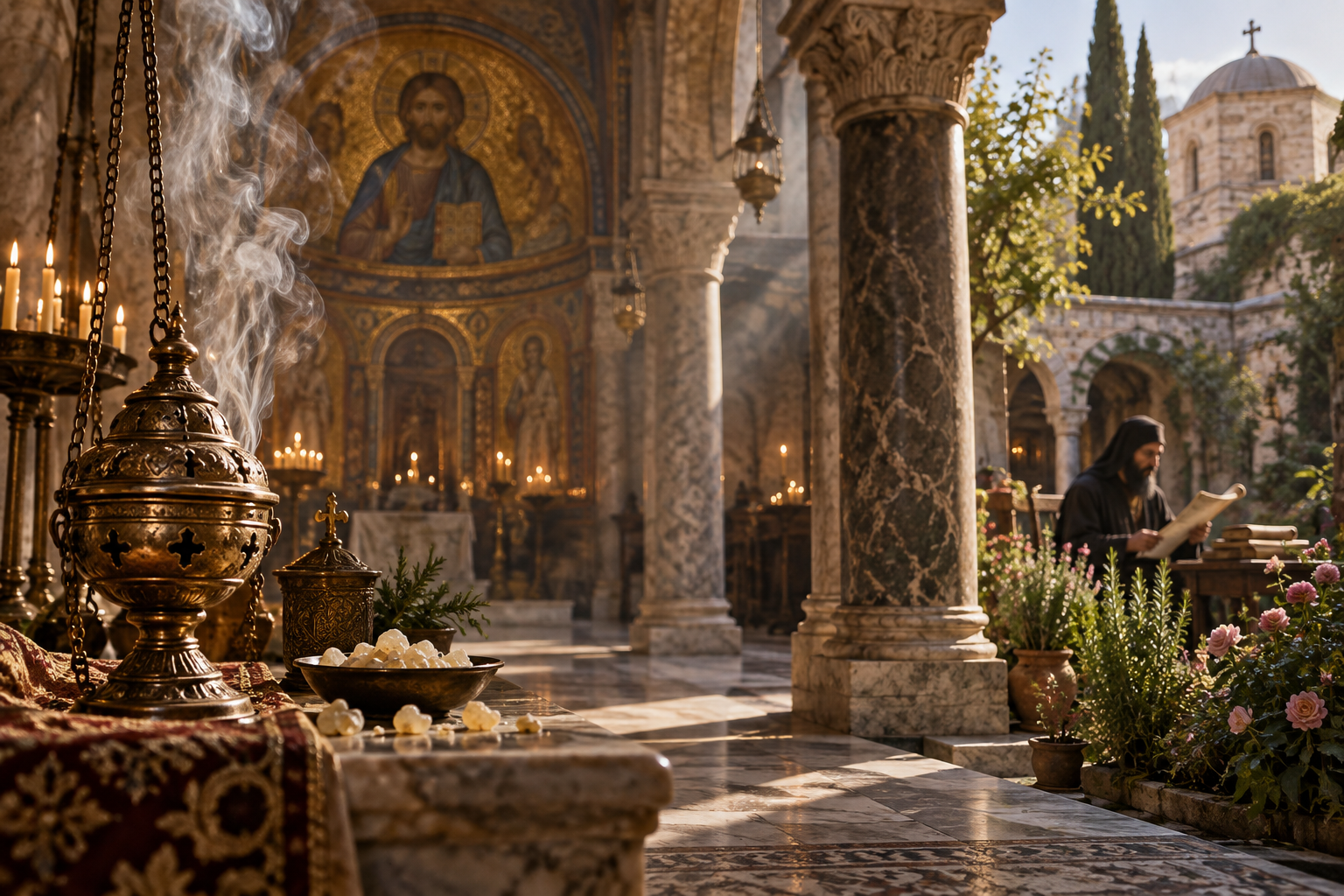
Liturgical Incense. Early Christians seemingly avoided it because burning incense was associated with pagan sacrifices and emperor worship. However, from around the 4th and 5th centuries, when Christianity became the official religion of the empire, incense gradually returned to worship—this time as a symbol of prayer rising to heaven. As a result, there was a constant demand for this rare resin throughout the Middle Ages, and long-distance trade in it never completely ceased.
Monasteries. Monks copied ancient texts on medicinal plants, especially the work of the Greek physician Dioscorides, and cultivated herbs like sage, rosemary, mint, or lilies in monastic gardens. The rose, a flower so beloved by the Romans, also survived more as a medicinal plant and symbol than as a banquet luxury. Similar plants are listed in an ordinance attributed to Charlemagne from around the year 800, which specified what should be grown on royal estates.
The church's relationship with personal fragrance was initially reserved. Some early Christian authors, such as Clement of Alexandria, warned against fragrant ointments as a sign of vanity, although they did not entirely reject their moderate use. Fragrant substances thus maintained their place mainly in churches and in caring for the sick, while the ostentatious perfuming known from Roman feasts receded from everyday life in the West for a long time.
While Europe was more about preserving scents than developing them, real progress was happening elsewhere—in the third installment, we will therefore venture into the Arab and Persian worlds, where, according to tradition, thanks to scholars like Avicenna, distillation was perfected, and rose water became a sought-after commodity.
Category
Recommended articles
Riiffs Freeze in Flames: Ice and Flames Illuminate Warsaw "Give a girl the right shoes and she can conquer the world!" Marilyn Monroe
