



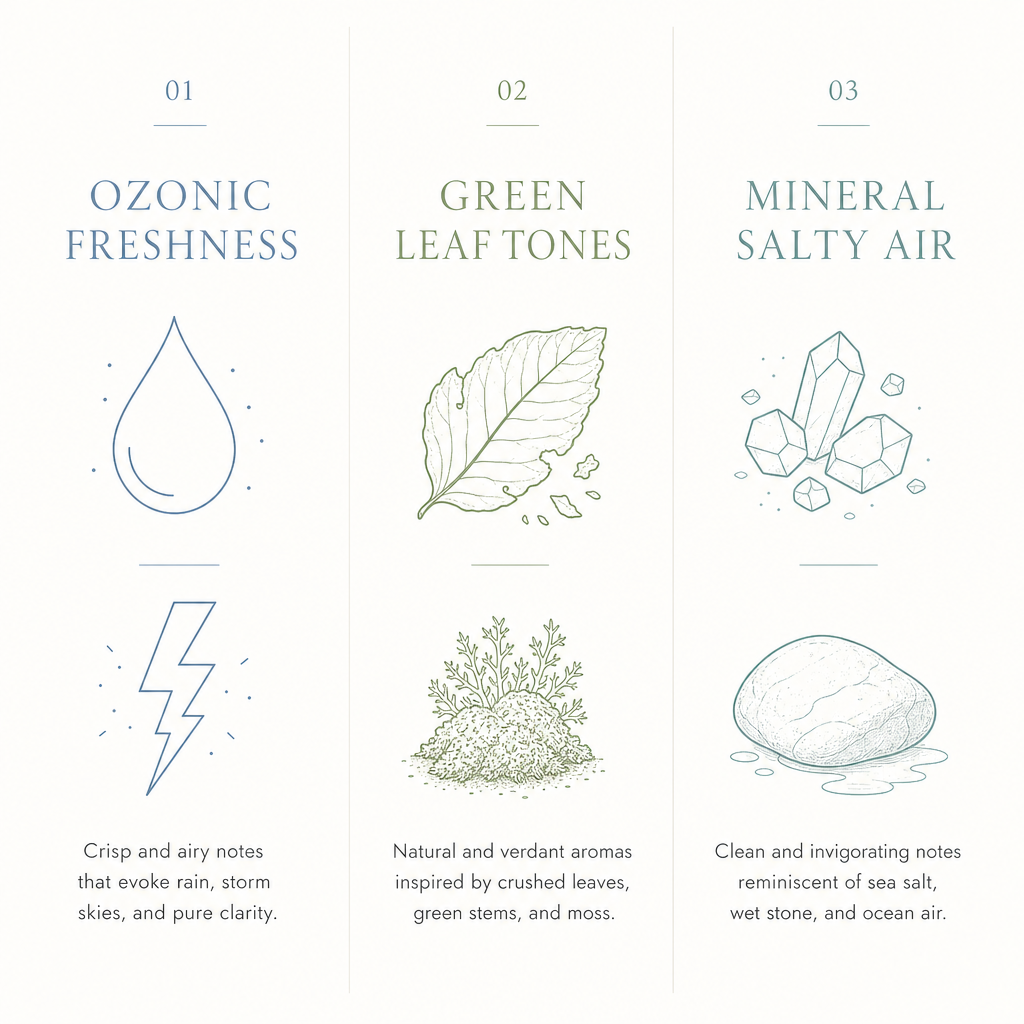





The scent of rain, sea air, or damp greenery is much harder to describe than vanilla or cinnamon – yet these are precisely the types of fragrances people are increasingly buying online for their homes, without the chance to smell them first. We'll break down the notes that make up this impression and show you how to choose a fragrance based on the label description, even if you can't smell it beforehand.
Why Outdoor Scents Are the Hardest to Choose
Vanilla, cinnamon, or freshly baked pastries are scents almost anyone can imagine. Just reading the name of a scented candle can conjure up a pretty accurate picture in your mind. But when you see "rain scent," "wet grass," or "sea air" on the label, the certainty fades. You recognize the sensation from a walk, but you can't quite name it—and you especially can't be sure if what you'll smell in your living room will even resemble the moment when rain starts after a dry day.
This is where the most common disappointment in purchasing arises. Home fragrances are ordered online, without the chance to smell them first, and outdoor themes are among the hardest descriptions to interpret. A gourmet candle promises an ingredient you know from the kitchen, and you immediately understand. An ozone scent promises an atmosphere—and everyone interprets atmosphere a little differently.
The second reason is more prosaic: "outdoor scent" is not a single category. It's an umbrella term for several distinct olfactory strategies that sit side by side on the same shelf yet smell quite different.
- Ozone Freshness – a cool, clean, slightly metallic impression of air after a storm. It works with the feeling of moisture and space, not with a specific flower or fruit.
- Green Leafy Notes – crushed leaves, freshly cut grass, moss, stalks. They tend to be more bitter and dense, closer to the earth than the sky.
- Mineral Salty Air – coastline, sea salt, sun-warmed stone, and driftwood. It feels drier and warmer than ozone.
If you don't distinguish between these three directions, you might easily end up buying a diffuser labeled "fresh" that actually smells citrusy clean like freshly laundered clothes, while you were expecting the cool air after rain. The mistake wasn't in the product but in the expectation.
The third thing that complicates the selection is the way scents are described. The breakdown of top, heart, and base notes in a product description isn't just a marketing embellishment or a mandatory field. It's a timeline: it tells you what you'll smell in the first few minutes, what will linger in the room after half an hour, and what will still be noticeable in your home by evening. For outdoor scents, this breakdown is more important than for gourmet ones because the individual layers differ much more significantly. An ozone start might easily rest on a woody base that has nothing to do with rain—and that's the scent you'll remember.
The good news is that you can learn to read these descriptions. When you know which ingredients are behind the impression of rain, which are behind damp greenery, and which are behind a salty coastline, you can piece together the result in your mind before adding the product to your cart. We'll go through the individual layers of the composition step by step—from the first breath to what lasts longest in the room—and finally, we'll put them back together into a process that can guide you in making a choice even from afar.
Ozone and Wet Stone: How the Impression of Rain is Created
The air after rain doesn't have a raw material. It can't be picked like lavender or pressed like orange peel, yet you'll encounter it repeatedly in the descriptions of scented candles and diffusers. This is where the first layer of outdoor fragrances begins – the top notes that you smell in the first few minutes and which determine whether the composition initially feels cool or warm to you.
In perfumery, three terms have been established for this layer: ozonic, aquatic, and mineral accord. An accord is a group of components that together create a single cohesive impression – similar to the harmony of multiple notes in music. None of these three words refer to a plant or fruit. They all describe the result, not the origin.
Ozonic Accord: The Impression of Air, Not a Substance
The term ozonic is borrowed from the description of the air after a storm – that peculiar feeling of cleanliness and coolness that remains outside after rain. Of course, there is no ozone in a candle or diffuser. It involves synthetic molecules that trigger the same association in the nose: clean, empty, slightly metallic air without sweetness. Ozonic notes therefore feel more like space than material.
Aquatic Accord: Water That No One Distilled
Aquatic notes work with water itself – with the surface, drops, moisture. They tend to be slightly rounder and softer than ozone, as they often include a light melon or cucumber nuance. Again, it's a construction: water itself doesn't have a scent, so the perfumer assembles its impression from materials that together evoke coolness, moisture, and a hint of sweetness.
Mineral Accord and Wet Stone
The most metaphors are associated with the third type. Mineral notes describe what actually smells more than the water itself: the surface it falls on. Heated pavement, stone walls, gravel, dust on the road. There's even a technical term for the scent of the first rain on dry earth: petrichor. The mineral accord tends to be dry, slightly dusty, and less sweet than aquatic. It's what gives outdoor scents the feeling that you're truly outside, not in a bathroom after a shower.
Why You Read Images Instead of Ingredients in Descriptions
With a floral candle, you can imagine the result quite accurately from the word rose. With outdoor scents, such an anchor is missing because the corresponding raw material doesn't exist – no one presses rain or distills fog. Instead of a plant name, the manufacturer offers you an image, and that is always somewhat subjective. Two descriptions with the same word wet stone can thus smell different.
A practical guide is therefore simple. The more ozonic and mineral words the description contains, the cooler and airier the first impression will be after lighting the candle or unfolding the diffuser. A predominance of aquatic and fruity terms, on the other hand, means a softer and sweeter start. The signal words can be roughly divided as follows:
- ozonic, airy, fresh air, after the storm – a cool, empty, and unsweetened start;
- aquatic, raindrop, dew, melon, cucumber – a softer and juicier impression of water;
- mineral, wet stone, gravel, quartz – dry earthy coolness with a hint of dust;
- fresh laundry, soapy – cleanliness more domestic than outdoor, often mixed with ozone.
Top notes are the most fleeting of all three layers. In a candle, you'll smell them most distinctly in the first few minutes of burning and when sniffing the cold wax, in a diffuser during the first few days after inserting the sticks. The impression you form of the scent at the beginning is thus predominantly made up of ozone, water, and stone.
Moss, Myrtle, and Damp Greenery at the Heart of the Composition
Once the initial breath of ozone and wet stone fades, a layer emerges that determines whether the outdoor scent in your home will last or feel empty after half an hour. The heart of these compositions is almost always green, and it is this greenery that gives the fragrance its body. Without it, you're left with just the impression of freshly laundered clothes: pleasant, but flat.
Ingredients that Form the Green Heart
Green heart notes are not a single ingredient but a whole family of materials with very different characters. In descriptions of home fragrances, you will repeatedly encounter these:
- Moss – the darkest part of the green palette. It smells earthy, slightly leathery, somewhat like bark and forest soil. In the composition, it acts as a binder that connects the fresh top notes with the wood in the base, preventing an empty gap from forming between them.
- Myrtle – a Mediterranean shrub with an aromatic, slightly camphorous, and sweet greenery. It is cleaner and airier than moss, closer to herbs than to the forest.
- Fig Leaf – a milky green, juicy note reminiscent of a leaf crushed between fingers. It carries a gentle sweetness that prevents the greenery from being sharp.
- Tomato Leaf – the sharpest of the listed ingredients. It is bitter, pungent, and distinctly stem-like; in small amounts, it adds a realistic touch of a garden and greenhouse to the composition.
- Herbal Notes like sage, rosemary, or thyme – dry, slightly resinous, sometimes even sour. They evoke a sun-drenched slope rather than a damp meadow.
- Grassy Accords – freshly cut grass, hay, wheat stalk. They are the most nostalgic but also the most fragile: in a closed room, they fade faster than moss or myrtle.
Dry Herbal Greenery versus Damp Forest Underbrush
Two types of greenery often merge into one word in descriptions, yet they behave completely differently. Dry Mediterranean Greenery relies on myrtle, sage, rosemary, and grassy notes. It is bright, airy, often complemented by citrus, salt, or a mineral accord. In a home, it feels light and unobtrusive, making it suitable even for smaller rooms or bedrooms.
Damp Shady Greenery of the forest underbrush is a different world: moss, ferns, wet soil, fig, and tomato leaves. It is denser, darker, and carries a sense of moisture that expands into the space indoors. It fits better in a larger living room, hallway, or study and is best appreciated during cooler months.
You can distinguish between the two even without smelling them. Look at what is listed alongside the greenery: citrus, salt, and mineral accords pull the composition towards the dry side, while musk, wood, soil, and aquatic notes push it towards the damp side. Words like garrigue, herbal, or sun-warmed indicate the first variant, while terms like forest, earthy, or after rain point to the second.
Why the First Few Minutes Reveal Nothing
Green notes have a characteristic that can mislead even experienced noses: they develop slowly. During the first few minutes after lighting a candle, you mainly smell the top notes, melted wax, and wick; only when the entire top layer of wax has melted does the heart of the composition begin to release into the room. With diffusers, the onset is even longer because the sticks need to become saturated and the oil must rise to their top end.
So before you dismiss a scent as too sharp or too subtle, give it time. Close the window, let the candle burn, and return to the room after a while, ideally from outside, so your sense of smell has time to clear. That's when you'll know if the greenery in the heart holds the fragrance together or if it falls apart into a fresh start and an unrelated finish.
Salty Air and Cedar Base: What Holds the Fragrance Together
The top notes fade within minutes, the heart lasts an hour or two – and then the base takes over. Base notes consist of the heaviest fragrance molecules, which evaporate the slowest, and they determine how a room will smell when a candle or diffuser has been running for a while. This is especially true for home fragrances: you experience a perfume on the skin throughout its development from the first spray, while at home, you return to the scent after hours. What you smell when you come back from work is almost always the base.
The most common support for outdoor compositions is cedar. It has a dry, slightly resinous character, often described as pencil-like, and can hold even the airiest top notes together – without such support, an ozone accord would feel flatter and dissipate more quickly. Alongside cedar, other woody motifs appear in the base, each fulfilling a slightly different role:
- Vetiver – spicy, earthy, with smoky and bitter undertones. It anchors the scent downward, towards the earth and moist soil.
- Driftwood – a woody accord dried by salt and sun. It smells less sweet than cedar and carries the idea of the coast.
- Sandalwood – creamier and warmer. It softens the scent and shifts it towards a cozier, more interior feel.
- Patchouli – dark, earthy, slightly balsamic. It appears more in forest than in marine compositions.
Besides woods, you will almost always find amber and musk accords in the base, although you rarely recognize them as separate scents. Their role is different: they give the composition volume and fluidity. Musk tones smooth transitions between layers, so the fragrance doesn't feel like a sequence of separate phases but as one whole. Amber tones add warmth and depth, preventing mineral and salty motifs from feeling too cold. So when you encounter the term amber base in a description, expect a warm rather than a sharp result.
The salty accord itself is often described as a mineral, dry, and slightly metallic note reminiscent of air above the sea. On its own, it is quite fleeting, and therefore needs a base to hold it. The meeting of the salty motif with wood is the pivotal moment of the entire composition: depending on which wood takes the lead, the same salty accord can shift in two completely different directions.
- Warm Woody Base (sandalwood, amber, and soft musk accords) – the salty motif loses its sharpness and transforms into the impression of warmed wood and skin after a day by the water. It suits the living room and cooler months.
- Dry Mineral Base (cedar, vetiver, driftwood, stony accords) – the salty motif remains airy and open, the scent feels almost like a breeze through an open window. It works well in the bathroom, hallway, or study.
This difference determines whether the result ultimately feels like a summer coast or an autumn forest after rain – even when both scents have practically identical top notes in their description. It's worth reading the composition from the back: the base tells you more about the final impression than the flashy name on the label.
In practice, save your judgment for later. With a candle, evaluate the scent during the second hour of burning, with a diffuser, even the next day when the sticks are saturated. Only then does the composition reveal what it truly is. If it initially seems fresh, but after a few hours you sense a sweeter warmth in the room, an amber or sandalwood base is working in the background. Conversely, if the air remains dry and clean even after a long time, cedar and vetiver are holding the scent. Try both settings in different rooms – the difference between them is often more noticeable than the difference between two neighboring scents from the same line.
How to Read the Fragrance Pyramid and Choose a Scent Without Smelling
When purchasing a home fragrance online, the only information you have is the composition description. The good news is that the fragrance pyramid is not just a decorative element on the product page. It's a fairly reliable guide to predicting how the scent will behave in a room. You just need to read it layer by layer and know what to ask about each one.
- Read the top notes as the first impression. They are the lightest, appearing shortly after lighting a candle or in the first days after a diffuser is set up, and they fade quickly. They will tell you whether the scent will refresh you at first or wrap you in warmth – but don't decide based on them how the room will smell in three hours.
- The heart is the true character of the composition. Here you will understand what the fragrance is really about. The heart notes last the longest and determine whether the result is green, floral, spicy, or mineral-cool.
- The base is what remains in the room. The heaviest ingredients release the slowest and linger in fabrics even after the scent is gone. If a fragrance doesn't suit you in the long term, the cause is often in the base.
When you translate these three questions into practice, they become a simple filter. You don't need to know every ingredient – just look at which family dominates the description:
- Do ozone, aquatic, and mineral tones prevail? The result will be the impression of cool, freshly rinsed air. It suits small rooms, bathrooms, and studies where you want to open up the space rather than fill it.
- Is there a strong greenery in the heart? Moss, leaves, herbs, and myrtle add moisture and liveliness to the scent. They feel natural but need space – they work better in a living room than in a bedroom.
- Is the base built on wood, cedar, or musk? Then expect warmth and stability. Such a fragrance is suitable for rooms where you spend long evenings and can withstand cooler months.
The format also plays a role in your decision, as the same composition behaves differently in various forms. A scented candle works with burst intensity – it fills the space quickly and can be controlled by the burning time. A diffuser, on the other hand, creates a long, even background without your intervention, making it more practical for hallways or rooms where you don't want to monitor anything. You can also combine layers: a diffuser with a calm base as a foundation and a candle with a fresh top as a seasonal accent.
And since you can't actually smell the fragrance, it makes sense to start with a smaller size. Small candles and diffusers around a hundred milliliters will tell you in a few days what's essential – whether the family suits your household's everyday life, not just in the description. Only then does it make sense to buy a large size or a refill.
In Brasty's home fragrance selection, you can search for these three layers specifically. If you're drawn to woody grounding, check out Woodwick candles – names like Lavender & Cedar make it clear that the base is wood-based, and the wooden wick adds a soft crackling sound. For a fresh and mineral angle, Yankee Candle is a good starting point with a wide range of sizes from the smallest samples. And if you're looking for a herbaceous green heart in a long-lasting format, go for Millefiori Milano diffusers – the Italian line works with myrtle among other things and offers refills, so you can easily return to a proven scent.
Whether you're eventually captivated by rain, wet stone, or salty air, the principle remains the same: read the layers, estimate what will remain, and test it with a small size. Outdoor scents are harder to choose than sweet or floral ones, but that's why a bit of systematic approach is worthwhile.
Category
Recommended articles

"Give a girl the right shoes and she can conquer the world!" Marilyn Monroe