



The Three Most Common Ingredients in Home Fragrances
Whether you're choosing your first scented candle for the living room or looking for a diffuser for the hallway, you'll repeatedly encounter the same three names on the labels: lavender, mint, and citrus. This isn't due to a lack of imagination from the manufacturers or a coincidence. This trio forms the basic alphabet of home fragrances – once you understand it, you can read the description of almost any product without needing to smell it first.
The first reason is practical. Home fragrances aren't chosen just for yourself: they are experienced by visitors, children, roommates, and even you after several hours when your nose no longer reacts the same way as it did in the first few minutes. That's why manufacturers rely on ingredients that are recognizable, widely accepted, and convey a clear idea. Lavender suggests calm and cleanliness, mint freshness and coolness, and citrus light and morning. Each belongs to a different fragrance family – aromatic-herbal, fresh minty, and citrus – so they don't overlap in one home and can be alternated.
The second reason is technical and relates to how the fragrance is released into the air from the product. With perfume on the skin, body temperature works with the composition: the fragrance warms up in one spot and gradually develops from top notes to base notes. But in a home, there's no skin. The fragrance is released by melted wax around the wick, evaporation from the diffuser's reed sticks, or the dispersion of a room spray into the space. The pyramid of notes, therefore, doesn't unfold sequentially but rather alongside each other – and it's much more influenced by the size of the room, drafts, temperature, and humidity.
The division into three layers works a bit differently in a home environment than you're used to in perfumery:
- Top notes are what you smell first – in a scented candle within minutes of lighting, in a diffuser most prominently in the first few days after inserting the sticks. These are typically citrus and mint.
- Middle notes, or the heart of the composition, form the character of the fragrance you perceive most of the time in the room. This typically includes floral and herbal components, including lavender.
- Base notes last the longest. These include wood, musk, vanilla, or resin, and you'll recognize them because they linger in the room even after you extinguish the candle.
Now, when you pick up a specific product, its description makes immediate sense. A label like "lavender and cedar" suggests that the fragrance will start herbaceous but settle into a soft woody trail that lasts in the room. A purely citrus composition, on the other hand, will be immediately striking and rather short-lived, making it suitable for places where you want a quick effect – like the kitchen after cooking or the bathroom. Mint combined with fruit or cucumber promises a cooling impression that doesn't aim to last the entire evening.
This is where the three ingredients differ the most. It's not just about how they smell, but how long they last and when during the day they make the most sense. Citrus works in short, sparkling intervals, mint lasts a bit longer but also fades relatively quickly, and lavender has the longest staying power of the trio because it relies on a soft base. Later in the article, we'll look at each one individually – what exactly you'll smell, what it's typically combined with, and in what format it excels.
Lavender: From Herbal Freshness to a Soft Woody Base
Lavender is one of those ingredients you recognize even before you read the label. The first whiff is distinctly herbal – sharply green, slightly camphoraceous, with a cool edge reminiscent of a sprig crushed between your fingers. This initial sharpness is often why some people think they don't like lavender. However, the scent transforms so much over the course of several minutes that by the end, you can barely recognize it as the same ingredient.
As the initial impression fades, lavender rounds out. The herbal edge retreats, giving way to a floral, slightly honeyed aspect – softer, warmer, and somewhat sweeter. In the lingering trail of a scented candle or diffuser, a powdery woody base remains: quiet, clean, a bit like freshly pressed laundry. This third face of lavender is also the one that lasts the longest in a room, so it's a good indicator of whether you'll enjoy the scent over time.
Why Lavender Rarely Stands Alone
In home fragrances, lavender almost always appears with companions. On its own, it would feel one-dimensional, and its herbal edge would have nothing to soften it. You'll most commonly find it on labels paired with:
- Lavender and Cedar – the most widespread duo. The dry wood supports the powdery base and reduces the herbal sharpness; the result feels calm and more neutral than floral.
- Lavender and Musk – a soft, textile-like presence. Musk extends the scent's longevity and adds the impression of freshly laundered linens.
- Lavender and Sage – an aromatic, herbal approach that intentionally goes against softening. Suitable when you want a scent that's more fresh than soothing.
- Lavender and Vanilla – the sweetest option. Vanilla almost overpowers the herbal aspect and shifts the composition towards a cozy, gourmand warmth.
Herbal Lavender vs. Spa-Like Ambiance
In practice, you encounter two different interpretations of the same ingredient. The first is purely herbal: lavender remains green, sharp, close to the freshly harvested plant, often accompanied by rosemary, sage, or thyme. Such scents are refreshing, but few would describe them as calming – they have enough energy that they might not seem entirely suitable in a bedroom before sleep.
The second interpretation is softened, spa-like. The herbal component is subdued, with lavender resting on a soft wood, musk, or powdery base, and the overall effect resembles a warm bathroom more than a garden. In home fragrance catalogs, this version is significantly more common, and you can recognize it by names that use words like spa, bath, silk, or linen. If you're unsure of what you're buying, look at the accompanying ingredients in the description: wood, musk, and vanilla indicate a soft variant, while herbs and citrus suggest a sharper one.
Evening, Bedroom, Calm Before Sleep
Lavender makes the most sense in the evening. Its woody powdery base lingers slowly and creates a backdrop in a small, enclosed space that doesn't overpower other sensations – which is why it works well in the bedroom and bathroom, places where you don't want to focus on the scent, just have it in the background. In the kitchen or dining room, on the other hand, it can easily clash with cooking smells, and its herbal aspect might seem out of place.
The format depends on how much control you want. A lavender-scented candle creates a short evening ritual with a clear beginning and end, a diffuser keeps it in the space permanently at a lower intensity, and a room spray is suitable for a quick refresh of the bedroom before sleep. And one more practical note: lavender is often more potent than you expect. A smaller candle or a diffuser with fewer sticks is usually sufficient – an oversaturated space can turn the soft powdery trail into a heavy, soapy scent that no longer aids relaxation.
Mint: A Refreshing Top Note That Quickly Fades
You can recognize mint from the very first breath. As soon as you light a candle or place a diffuser on the shelf, the room fills with a sharp, cool green impression – just like the scent from a crushed leaf between your fingers. This is thanks to menthol: the nose perceives it as coolness, even though the room temperature doesn't change. This illusion of freshness is why mint is the go-to ingredient when you want to quickly refresh your home.
Mint is a textbook top note and behaves accordingly. The lightest and most volatile molecules are released first from the wax or aroma sticks, but they also disappear first. With a candle, you'll notice this in a single evening: the first twenty minutes fill the room with a sharp, herbal scent, but after an hour, only a quiet green hint remains, and the composition's underlying notes come to the forefront. This isn't a flaw; it's a characteristic of the ingredient – top notes are meant to open the fragrance, not sustain it.
This explains why mint in home fragrances almost never stands alone. To prevent the composition from becoming empty after half an hour, mint is paired with a longer-lasting ingredient. Most commonly, this includes:
- Cucumber and watery green notes – extend the feeling of coolness without adding sweetness;
- Green leaves and stems – maintain the herbal character even when the menthol peak fades;
- Oak and woody notes – provide mint with a dry, slightly earthy base that lasts for several hours;
- White musk – softens the sharp edge and connects the green part with a clean, laundered impression.
The second common approach is pairing with citrus, which works differently: the citrus component adds sparkle and acidity to the mint, but both ingredients are top notes, so they evaporate at about the same pace. The result is fresh, but short-lived. Herbal complements like rosemary, basil, or eucalyptus take mint in the opposite direction – towards an aromatic, almost garden-like impression that feels more sober than sweet green scents.
Peppermint or Spearmint?
Labels often distinguish between two types worth noting. Peppermint, listed as peppermint, is sharp, distinctly mentholated, almost medicinally clean; in a small space, it can be dominant and some people find it cold and piercing. Spearmint, labeled as spearmint, is softer, sweeter, and more herbal – closer to a mint tea leaf than a menthol lozenge. If peppermint seems too intense for you, spearmint is often a more agreeable choice – and vice versa, if you want a clear, cold signal.
Where to Place Mint Fragrance at Home
Short longevity isn't a disadvantage; it just determines where mint makes sense. It's most effective where you want a quick impact and don't need the scent to last all evening:
- Kitchen after cooking – the mint top note quickly overpowers residual food odors faster than heavier floral or woody scents. Twenty minutes of burning or a few sprays of room spray are usually enough.
- Bathroom – a small space benefits from mint, as the cooling impression doesn't need to fill a large volume. A diffuser with sticks is more practical here than a candle.
- Desk – in the morning, when you want to wake up rather than calm down. A small candle within reach works better than a large format at the other end of the room.
- Hallway and entrance area – a place you just pass through, so short longevity doesn't matter; you mainly notice the scent in the first few seconds.
Where mint is usually not a happy choice is the bedroom before sleep – a cool, sharp start is the opposite of what you typically expect from an evening fragrance. And if you have a large living room, keep in mind that mint alone won't suffice. It's worth looking for a composition where mint only opens the fragrance and the rest of the evening is carried by a woody or musky base.
Citrus: A Sparkling Start to the Day That Lasts Only a Moment
In home fragrances, citrus plays a role you can recognize in the first few seconds. As soon as you light a scented candle or turn the sticks in a diffuser, the citrus note is the first to make itself known – sharp, juicy, and sparkling. And just as quickly as it arrives, it departs. Citrus oils are among the most volatile ingredients in perfumery, so they evaporate from the space faster than woody notes, resins, or musk. This is not a weakness of the composition but its intention: citrus opens the door and then lets what's behind it speak.
Under one word lies a fairly broad family, and the differences between individual fruits are well heard in the home.
- Lemon – the sharpest and most acidic of the group. It feels literally clean, which is also its pitfall: in higher concentrations, pure lemon can resemble cleaning products. Perfumers usually soften it with herbs or white musk.
- Orange – rounder, sweeter, and much friendlier. Sweet orange warms and naturally pairs with cinnamon and cloves in autumn and winter compositions. Bitter orange is drier and less sweetly fruity.
- Bergamot – the most elegant member of the family, half citrus and half flower. It has a gentle bitterness and a tea-like nuance, which prevents it from feeling cheap even after a long time in the room. That's why it appears more often in perfumery than other citruses.
- Grapefruit – fizzy, distinctly bitter, with a slightly cracked signature that gives it a modern, sporty character. Of all four ingredients, it fades the fastest, but the first few minutes belong solely to it.
After the citrus, the space doesn't have to be left empty. From the same tree, the bitter orange tree, come two more ingredients with quite different characters: neroli is obtained from the flowers, petitgrain from the leaves and twigs. Neroli is a white, honeyed floral scent with a hint of citrus peel; petitgrain is greener, drier, and woodier. Both last significantly longer in the room than the juice of the fruit, forming a bridge between the sparkling start and the calmer base.
For the same reason, citruses rarely stand alone. You most often find them in three types of combinations. With wood, typically cedar or vetiver, they gain a dry backbone that the freshness can lean on. With white flowers, jasmine or magnolia, they unfold into a softer and more festive position. And with spices, like ginger, cardamom, or pink pepper, they gain warmth and a bit of spiciness – a position that works even in cooler months when pure citrus would feel unnecessarily cold.
The practical advantage of citruses is that they tend to purify the space rather than thicken it. Sweet gourmand and oriental compositions subjectively fill the air; a citrus scent, on the other hand, feels as if a window has just been opened in the room. Please take this as a sensory impression, not a substitute for ventilation or cleaning – home fragrances adjust the atmosphere, not the air quality.
In the hallway, you'll appreciate how quickly citruses unfold: the space is small, people just pass through, and there's no time for a long base development. A room spray or a small diffuser will do the job in no time. In the living room, on the other hand, choose a citrus with support – a combination with cedar, neroli, or white flowers will last the whole evening and won't leave you with an empty room after twenty minutes. And if your home has busy mornings, a citrus-scented candle or diffuser in the kitchen suits this activity best of all three ingredients: it kick-starts, scents breakfast, and by lunch, only a quiet woody trace remains.
How to Combine Three Ingredients Throughout the Day
Lavender, mint, and citrus don't have to compete for the same space. Each has its own character and longevity. By using a scent that matches what you're doing at the moment, you can get by with fewer products and avoid an overwhelming atmosphere.
Morning Citrus, Daytime Mint, Evening Lavender
Citrus scents make sense at the start of the day. They kick in quickly, filling the kitchen and hallway within minutes, and just as swiftly fade away – a benefit for morning scents, as nothing heavy should interfere with breakfast. A room spray or a briefly lit scented candle in the living room can fulfill this role better than a diffuser, which emits a continuous fragrance.
Mint is suitable for times when you need clarity – at your desk, in a home office, or in the bathroom during morning hygiene. Its refreshing impression is strong but doesn't linger, which is advantageous for work: the scent greets you and then fades into the background.
Leave lavender for the evening. When the lights dim in the home, its softer, powdery woody side, which can be overlooked during the day, comes to the fore. The bedroom, a reading chair, or the bathroom during an evening bath are its natural settings.
One Dominant Scent per Room
The most common issue when layering scents in a home isn't a poor choice, but the number of them. Two strong scents in one room can overpower each other, resulting in a blend that resembles neither. Stick to a simple rule: one dominant scent per room and one active source at a time.
In open layouts where the kitchen flows into the living room, expect scents to meet at the passage. Choosing two ingredients with a common thread can help – citrus and mint meet in freshness, while lavender and citrus share a herbal note. Between a morning citrus candle and an evening lavender, a brief airing is enough to reset the space.
Scented Candle, Diffuser, or Room Spray
Choose the format based on the size of the room and how long you want the scent to last:
- Scented Candle – for the living room and bedroom, where you are present and want to control the scent. Smaller sizes are suitable for the bathroom, while larger ones are ideal for more spacious rooms.
- Diffuser – for the hallway, office, or areas where you don't want to light anything. It provides a continuous fragrance, and you can adjust the intensity with the number of sticks.
- Room Spray – for a quick refresh before guests arrive or after cooking. It acts immediately and fades after a while, which is particularly useful for citrus scents.
Three Tips for Guidance
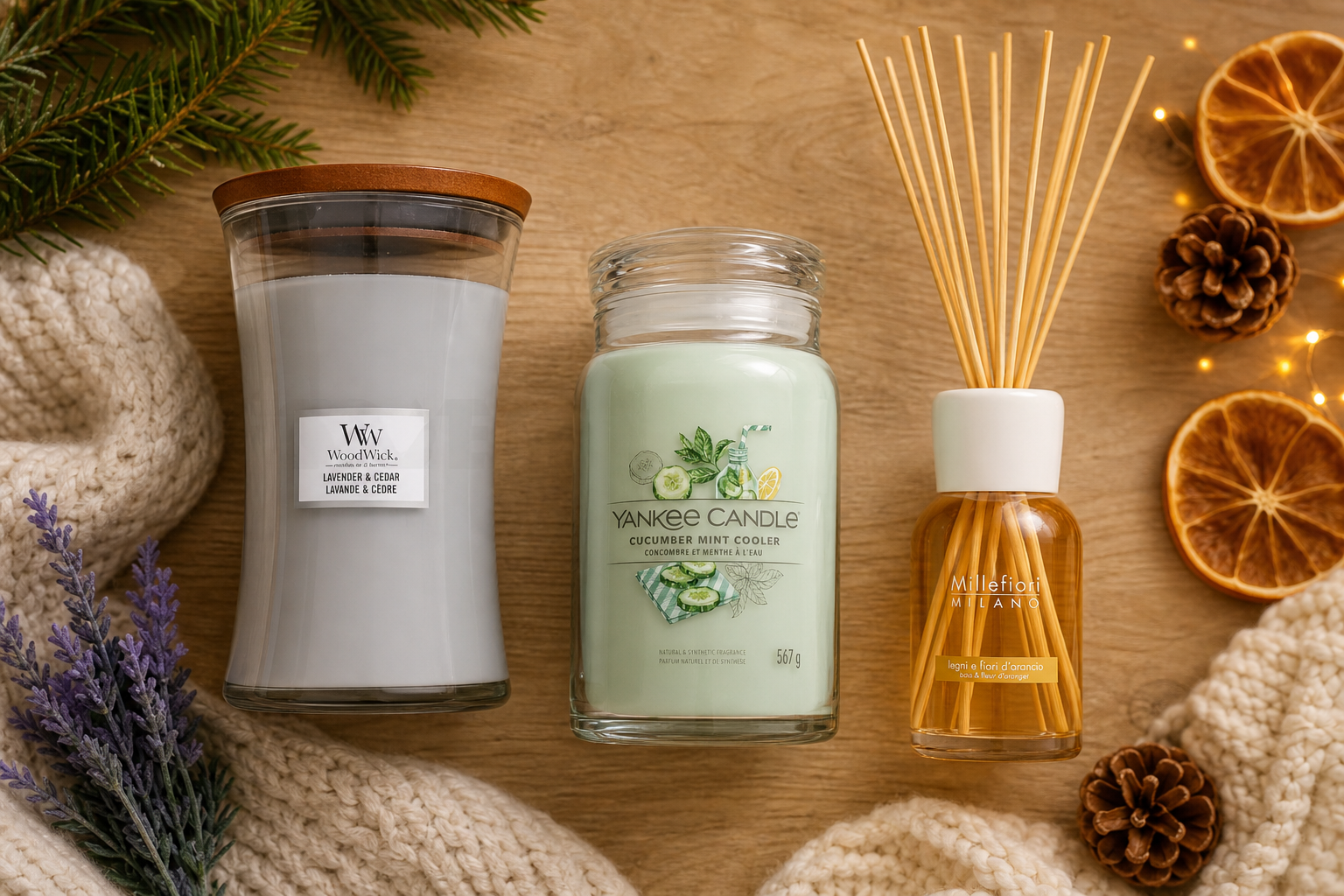
If you want to try each of the three ingredients with a specific product, you might start with this trio from our home fragrance category. Consider it a starting point for further exploration, rather than a shopping list:
- Woodwick Lavender & Cedar – lavender with a cedar accompaniment, offering a calmer woody tone that works in the bedroom at night. Available in various sizes, so you can try it in a smaller package.
- Yankee Candle Cucumber Mint Cooler – minty freshness complemented by cucumber. The cooling top note isn't sharp, making it well-suited for a workday at the desk.
- Millefiori Milano Legni e Fiori d'Arancio – a diffuser with orange blossom and wood, maintaining a citrus note even where you don't want to light anything.
Once you know which of the three ingredients suits your home best, the rest is a matter of format and package size. Try one scent first in the room where you spend the most time, and only then add more – this way, you can keep track of what you're actually smelling.
Category
Recommended articles
"Give a girl the right shoes and she can conquer the world!" Marilyn Monroe