



Nails don't break on their own – their fragility is often due to dry skin, frequent hand washing, or mechanical stress. Let's explore the most common causes of nail breakage and how to prevent it in your daily care routine.
What Does a Healthy Nail Look Like – Understanding Nail Brittleness
Dealing with brittle nails without understanding the cause is not effective. Before grabbing the first product that promises strength, it's important to know what you're dealing with. The nail plate is not living tissue – it's made up of keratinized layers of keratin, the same protein found in hair and the outer layer of skin. Once the nail grows beyond the nail bed, no metabolic exchange occurs within it. Therefore, it cannot be "nourished" from the inside as often advertised – it can only be protected from external damage.
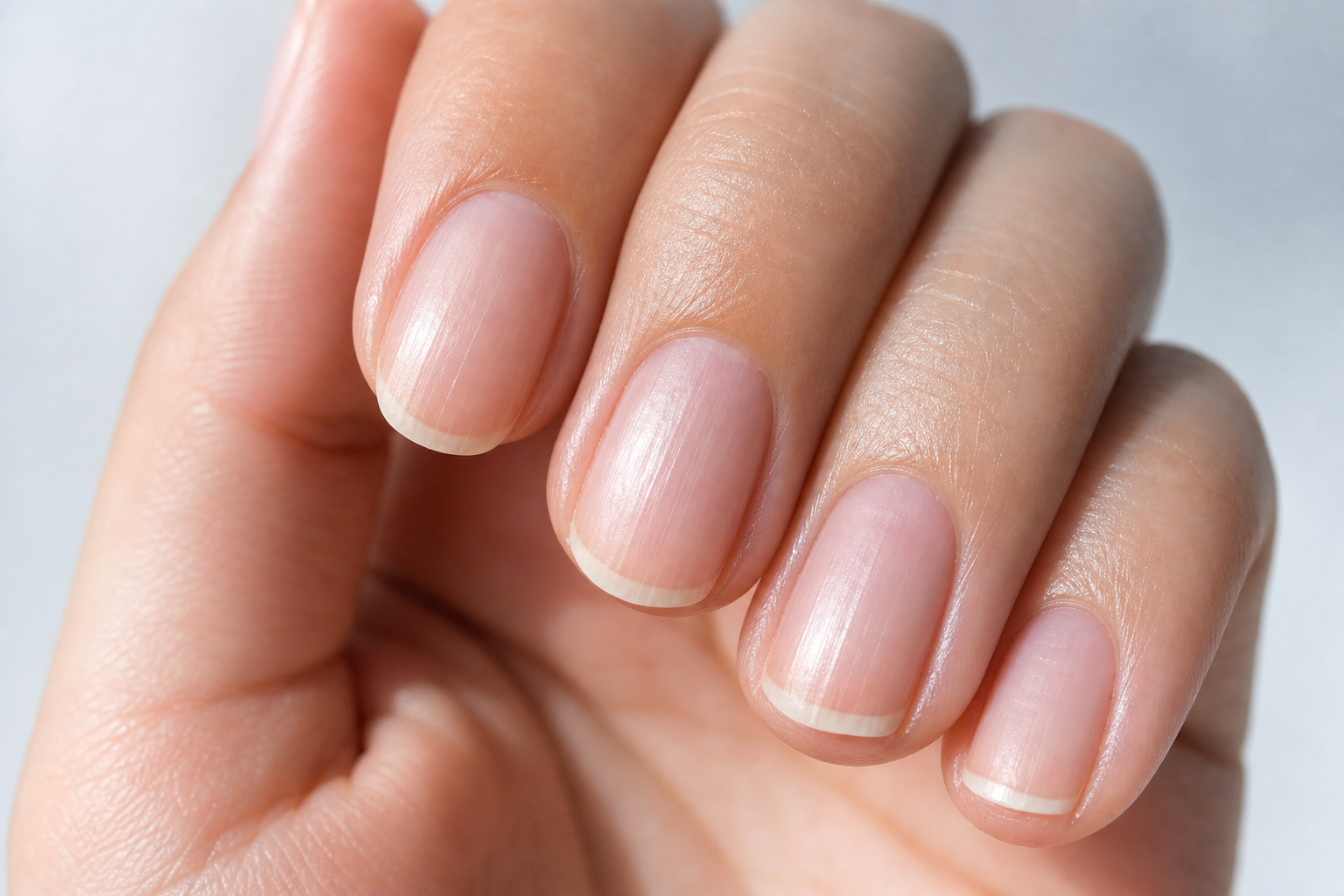
Two things hold the individual keratin layers together: fats and water. Between the keratin plates is a thin lipid layer and a certain amount of moisture, which makes the nail flexible and prevents it from cracking with every bump against a keyboard or a jacket zipper. When this binding system diminishes, the layers start to separate, and the plate behaves like glued paper that has gotten wet and dried again. A healthy nail is smooth, slightly shiny, approximately the same thickness across the surface, and slightly flexible – not hard like glass.
The growth itself starts elsewhere than where care is usually directed. New keratin is produced in the matrix, the germinal part hidden under the cuticle at the nail root. Everything you see on the plate today was formed there several months ago. This implies two things: it's primarily worth protecting the area around the nail root, and any change in care will show with a delay.
Three Types of Damage Often Confused
When you examine your nails closely, you can learn quite a bit about what's happening to them based on the appearance of the damage. Three basic situations can be distinguished:
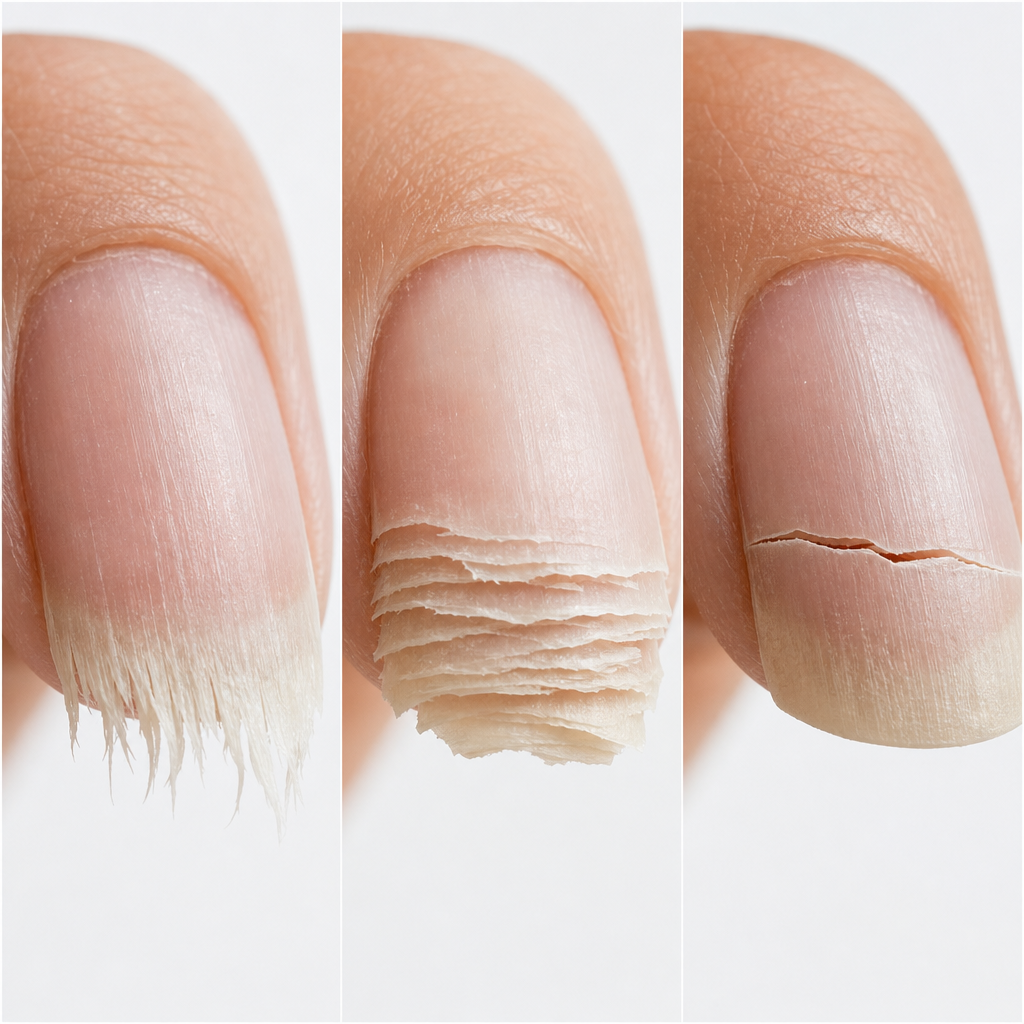
- Splitting at the Free Edge – the end of the nail breaks into fine fibers and flakes. This typically involves wear on the part of the plate that no longer contacts the bed, so it dries out and wears down the fastest.
- Peeling in Layers – the nail peels like puff pastry, with layers separating in horizontal tiers. This is often due to lipid loss and repeated cycles of moisture and dryness.
- Deep Cracking – a crack runs across the plate, sometimes reaching the bed, and is sensitive to touch. It is usually the result of a one-time injury or a long-term weakened structure that can no longer withstand an additional impact.
The difference between them is worth noting because each type points in a different direction. Splitting and peeling can be influenced by adjusting habits and regularly moisturizing the hands. A deep crack, on the other hand, requires mainly caution and time – until it grows out, no product will mend it.
And time is a factor that cannot be skipped with nails. A fingernail grows about three millimeters per month, so from root to free edge, it takes approximately three to six months, and even longer for toenails. You can't repair the damaged part; you can only let it grow out and trim it off. If you start caring today, you'll see the first genuinely assessable result in a few weeks, when a piece of nail that developed under better conditions grows above the cuticle. Impatience is a common reason why people give up after two weeks.
Most causes of brittleness fall into three categories: loss of water and fats from the plate, mechanical stress, and influences coming from within the body. By determining which category most likely applies to you based on the appearance of your nail, you can save yourself unnecessary attempts with care that doesn't address your specific problem.
Frequent Hand Washing, Chemicals, Dry Skin Around Nails
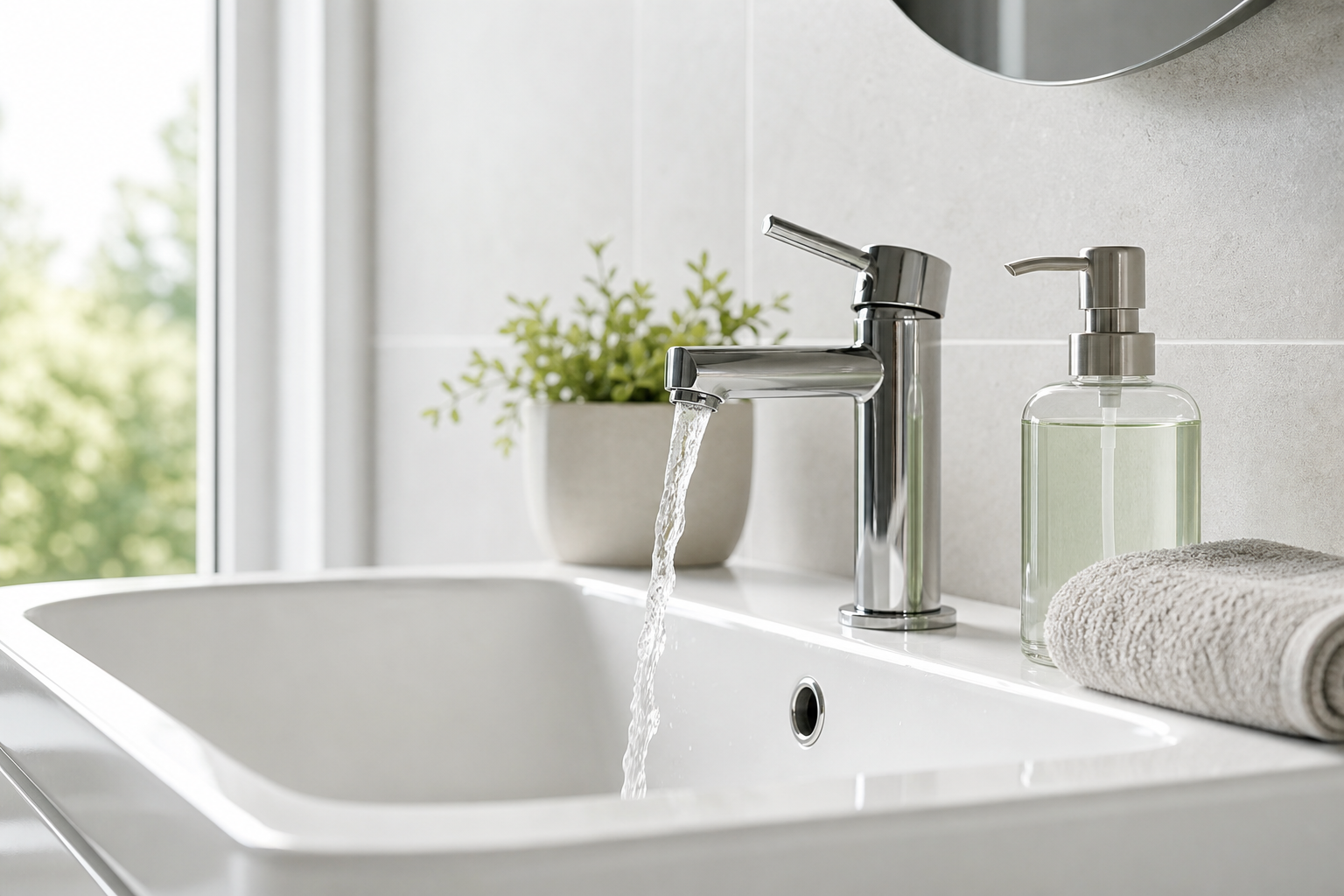
If you're looking for a common external cause of brittle nails, it's water—specifically, the constant cycle of wet and dry. You might wash your hands ten times a day: after shopping, before eating, after cleaning, on your way home from work. One wash means nothing at all. But over weeks and months, it creates a condition where the skin around your nails can't keep up with renewing its protective layer—and the nail growing from this skin will eventually show it.
Water also washes away oils. A thin film of sebum and lipids lies on the skin's surface, acting as a seal to keep moisture in. Cleansers dissolve this film because that's their job—otherwise, they wouldn't remove grease or dirt from your hands. The problem arises when this happens so often that the skin doesn't have time to replenish what it has lost. The nail plate is no different: it contains a certain amount of water and fats, and its flexibility or brittleness depends on them. A nail that repeatedly absorbs water and then dries out behaves like fabric that is constantly washed and dried—it gradually loses cohesion and starts to split into thin layers at the free edge.
Several factors significantly accelerate this process:
- Hot water. The hotter it is, the more readily it dissolves skin oils. Lukewarm water cleans hands just as effectively and is much less harsh on the skin.
- Aggressive soaps. Traditional bar soaps tend to be more alkaline than the skin's natural pH, leaving a typical "squeaky" feeling after washing. This feeling is not a sign of cleanliness but of a disrupted skin film.
- Alcohol-based disinfectants. They evaporate quickly, taking moisture from the skin with them. On hands that go through this many times a day, it shows very clearly on the skin around the nails.
- Cleaning and washing chemicals. Dishwashing liquids, surface cleaners, and detergents are designed for tough dirt, not for contact with fingers. Washing dishes without gloves combines three stresses at once—heat, surfactants, and prolonged contact.
- Heating season. In winter, indoor and outdoor humidity drops, and the skin evaporates more water than it can replenish. That's why many people experience brittle nails regularly from autumn to spring.
Interestingly, the problem almost never first appears on the nail itself. You'll notice the surroundings first: the cuticle is dry and tight, hangnails appear around the nail fold, and the skin at the edges cracks or peels. There's a reason for this—the skin around the nails is thin, has few sebaceous glands, and reacts almost immediately. In contrast, the nail grows slowly, so the part of the plate that is breaking today formed at the nail root several months ago. You're seeing a delayed record of how you treated your hands at the start of winter, not a picture of today's condition.
The practical takeaway is worth remembering: if you consistently get hangnails and cracked cuticles around your nails, take it as an early warning. It's worth intervening at this point because you can still influence the nail that is forming.
Of course, you can't and don't want to completely avoid washing your hands. The difference lies in what you use to wash them. Gentle cleansing gels and shower oils are formulated to remove dirt while leaving some lipids in the skin—so there's no feeling of tightness after rinsing. Compared to regular soap, this is a significantly milder stress, and for hands that go through water many times a day, this difference adds up. Likewise, rubber gloves for cleaning and dishwashing and thoroughly drying hands, including the area around the nails where water tends to linger, will help.
Mechanical Stress: Filing, Manicure, Hand Work
A large portion of the damage you see on nails doesn't come from within, but from simple handling throughout the day. The nail plate is layered, and every prying, scraping, or rough filing gradually separates these layers. The nail doesn't tear all at once but peels off in layers, most often at the free edge. This group of causes can be influenced most easily – by changing habits, not by purchasing products.
Hand Work, Cleaning, Minor Impacts
We use our nails as tools more often than we admit. Opening lids, peeling labels, scraping dried stains – in all these situations, the nail acts as a lever. The longer the edge, the greater the leverage. Soil and rough surfaces wear down the sides of the nail, and wet work softens it – and a soft nail breaks more easily. Gloves help: rubber ones for dishes, sturdy textile ones for gardening.
Typing on a keyboard and using a touchscreen with a nail is a chapter of its own. With longer nails, the impact lands on the tip, and repeated pressure adds up – try consciously typing with your fingertips. Then there's the length: a nail that significantly extends beyond the fingertip receives many more impacts that you aren't even aware of. Shortening it by a few millimeters often does more than any additional care.
Filing: Direction, Material, Coarseness
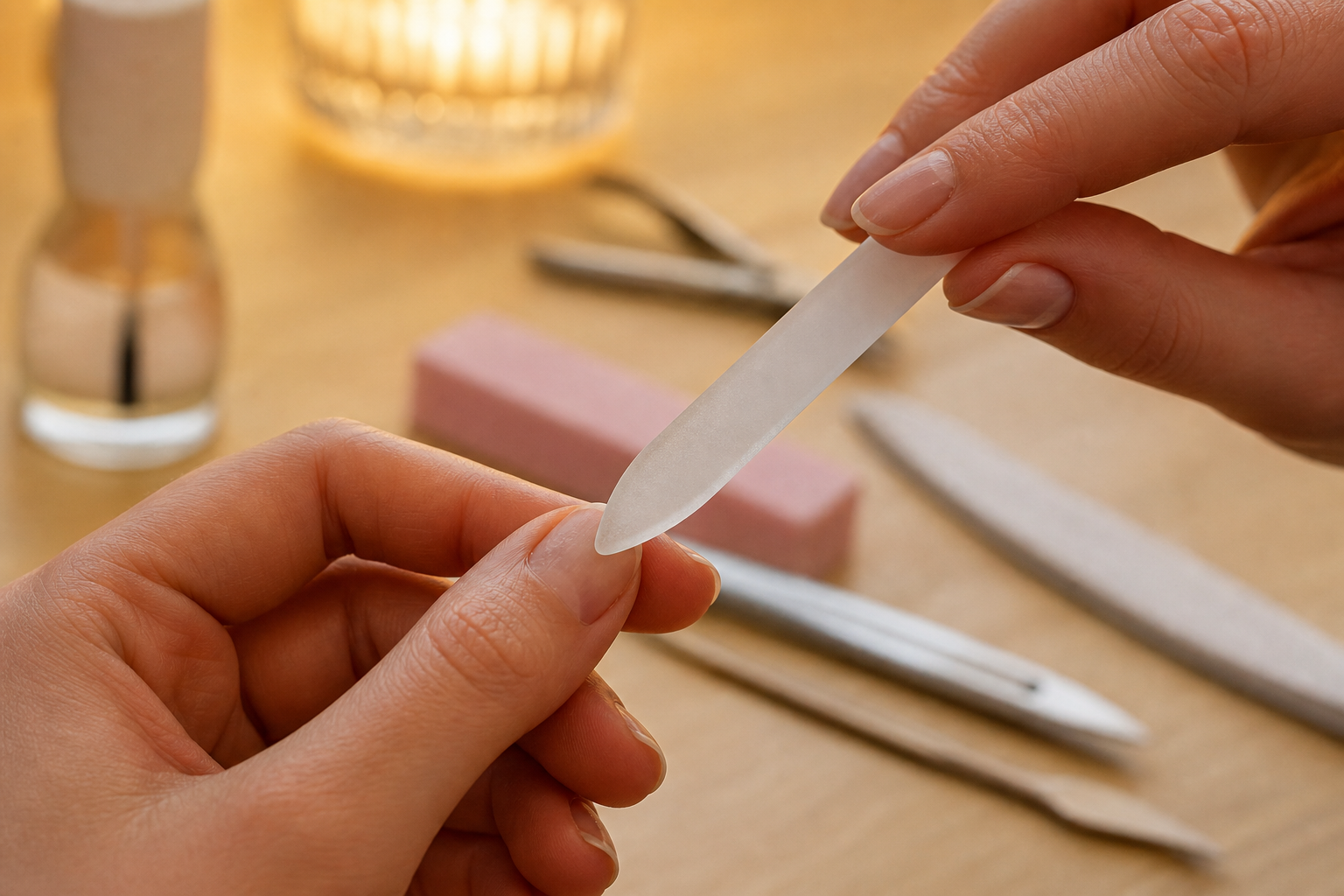
Filing is a common mistake people make in good faith. A metal file with coarse grit and a back-and-forth motion acts on the nail edge like a saw: the layers fray, and the nail starts to peel right where you wanted to smooth it.
- File in one direction, from the edge to the center. Back-and-forth movement literally unravels the nail layers.
- Choose a finer grit. A glass or fine emery file removes material more slowly but without tearing the edge.
- Don't file right after a bath. A soaked nail is soft and bends under the file rather than being evenly filed down.
- Choose the shape according to stress. Sharp corners catch and break more easily; for hands that are heavily used, a rounded shape holds better.
Gel or Acrylic Manicure
Modeled manicure itself is not the enemy; for many people, it strengthens the nail. The problem often lies in the way the material is removed. Peeling off the gel with the nail takes the top layer of the plate with it, and after several such cycles, the nail is noticeably thinner, translucent, and soft. Similarly, repeated surface filing has the same effect. It makes sense to have the material removed professionally and to take breaks occasionally to let the nail grow without interference.
Nail Polish Remover, Acetone, Cuticle Pushing
Acetone-based nail polish remover removes polish quickly, but it also strips the nail of oils and water, leaving it dry and brittle. If you remove polish often, opt for a non-acetone variant, place the pad on the nail for a moment instead of scrubbing for a long time, and give your nails a day or two off between polishes.
The last common cause is aggressive work with the cuticle. The cuticle is not useless: it seals the area where new nail material forms. If you push it back forcefully with a metal tool or cut it too short, you can irritate the growth area. Typical signs are transverse ridges that appear with a delay of several weeks, so you no longer associate them with the procedure. It's safer to gently push the cuticle back, ideally when softened.
What You Can Change Immediately, Without Costs
- Shorten nails to a length that does not extend beyond the fingertip.
- Stop using the nail as a lever or scraper.
- Wear gloves for cleaning, dishes, and gardening.
- Push the cuticle back gently, never tear it off.
Judge the result by the newly grown part at the bed, not by the end of the nail. The damaged section won't repair itself retroactively; it has to grow out – for hands, this usually takes about three to six months.
When the Cause Isn't Just External: Diet, Health, Age
Whether you've already perfected your hand care routine or are just starting out, there are some causes that no cream can address. Nails form deep under the skin and grow slowly—it usually takes several months for a complete renewal. The change you see at the free edge today often reflects what was happening in your body long ago. That's why it's worth considering factors unrelated to manicure.
An unbalanced diet is the first thing to consider. Nail material is protein-based, so a long-term low protein intake, strict weight-loss diets, or very one-sided eating habits usually affect nail quality. Brittle nails are also linked to a lack of iron, zinc, or B vitamins. However, it's not advisable to start taking supplements on a whim—if you suspect a nutrient deficiency, it can be confirmed with a blood test by a general practitioner, who can also advise on what and how long to supplement.
Hormonal changes are another factor beyond the reach of cosmetics. Nails often change during pregnancy and after childbirth, during breastfeeding, and menopause—some people find their nails grow faster and stronger, while others experience softening and splitting. Thyroid disorders or long-term illnesses, after which the body is recovering, can also affect nail growth. That's why brittleness sometimes appears weeks after you've gone through something strenuous.
Some medications and more intensive medical treatments can alter nail growth on their own. If you've started a new medication and your nails have changed since then, don't stop taking it on your own—mention it to the doctor who prescribed it and find a solution with them.
Age is the last, entirely natural factor. As the years go by, nails grow more slowly, tend to be drier, show more pronounced longitudinal ridges, and are more prone to splitting into layers. It's not a disorder, just a change that care can adapt to: more frequent moisturizing and gentler trimming will benefit mature nails more than any one-off treatment.
Cosmetics can do a lot, but they can't diagnose. Make an appointment with a general practitioner or dermatologist if you notice any of these changes:
- sudden color change—yellowing, significant whitening, or a dark streak in the nail;
- change in shape or texture: deep ridges, indentations, deformities, or detachment of the nail from the bed;
- pain, swelling, redness, or oozing of the skin around the nail;
- affecting all nails at once, not just one or two;
- brittleness that lasts for months and doesn't respond to changes in care or gentler handling.
Think of it as a division of labor. Nourishing hand creams, oils, and balms can hydrate the nail and the skin around it and protect against drying out—that's the part you can control. What's happening inside the body, however, can only be assessed by a doctor. When both sides work together, daily care makes a visible difference; when you're trying to mask a health issue with cosmetics, the results won't show.
Daily Care for Nails – Step by Step
Nails won't improve overnight. They grow slowly, so expect visible changes over months rather than weeks – it's worth focusing on habits you can repeat daily rather than a one-time treatment. The good news is that such a routine doesn't have to be complicated or time-consuming. Most of the work is done by a few small actions that can fit into your everyday life.
Daily Essentials
- Gentle washing. Try replacing harsh soap with a mild cleansing or shower product and wash your hands with lukewarm water. Hot water removes the protective oily film from the skin faster than lukewarm water.
- Cream after every contact with water. This is the step most often forgotten. Dry your hands thoroughly after washing and immediately moisturize – don't just stop at the back of your hand, massage the cream into your fingertips and around your nails. A small bottle by the sink works better than a large tube hidden in the bathroom.
- Gloves for wet and dirty work. Dishwashing, cleaning, working with detergents, and gardening – rubber or work gloves will help in all these situations. If your hands sweat in them, wear thin cotton gloves underneath.
- Cuticle oil in the evening. The best time is before bed when you won't be washing your hands again. Apply a drop to the base of each nail and massage it in with a circular motion. More flexible cuticles tear less and cause fewer hangnails.
Once a Week
- Trimming and filing. Set aside a calm moment for this. File dry, in one direction from the edge to the center, and then smooth the edge with the finer side of the file. Keep the free edge relatively straight with slightly rounded corners.
- Length check. A sustainable length is one you can work with daily without breaking. If your nails keep tearing at the same spot, they're simply too long for your daily activities.
- Intensive hand treatment. Every now and then, treat yourself to a rich balm or moisturizing hand mask, ideally overnight under cotton gloves.
- Break from polish. If you regularly polish your nails, let them rest for a few days after removing the polish and moisturize them more thoroughly.
What to Avoid
A few habits can unnecessarily weaken nails without needing any product: tearing off hangnails and peeling nail layers, cutting cuticles with scissors, or opening packages with your nails. If a nail repeatedly breaks in the same place, changes color, or separates from the nail bed, have it checked by a professional – cosmetic care cannot replace medical examination.
Tips for Enhancing Your Routine
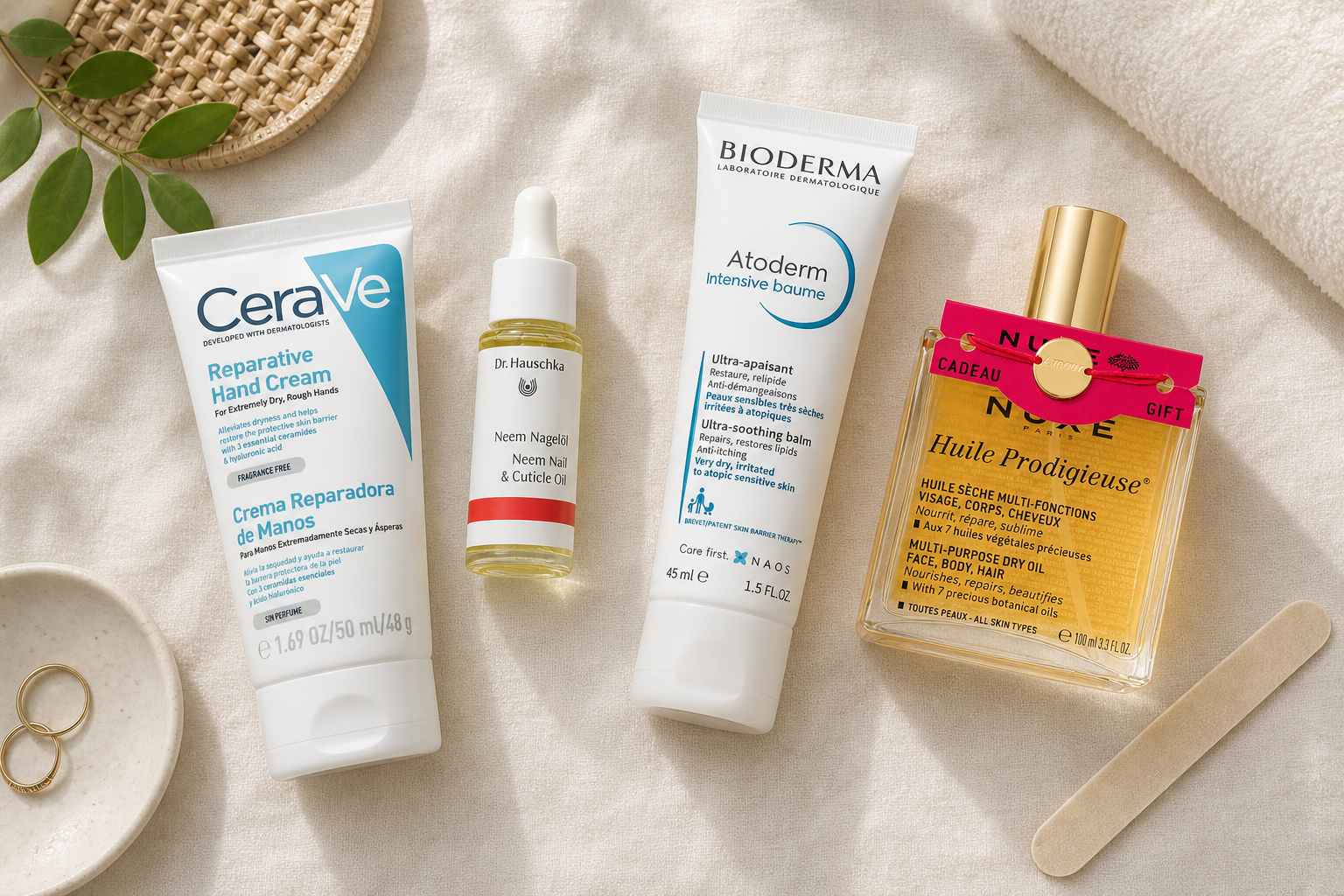
The specific brand isn't the main thing; regularity is what counts. However, if you're looking for products to fit into the described routine, check out the body care category for nourishing body balms and shower oils – lines like Bioderma Atoderm, La Roche-Posay Lipikar, or CeraVe offer these. Shower oil can replace regular soap, and balm can be used to moisturize hands after bathing. For evening massage around the nails, a lighter dry oil like Nuxe Huile Prodigieuse is suitable, and for a weekly treatment, there are moisturizing hand masks available from brands like Dermacol.
Consider these as suggestions to try, not as mandatory equipment. The routine works even with products you already have at home – the key is to stick with it long enough for a new, better-cared-for nail to grow.
Category
Recommended articles

"Give a girl the right shoes and she can conquer the world!" Marilyn Monroe