




Pigmentation spots are not a random flaw, but a visible reaction of the skin to specific stimuli – sun, hormones, or healing acne. We will explain how pigmentation occurs, why it affects certain skin types more, and why daily sun protection is the foundation of prevention, without which the rest of your skincare routine loses its purpose.
When the First Dark Spots Appear on Your Skin
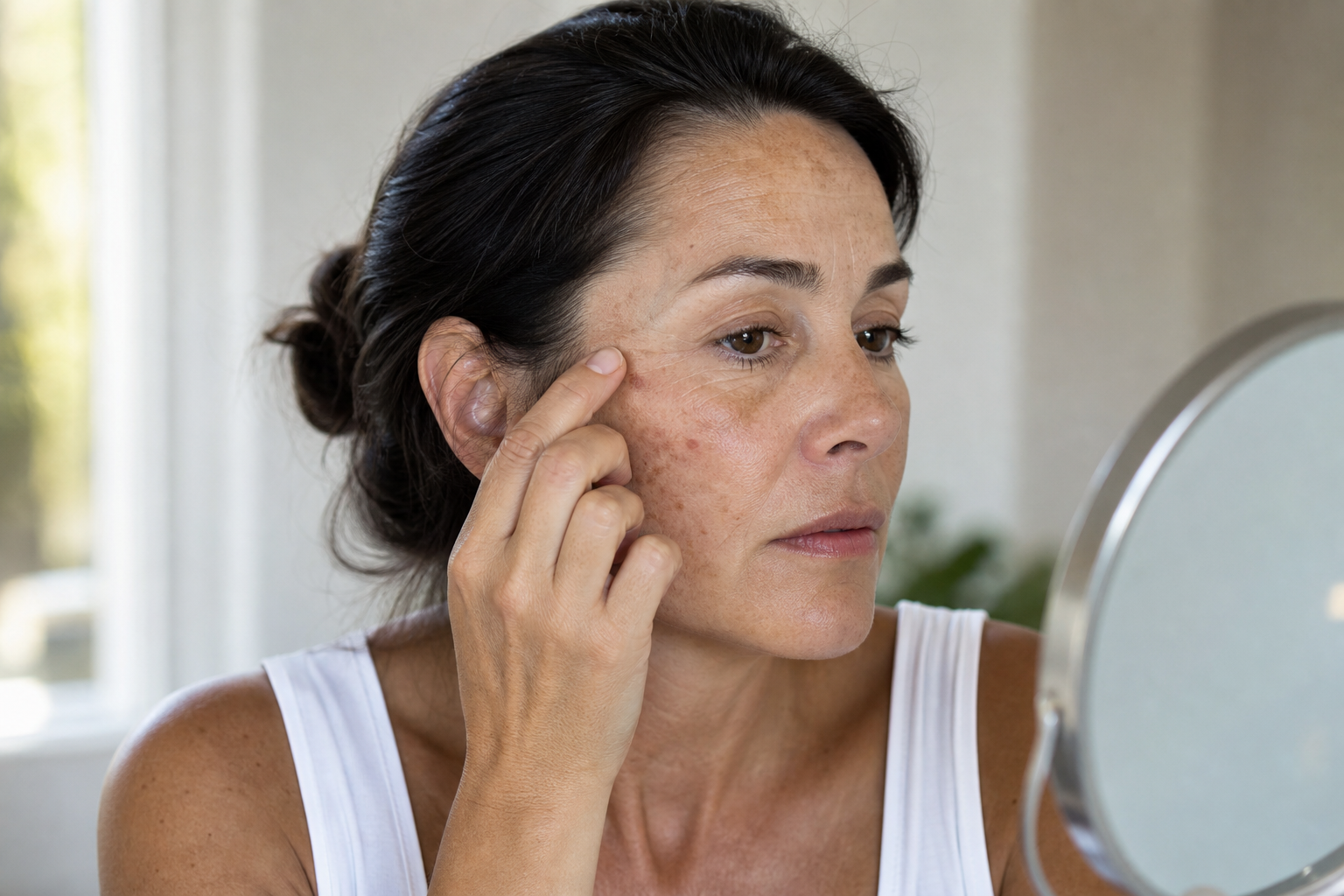
You've been there. You look in the mirror in the morning, the light hits differently than usual, and suddenly you notice small brown spots on your cheekbones that you hadn't seen before. Pigmentation also likes to appear on the forehead, above the upper lip, or on the backs of the hands, areas that are most exposed throughout the year. People often notice it at the end of summer and the beginning of autumn, when the skin returns to its normal tone and differences in pigmentation become more noticeable.
The first reaction is almost always the same: cover it up as quickly as possible and get rid of it as soon as you can. However, a pigment spot is not a random flaw or dirt that can be washed away. It is a visible response of the skin to a specific stimulus – sun exposure, a past inflammation, or a hormonal change. And since there are multiple triggers, pigmentation is not just one single thing.
In practice, the term covers three situations that differ in origin and behavior:
- Freckles – small, sharply defined spots that appear in childhood and have a strong hereditary basis. They are typical for lighter skin types, darken in the sun, and fade again in winter. However, their distribution does not significantly change over time.
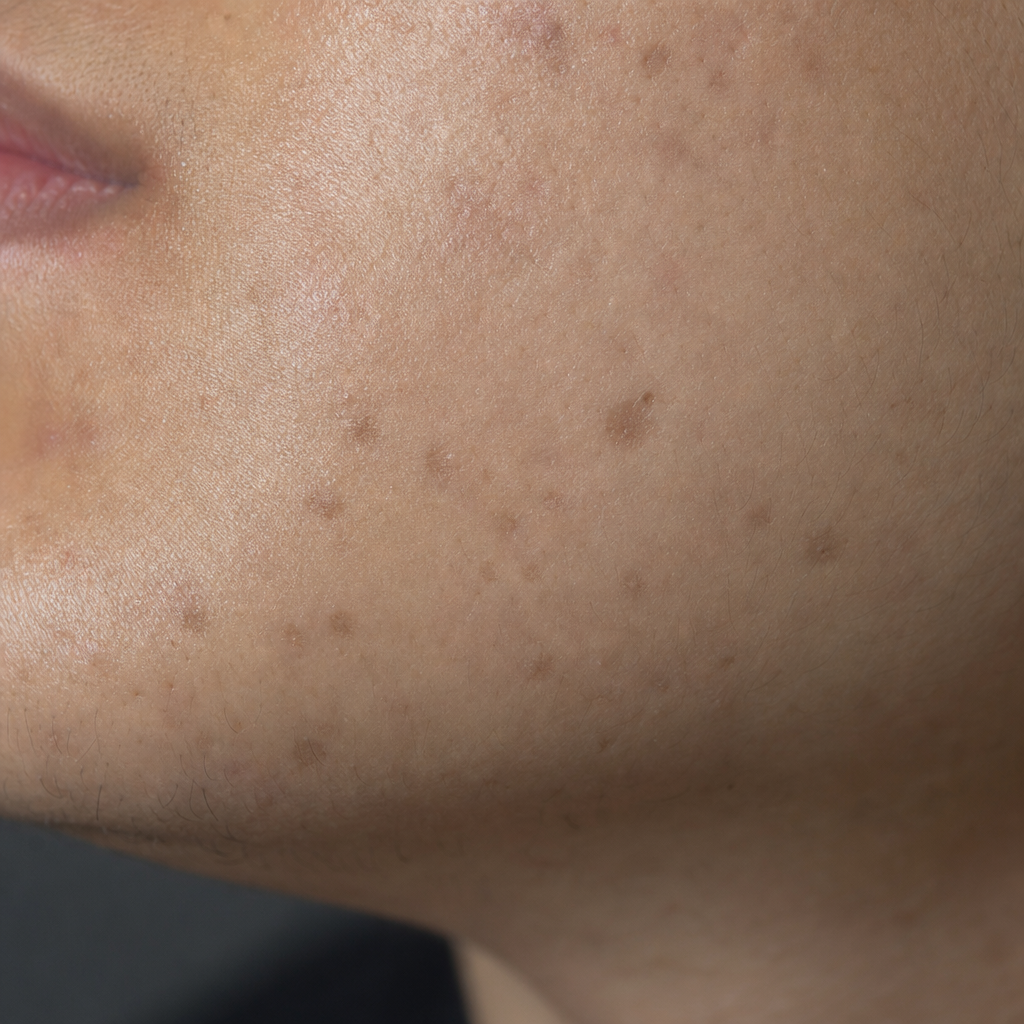
- Post-inflammatory pigmentation – a darker trace that remains exactly where the skin was healing. You can recognize it by its lack of a regular pattern: it outlines areas after acne, scratches, burns, or overly aggressive treatments.
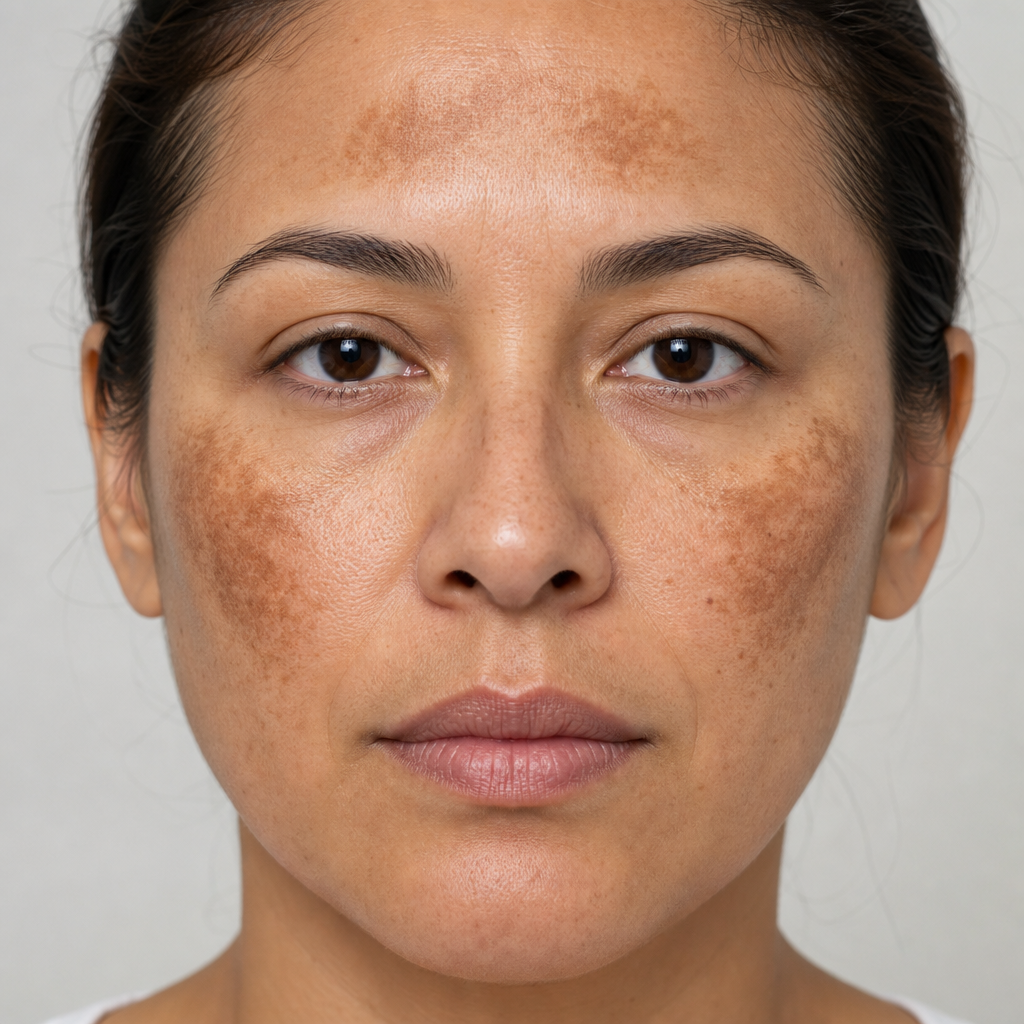
- Melasma – larger and less sharply defined areas that appear noticeably symmetrically on both cheeks, the forehead, or above the upper lip. They are related to hormonal fluctuations and tend to be more persistent than the other two groups.
In more mature skin, so-called solar lentigines, commonly known as age spots, are added to the mix. They are not as closely related to age as commonly believed – they are more a record of years spent in the sun. They are larger than freckles, have a stable color, and do not fade on their own during winter.
Distinguishing between the different types makes sense for one simple reason: each behaves differently and responds differently to care. Freckles do not require correction, and their removal is not usually a realistic goal. Post-inflammatory pigmentation typically fades on its own over time, but it can take many months, and repeated irritation of the same area reliably prolongs it. Melasma, on the other hand, reacts even to short sun exposure and tends to return without consistent protection, even if it has already faded once.
One more note before we dive into the causes. Cosmetic care is for evenly colored spots that behave calmly and do not change dramatically over time. If a skin lesion grows rapidly, changes shape or color, itches, or bleeds, have it assessed by a dermatologist. That is not a job for a cream.
Understanding what triggered the spot is the first step to making subsequent care meaningful. Without it, addressing pigmentation easily narrows down to searching for a miraculous product to fix something that continues to occur in the skin. In the following sections, we will explore how pigment forms in the skin, what most often triggers its production, and what can be done before the spots appear.
How Melanin is Formed and Why It Deposits Unevenly
Before we tackle how to prevent pigmentation spots, it's worth understanding what's happening in the skin. Melanin is not a flaw or disorder – it's a natural pigment that protects your skin from radiation. The problem arises when its production locally exceeds what's necessary.
Melanocytes as Small Pigment Workshops
In the lower layer of the skin sit cells called melanocytes. They make up only a small fraction of all skin cells but have a clear task: to produce melanin. This pigment is formed in tiny vesicles inside the melanocyte and then travels to surrounding skin cells, which gradually move to the surface. Simply put, a melanocyte functions like a workshop that sends pigment packages to its neighbors, creating a protective shadow over their nuclei.
Interestingly, most people have a roughly comparable number of melanocytes regardless of skin color. The difference lies in how active they are, how much pigment they produce, and what type of melanin predominates – darker, which absorbs radiation more effectively, or lighter with a reddish tint and lower protective capability.
Why Pigment Doesn't Spread Evenly Across the Skin
Melanocytes don't respond to a command from a central hub but to local stimuli. When a part of the skin receives a stronger signal – inflammation, irritation, hormonal impulse, or repeated radiation – production kicks off precisely there. Therefore, pigment doesn't form uniformly but in defined patches.
The second factor is the depth of deposition. Pigment that remains in the upper layers of the skin moves upward with natural cell renewal and fades over time. If it penetrates deeper, cell renewal won't help, and the spot lasts significantly longer. That's why some spots fade on their own within a few months, while others recede very slowly.
The memory of the cells themselves also plays a role. A melanocyte that has been repeatedly stimulated remains more sensitive and activates faster than its surroundings upon the next stimulus. The spot then returns to the same place, even if it seemed almost gone in the meantime.
Phototype Determines How Skin Reacts
The tendency to pigmentation is largely determined by phototype, the innate type of skin that describes how you react to sunlight:
- Lighter phototypes – the skin tans with difficulty, burns easily, and is more prone to freckles and small light brown spots.
- Medium phototypes – the skin tans more easily, but under greater stress, it reacts with more continuous brown areas, typically on the cheekbones and forehead.
- Darker phototypes – melanocytes are more active, pigmentation is more pronounced and harder to correct. Dark marks from inflammation or injury form more easily and fade more slowly.
Sensitive and Mature Skin Have It Tougher
Besides phototype, the current state of the skin also comes into play. Sensitive skin has a lower threshold for irritation – it reacts with redness and micro-inflammation where more resilient skin doesn't react at all. And since inflammation is one of the triggers for melanin production, repeated irritation can eventually manifest in color.
For mature skin, two additional factors come into play. Cell renewal slows with age, so once deposited, pigment moves to the surface more slowly. At the same time, cumulative exposure over the years adds up, and melanocytes tend to be more unevenly distributed – resulting in sharply defined spots on the backs of the hands, décolletage, and forehead.
Similarly, dry skin and skin with a weakened protective barrier struggle: they are less able to defend against external influences and are more easily irritated. Therefore, it makes sense to look at pigmentation from two angles – to reduce the stimuli that trigger melanin production and to keep the skin calm and hydrated.
Ultraviolet Radiation as the Main Trigger for Pigmentation
If we were to identify a common factor in pigment spots, it would, in most cases, be ultraviolet radiation. The sun may not be the only cause, but it almost always acts as a trigger: it signals the pigment-producing cells to speed up their work. In areas where their activity is already uneven, the contrast between the surrounding skin and the darker spot becomes even more pronounced. This is why pigmentation care that ignores the sun usually proves ineffective.
The effects of sun exposure do not appear the very next day. The production of pigment and its deposition in the upper layers of the skin is a gradual process that takes days to weeks, and fresh tanning temporarily blurs the differences between individual shades. A spot that formed in July is often most visible when the tan begins to fade—towards the end of summer or in autumn. Many people therefore associate pigmentation with changes in weather or autumn care, even though it was the sun months earlier that caused it.
Moreover, the ultraviolet radiation that hits the skin is not uniform. It is simply divided into two components that differ in penetration depth and in how their effects manifest:
- UVB radiation primarily affects the surface layers of the skin. It is responsible for sunburn, redness, and unpleasantly sensitive skin after a day in the sun, and its intensity varies significantly with the season and time of day.
- UVA radiation penetrates deeper, does not cause sunburn, and therefore goes unnoticed during a typical day. However, it contributes to long-term skin changes, including uneven pigmentation, and its intensity remains fairly consistent throughout the year.
Crucially, the UVA component passes through ordinary window glass. Exposure does not end at the beach or poolside—it continues on the way to work, by the office window, and while driving, where one side of the face is often more exposed than the other. Similarly, cloudy weather does not automatically mean safety, as clouds allow some radiation to pass through. For skin prone to pigmentation, this has a simple consequence: it is not just the two weeks at the seaside that matter, but mainly the small and inconspicuous exposure spread throughout the rest of the year.
This is closely related to the principle of cumulative damage. The skin does not start each summer with a clean slate—individual doses of ultraviolet radiation add up, and the traces remain in the deeper layers long after the redness and peeling have disappeared. Every sunburn counts, including those from childhood and adolescence that you no longer remember. Pigment-producing cells in repeatedly stressed areas gradually change their sensitivity: in some patches, they remain permanently more active than their surroundings. This is where spots typically appear on the cheekbones, forehead, nose, and backs of the hands—precisely where the skin receives the most sun throughout life.
The final piece of the puzzle explains why pigmentation returns after each summer. During winter, spots often fade to the point where they are barely noticeable in the mirror, leading you to believe the problem has resolved itself. However, the increased sensitivity of the affected areas persists, and pigment forms more quickly and readily than in the surrounding skin. Just a few unprotected spring days are enough for the spot to reappear in the same place, usually more pronounced than the previous year. Therefore, addressing pigmentation seasonally is pointless: any unifying care only works when accompanied by consistent sun protection throughout the year.
Hormonal Changes and Post-Inflammatory Pigmentation After Acne
Not every dark spot appears on the beach. Besides ultraviolet radiation, there is another major group of causes for pigmentation that occur inside the body or directly in healing skin. These explain why spots appear even in people who avoid the sun and why they sometimes persist exactly where a rash or small wound was a month before.
Melasma and Hormonal Fluctuations
Melasma is often associated with periods when sex hormone levels change significantly – typically during pregnancy, with hormonal contraception, or with hormone therapy. It is colloquially known as the "pregnancy mask" because it appears in some women during the second half of pregnancy and gradually fades after childbirth. However, this is not automatic: for some, it lasts much longer and returns without care.
You can recognize it by its nature. It is not sharply defined small freckles but larger areas with blurred edges that appear noticeably symmetrically on both sides of the face – on the cheekbones, forehead, above the upper lip, or on the chin. This symmetry is the most reliable guide to distinguish melasma from randomly distributed spots after a one-time burn.
Hormones themselves do not create pigment. However, they change the sensitivity of melanocytes, so they react to stimuli that the skin would otherwise handle without a visible trace. This is why melasma is persistent and cannot be addressed sporadically. If you are troubled by widespread spots on your face, have them assessed by a dermatologist – home care is a supplement in this case, not a replacement for professional examination.
Post-Inflammatory Pigmentation After Acne
The second common scenario is familiar to anyone who has experienced acne. An inflammatory pimple heals, but a brown to gray-brown spot remains, lasting weeks or months. It is not a scar: the skin surface is smooth, only the color has changed. The skin responded to the inflammation with increased pigment production, which settled in the area.
Practically any significant irritation can trigger such a reaction:
- healed inflammatory acne, especially deeper and painful manifestations,
- squeezing and mechanical irritation of pimples,
- minor injuries, scratches, or healing wounds,
- overly aggressive peeling or a combination of several strong products at once,
- reaction to irritating cosmetics on sensitive and problematic skin.
The most common mistake remains squeezing. Pressure spreads the inflammation into deeper layers, the damage is greater, and the area where the skin deposits pigment increases. A subtle irregularity that would have faded in a few days thus becomes a spot lasting several months.
In practice, restraint works better than determination for post-inflammatory pigmentation: gentle cleansing, calm hydration, one targeted product instead of five, and patience. The color gradually evens out, with lighter marks taking weeks and darker ones several months. And as long as new inflammations occur, new spots will also appear – that's why it makes sense to address the root cause of the acne first.
The Sun as an Amplifier, Not the Cause
The same rule applies to both types of pigmentation. The sun was not the original cause, but it reliably worsens the outcome. Melanocytes, which have already received a signal for increased pigment production, react more sensitively to ultraviolet radiation than their surroundings. Therefore, the spot darkens more quickly after exposure and blends less with its surroundings.
This is also why melasma intensifies after summer and why acne marks that faded over winter reappear in spring. Sun protection is not a separate chapter alongside pigmentation care but an essential part of it.
Daily Sun Protection as the Foundation of Prevention
Whether you're dealing with acne scars, melasma, or just an uneven tone after summer, there's one common rule for all these situations: without daily protection with a high SPF, ideally SPF 50 or more, the rest of your pigmentation care loses most of its purpose. Serums and creams aimed at unifying skin tone work against the process that ultraviolet radiation triggers repeatedly. Prevention is often simpler and cheaper than later correction – just one extra step in the morning routine and, most importantly, consistency.
Properly Applied Protection Step by Step
The most common weakness isn't the choice of product, but the amount used. Most of us apply a significantly thinner layer than what corresponds to the declared protective factor, and the actual protection decreases as a result. A proven method is the so-called two-finger rule: the amount applied along the length of the index and middle fingers roughly corresponds to the necessary amount for the face and neck.
The second aspect is reapplication. The protective film wears off during the day due to sweat and hand contact, so one morning application isn't enough for a whole day spent outdoors. If you're exercising, swimming, or spending extended time in the sun, plan to reapply approximately every two hours. Under makeup, spray and powder forms are suitable as they can be used without smudging makeup.
And thirdly, the season. It's worth using protection even outside the summer months – in spring, autumn, and winter in the mountains, where radiation reflects off the snow. It's the year-round consistency that makes a bigger difference for skin prone to pigmentation than one careful week on vacation.
Choose a Texture You'll Actually Use
A protective product only works if you actually apply it every morning. Therefore, it's worth choosing a texture based on your skin type:
- Oily and combination skin – light fluids and gel textures with a matte finish that don't leave a shine on the skin.
- Dry and mature skin – creamy textures with moisturizing and nourishing ingredients that can also replace a day cream.
- Sensitive and reactive skin – products with mineral filters and simpler compositions, usually fragrance-free.
- Acne-prone skin – non-comedogenic fluids; avoid heavy balms that can unnecessarily burden the skin.
A special category includes tinted variants. Besides providing protection, they visually even out skin tone, making darker areas less noticeable from the first day.
When to Add Tone-Unifying Care
If you already have spots and manage daily protection regularly, it makes sense to add a second step – a product focused on brightening and unifying tone. This type of care often includes ingredients like niacinamide, vitamin C, azelaic acid, or arbutin. For more significant skin surface renewal, retinoids and acids are added, which are used in the evening because the skin tends to be more sensitive to light afterwards.
It's good to set expectations realistically: pigmentation adjusts slowly, usually over weeks to months, and without concurrent protection, the result won't last. If a spot changes rapidly, grows, or has irregular edges, it belongs to a dermatologist, not a cosmetic routine.
Where to Find Protective Products
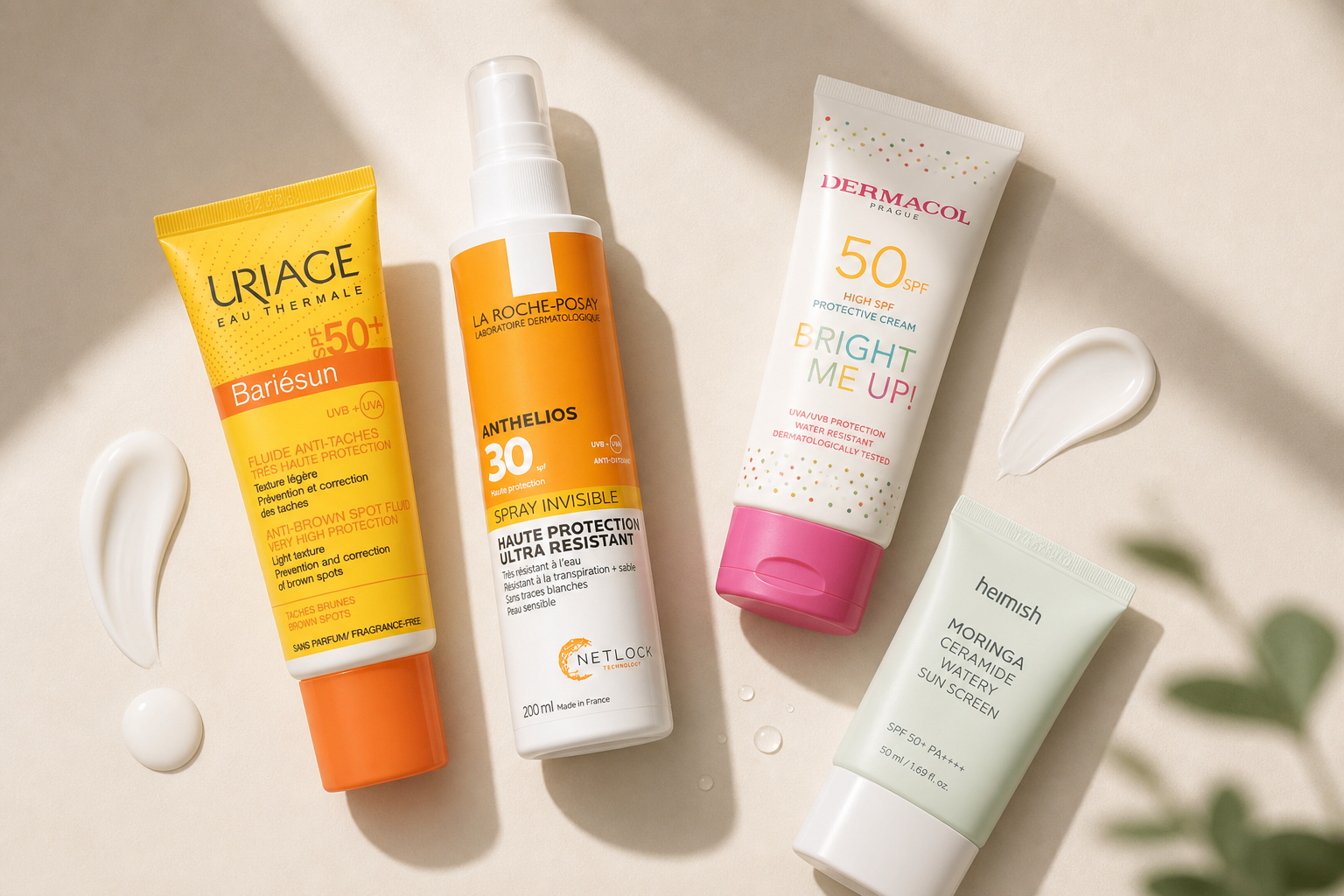
In our range of facial and body cosmetics, protective products form their own category across price levels. Among the most sought-after are dermocosmetic brands La Roche-Posay, Vichy, and Uriage with extensive lines also suitable for sensitive skin, and from Korean cosmetics, Beauty of Joseon with light textures for everyday use. Alongside them, you'll also find after-sun care for the body, so protection doesn't have to stop at the face.

Category
Recommended articles

"Give a girl the right shoes and she can conquer the world!" Marilyn Monroe