

Why the Eye Area Ages Faster Than the Rest of the Face
When you look in the mirror in the morning, the first subtle changes usually don’t appear on your forehead or cheeks, but around your eyes. This is no coincidence, nor does it mean you’re not taking good care of your skin. The eye area is anatomically different from the rest of the face and behaves accordingly.
The skin of the eyelids is among the thinnest on the entire body. While the thickness of the skin on the cheeks is measured in millimeters, on the upper eyelid it's only fractions of that. A thin layer also means less collagen and elastin, which are the internal supports that keep the skin taut. As their levels naturally decrease with age, it shows first where there was the least to begin with.
There are more differences compared to the rest of the face, each playing its role:
- Minimal sebaceous glands. The eyelids have significantly fewer than the forehead or nose, so they can't create the same continuous protective film. Therefore, the skin here appears dry even in people who otherwise have oilier skin.
- Weaker protective barrier. The thin hydrolipid film is less effective at preventing water evaporation. Lack of hydration shows up sooner and more visibly around the eyes than elsewhere – fine lines become prominent and the eyes look tired.
- Thin subcutaneous tissue. There is little fat padding under the skin here, which elsewhere smooths the surface. Blood vessels under the thin tissue easily show through, making the eye area appear darker.
- Tendency to retain fluids. The loose tissue structure can hold quite a bit of water. That's why puffiness appears here in the morning, which you won't notice on the cheeks or chin.
When these characteristics add up, you get an area that reacts more quickly and sensitively than the surrounding skin. The first fine lines in the outer corner of the eye appear for many people around the age of thirty, for some even earlier. It's not a failure of care or a sign that you've neglected something – it's a logical consequence of how this part of the face is structured. The difference is more about when you start targeted care and how regularly you maintain it.
The good news is that you can work with thin and dry skin. No cream will erase wrinkles or turn back your skin ten years, but well-chosen care can replenish moisture, support its barrier, and improve the overall appearance of the eye area. That's why there's a separate Eye Care category – products in this category have different consistencies, different concentrations of active ingredients, and gentler formulations than regular facial creams.
In the following sections, we will look at what accelerates the aging of the eye area the most, which active ingredients in eye creams truly make sense, and what is not worth paying attention to. We will also recommend six specific creams and serums from Brasty's range and advise on how to apply them and how to choose the right one for you.
Facial Expressions, Sleep, and Sun – What Accelerates Aging the Most
The delicate skin around the eyes doesn't create wrinkles on its own – it just reveals them earlier than the rest of the face. How quickly the first lines appear is mainly influenced by what you expose your eye area to every day. Most visible changes are caused by three factors: repeated facial expressions, lack of sleep, and ultraviolet radiation. You can mitigate the impact of all three.
Facial expressions are the least noticeable but the most persistent. You blink several thousand times a day, and this is compounded by squinting at a monitor, in bright light, or due to uncorrected vision problems. Each muscle contraction bends the skin in the same spot. Initially, it straightens itself out, but over the years, the crease becomes permanent, resulting in fine lines visible even with a relaxed face. It's not about stopping smiling – it's about reducing unnecessary squinting: check your prescription, adjust the screen brightness, and give your eyes short breaks.
Sleep has an immediate and visible impact on the eye area. After a short or restless night, water is more easily retained under the skin, the eyelid becomes swollen, and the gaze appears tired. Morning puffiness doesn't create wrinkles by itself, but repeated stress stretches and relaxes the skin over and over. Sleeping position and evening routine also play a role: pressing your face into a pillow compresses the eye area, and a lot of salty food or alcohol will show up here in the morning. Dark circles are largely due to anatomy and visible blood vessels, with fatigue only highlighting them.
The sun is the strongest external factor of the three and also the one you can address most affordably. Ultraviolet radiation hits the face even on days when the sun doesn't seem strong. Additionally, there's a second effect: in bright light, you automatically squint, so sun exposure adds to the facial expression strain. Daily protection is therefore more important for the eye area than the most expensive cream applied only when wrinkles are visible.
If you're looking for a specific product, some of the most sought-after at Brasty are protective care products from brands like La Roche-Posay and Vichy. From La Roche-Posay, there's the lightweight ANTHELIOS Invisible Fresh Mist SPF 50+, and from Vichy, daily creams with high protection, such as Liftactiv B3 SPF 50 or the Capital Soleil range. When applying around the eyes, use only products intended for the face, and apply up to the orbital bone, not directly on the eyelids.
Besides the main trio, several smaller influences affect the condition of the eye area. They don't seem important on their own, but they add up day by day:
- Smoking – combines poor skin quality with repeated squinting in smoke.
- Lack of fluids and dry air – air conditioning in summer, heating in winter, and not drinking enough water make the skin under the eyes papery and lines more pronounced.
- Rough makeup removal – pulling on the eyelid and rubbing with a cotton pad unnecessarily stresses the eye area. It's gentler to let the remover work for a moment and remove makeup without pressure.
- Allergies and rubbing eyes – during pollen season, swelling is compounded by mechanical irritation that repeatedly stretches the skin.
In sensitive skin, all these influences manifest earlier and more prominently: the barrier is more easily disrupted, so even regular makeup removal or cold wind can result in redness and tightness. Products for sensitive skin make sense even if you don't consider yourself to have sensitive skin elsewhere on your face.
You can't completely turn off facial expressions, you can only partially improve sleep, and you can't influence genetics at all. Sun protection is the only one of these factors that you have full control over, and it's also the cheapest prevention for the eye area. Only on this foundation does it make sense to address what active ingredients the eye cream itself should contain.
Effective Ingredients in Eye Creams That Truly Make a Difference
The ingredients list is often the first thing you look for on an eye cream label – and yet it's the hardest to read. Most brands work with a relatively small group of proven ingredients, differing mainly in their concentration, combination, and carrier. Knowing which ingredient targets which issue allows you to choose based on your needs, not the packaging.
Hyaluronic acid, glycerin, and panthenol form the moisturizing foundation. They don't aim to restructure the skin – they bind water in the upper layers and replenish it where it's lacking. Opt for these if you're troubled by fine dry lines that are more pronounced in the morning and partially fade during the day. Panthenol is also known for soothing irritated skin, which is beneficial for the delicate skin around the eyes. From Brasty's selection, moisturizing concentrates like Vichy Minéral 89 Hyaluron Booster or Bioderma Hydrabio Serum Moisturising Concentrate fall into this category – but always follow the manufacturer's instructions with facial serums, as not all are suitable for the eye area.
Peptides target deeper layers, focusing on skin firmness and density. They're used for more mature skin and wrinkles that are visible even at rest, meaning when you're not smiling or squinting. The results are gradual and appear more over weeks of regular use than after just a few days. In our catalog, this group is represented by products like L'Oréal Paris Revitalift Peptides Wrinkle & Firmness Serum.
Retinol is among the most researched ingredients in mature skin care, but it's also the most challenging to introduce. Around the eyes, it's used in lower concentrations and strictly in the evening routine – in the morning, it makes sense to complement it with a protective factor. Start using it twice a week and only increase the frequency when your skin doesn't react with burning or peeling. If you want to try retinol outside the eye area first, consider night care products like Dermacol Bio Retinol Night Cream.
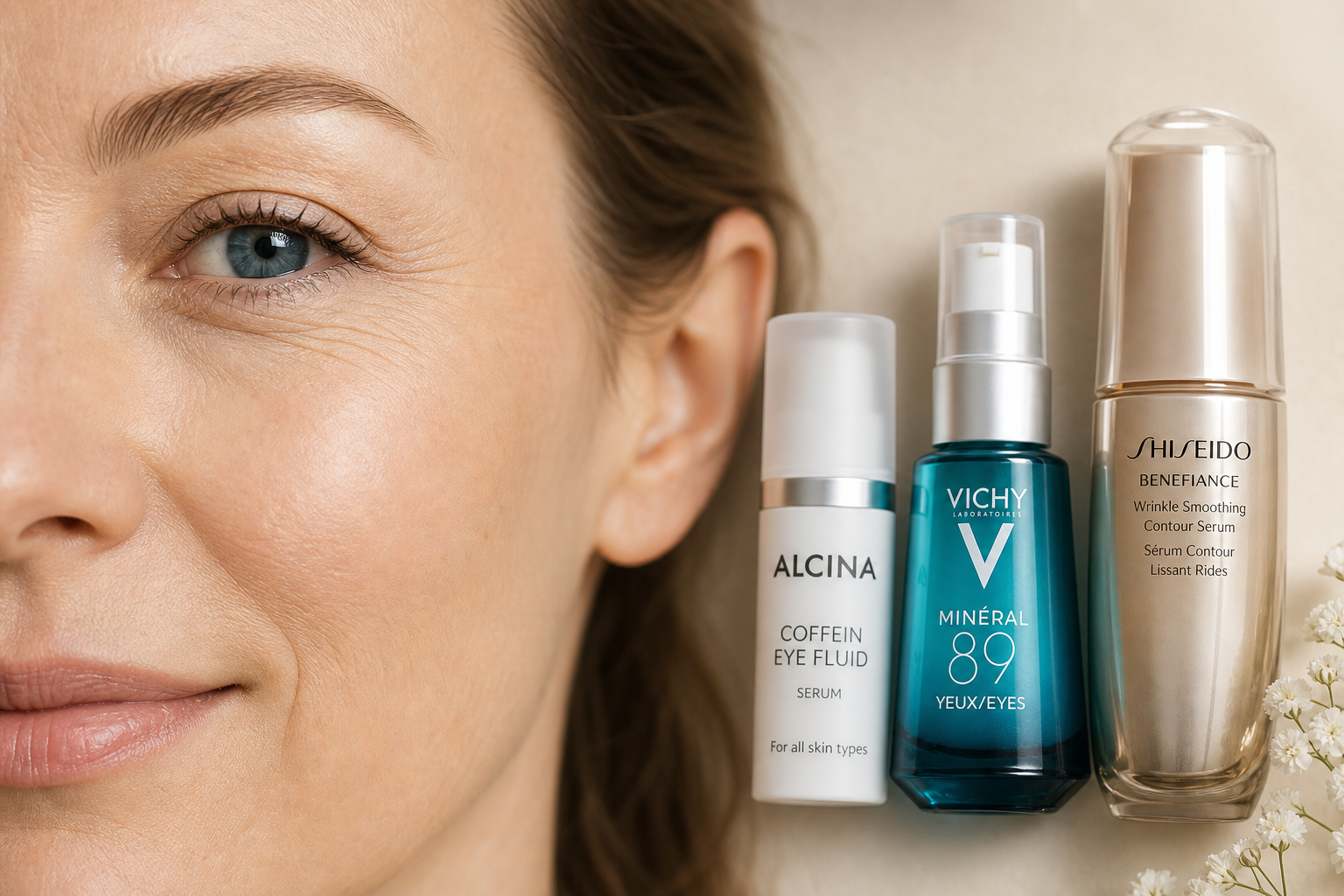
Caffeine addresses a different issue than wrinkles: morning puffiness and the feeling of heavy eyelids. It doesn't affect the depth of lines but works on short-term blood circulation and draining excess fluid, making it suitable for the morning routine and before makeup. A typical example from our range is the caffeine line by Alcina, specifically Alcina Coffein Eye Fluid.
Niacinamide and vitamin C work on uneven tone and dull skin. Niacinamide, or vitamin B3, is associated with strengthening the skin barrier and softening pigment spots, while vitamin C is linked to tone unification. Neither will remove dark circles caused by visible blood vessels or the shape of the eye socket – a concealer is more suited for that than a cream. From our catalog, Vichy Liftactiv B3 or La Roche-Posay Mela B3 Serum fit into this category.
To sum it up, here's a quick guide:
- fine dry lines and tightness – hyaluronic acid, glycerin, panthenol,
- loss of firmness and wrinkles visible at rest – peptides, retinol,
- morning puffiness and tired look – caffeine,
- uneven tone and pigmentation – niacinamide, vitamin C.
A final note that applies across all groups: the skin around the eyes is thinner and more sensitive than the rest of the face, so even a proven ingredient can irritate if in too high a concentration. Introduce new products one at a time, give them several weeks, and don't combine strong retinol with another active serum in the same evening. Cosmetics can improve the appearance of the eye area and slow aging, but no ingredient guarantees a specific result at a specific time – that's the difference between care and a procedure.
Six Eye Creams and Serums to Help Slow Down Aging
The area around your eyes doesn't need a miracle, but care that suits your skin and addresses your main concerns. That's why we've included six products in this selection that vary in format, texture, and price range—from more affordable dermocosmetics to concentrated serums from the higher end.
The difference between the various formats is worth mentioning before you dive into the selection. Eye cream is a classic and a universal starting point for most people: it has a medium-thick texture, stays in place, and is suitable under makeup and at night. Serums are usually lighter and more concentrated, absorb quickly, and often serve as an intermediate step before cream—ideal for those who find traditional eye cream too heavy. Richer balms are more suited for times when the skin is dried out from air conditioning, frost, or long hours in front of a screen.
Packaging also plays a role. A tube with a narrow neck or a metal applicator helps dispense a very small amount, and the cooling metal is soothing on morning puffiness. A jar usually offers a larger volume but requires clean hands or a spatula.
Price alone is not a guarantee of results. In our selection, you'll find both more affordable dermocosmetic options and pricier serums, whose higher cost typically reflects the concentration of active ingredients, packaging volume, or more sophisticated texture. The difference between them is often more about the comfort of use than the effectiveness of the cheaper option.
It's equally important to consider which skin type the product targets:
- Sensitive Skin – simpler formulations, gentle or no fragrance, and textures that don't irritate even when applied close to the lash line.
- Dry Skin – richer, more nourishing formulas that address tightness and fine lines caused by dryness.
- Mature Skin – products focused on loss of elasticity and more pronounced expression lines, usually with a higher concentration of active ingredients.
In the following selection, you'll find six specific recommendations across these profiles—from light serums to rich creams and across various price levels. Choose based on which description fits your skin best, not the order in the list.
How to Use Eye Care and Choose the Right One for You
Even the most carefully selected formula will only do part of the job if the product ends up in the wrong place or in too large a dose. The skin around the eyes is significantly thinner than the rest of the face, so the application rules differ. The following routine will take just a few seconds in the morning and evening.
How Much, Where, and in What Order to Apply
For both eyes combined, a rice grain-sized amount is sufficient. A larger dose won't speed up the results – it absorbs poorly, can easily get into the eye, and clumps under makeup. Divide it into three to four dots along the orbital bone, that is, along the bony edge of the eye socket about a centimeter from the lashes, not directly on the lower eyelid. The warmth of the skin will naturally spread the product closer to the eye.
Apply with your ring finger – it has the least pressure, so you're more likely to gently pat the skin. Don't drag your finger sideways, as this unnecessarily stretches the thin skin. Apply to the upper eyelid only if the manufacturer explicitly states so in the instructions.
The order of steps is determined by texture, from thinnest to thickest. After removing makeup and cleansing, apply eye serum, followed by eye cream, and finally face cream for the rest of the face. If you opt for retinol, it should be used exclusively in the evening routine, starting with two to three evenings a week until the skin gets used to it.
In the morning, sun protection has the final say – without it, much of the evening's efforts are wasted. A day cream with SPF, such as Uriage Age Lift SPF30 Protective Smoothing Day Cream, or a light spray for reapplication throughout the day, like La Roche-Posay ANTHELIOS Invisible Fresh Mist SPF 50+, will suffice.
Decision Key: What Bothers You Most About Your Look
Instead of searching for a universal product, first identify what you want to address. This makes it easier to choose the type of product:
- Puffiness and Tired Look – a lightweight gel fluid with caffeine, in the morning, ideally with a cooling metal applicator. It absorbs quickly and doesn't interfere with makeup; from the catalog, consider Alcina Coffein Eye Fluid 15 ml.
- Fine Lines and Dryness – a hydrating eye cream with hyaluronic acid, panthenol, or niacinamide. Focus on dermocosmetic lines from brands like Bioderma, Vichy, or La Roche-Posay, which have simple formulations and are suitable for sensitive skin.
- Mature Skin and Loss of Firmness – a richer cream with peptides or retinol, preferably for the evening. This includes Shiseido Benefiance Wrinkle Smoothing Eye Cream 15 ml or Nuxe Nuxuriance Ultra Eye And Lip Contour 15 ml, which treats both the eye and lip areas.
If you're dealing with two issues at once, combine a caffeine serum in the morning and a nourishing cream in the evening.
Also, manage your expectations. Cosmetics won't erase wrinkles – they slow their development, smooth the skin's surface, and improve hydration. You'll typically notice a smoother surface within one to two weeks, while changes associated with peptides or retinol are assessed after eight to twelve weeks of regular use. Expression lines, visible only when smiling, will remain.
Find the complete range in the Eye Care category on Brasty. If you're choosing based on budget, start with a lightweight caffeine fluid – it's more affordable and you'll quickly see if the morning treatment suits you. A mid-range option is a hydrating eye cream from a dermocosmetic line. And if you're addressing mature skin, it makes sense to opt for a premium eye cream with peptides. Wherever you start, consistency will achieve more than the price on the label.
Category
Recommended articles
"Give a girl the right shoes and she can conquer the world!" Marilyn Monroe