



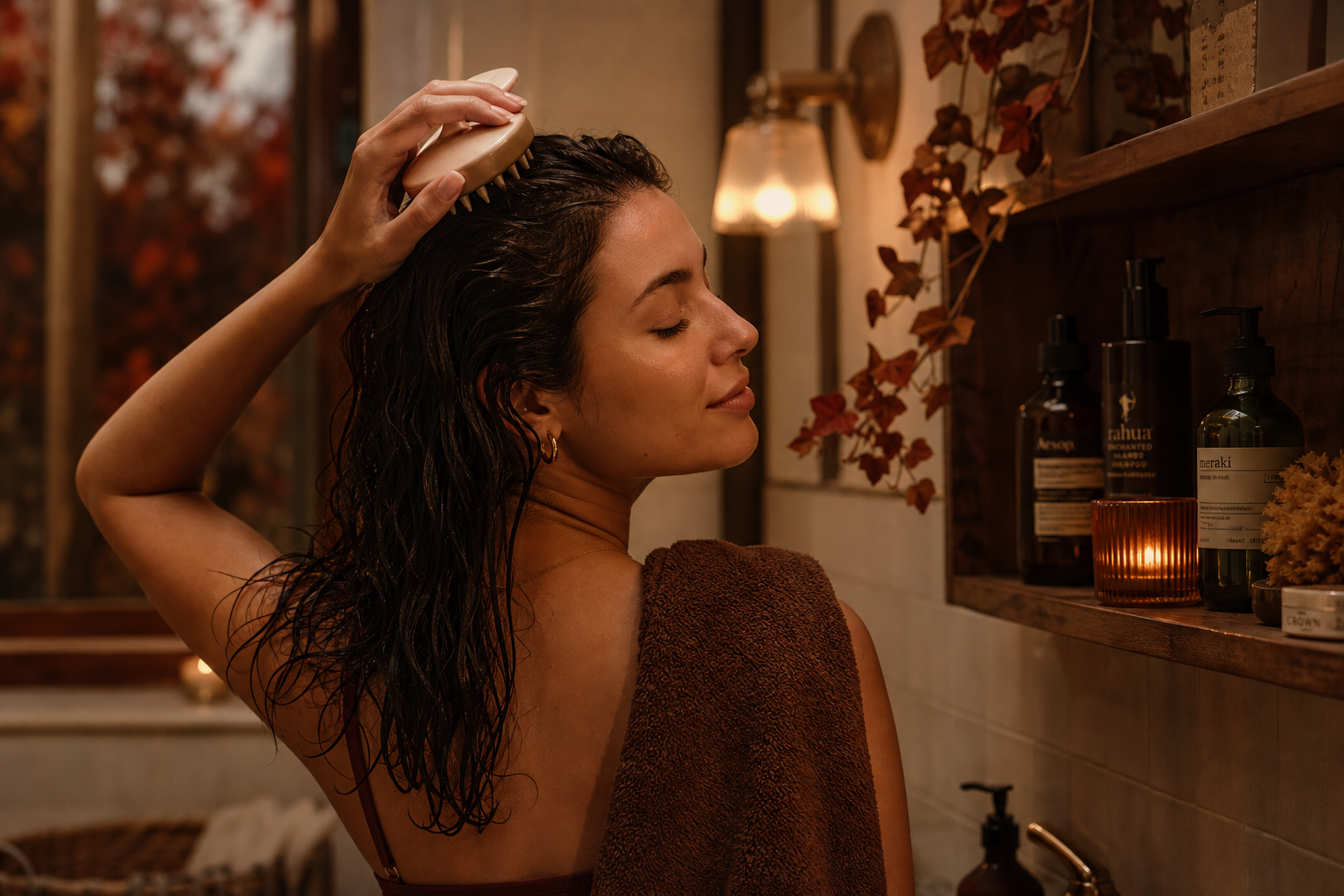
Why Your Scalp Protests in Autumn
Autumn affects your hair before you even get a chance to enjoy it. In September, your hair might hold its volume for two days, but suddenly your roots feel heavy the day after washing – or you might be surprised by itching while brushing, something you didn't experience over the summer. It's usually not one specific product to blame, but rather several factors coming together in one season.
Your scalp is skin like any other. You just don't see it or pay attention to it until it starts to make itself known. At the turn of the season, several things impact it at once:
- Dry air from heating. The difference between a heated interior and the cold outside dries out your skin all over your body, including your scalp. Dry skin flakes and itches more easily.
- Hats, scarves, and hoods. Hair doesn't breathe under them, roots get sweaty, and friction with the material makes hair limp. For some, this results in quicker greasiness, for others, irritation.
- Longer showers in warm water. Hot water feels nice in November, but it washes away more than just dirt and styling residues from your skin.
- Change in routine. Light summer products are set aside, replaced by richer masks and more intense styling – and the scalp gets neglected.
That's why autumn issues manifest in two seemingly opposite ways. Some complain about tight, itchy skin and white flakes on dark sweaters, while others find their roots get greasy faster than in summer. The common denominator is the same: the balance of the scalp is off, and the care that worked in July is no longer sufficient.
The good news is that fixing this doesn't require a salon appointment. A head spa, a ritual focused solely on the scalp, can be done at home in a shortened form. It only takes three steps that follow one another:
- Massage brush – a short massage before washing or directly in the shower, which relaxes the scalp and helps break down styling product build-up.
- Scalp shampoo – a different type of product than shampoo meant for lengths. It addresses what's happening at the roots, not how the ends look.
- Scalp serum – a leave-in step that maintains results between wash days.
If you're looking for specific lines, a good starting point is Wella Professionals SP Balance or Vichy Dercos. Both focus on scalp care but approach it differently: the first is a professional hairdressing line, the second is dermocosmetics. We'll discuss exactly how they differ and how to choose between them further in the article.
And one more thing to know in advance – this ritual won't take much of your time. The brush massage takes two to three minutes, the serum is applied in a few seconds, and you simply swap shampoos, not add an extra step. So, once a week, you invest about five minutes, and the rest happens during washing, which you'd do anyway.
Head Spa at Home: The Benefits of a Massage Brush
The concept of a head spa comes from the salon world, focusing on concentrated care for the scalp – an area we often neglect with just a couple of motions during regular washing. The home version is simpler, but the principle remains the same: first, you warm and relax the scalp, and only then do you apply treatment. That's why the massage brush, not shampoo, is the starting point of the entire ritual.
Scalp massage has three practical effects. Firstly, it mechanically warms and moves areas that are often compressed under a hat or hair tie all day – most people experience this as an immediate release of tension around the temples and crown. Secondly, it helps loosen dead skin and styling residue, making the scalp easier to clean. And thirdly – playing a key role in the autumn ritual – it spreads the product evenly across the entire area, rather than leaving it in three drops above the forehead.
How a Massage Brush Differs from a Detangling Brush
A detangling brush is designed to glide through lengths and untangle knots, so it's densely packed with thin bristles. A massage brush serves a different purpose: it’s meant to touch the scalp, not the hair. You can recognize it by several features.
- Softer and more flexible bristles with rounded ends – they bend under pressure, gliding over the scalp instead of scratching it.
- Less dense bristle arrangement – there's space between the bristles to prevent the brush from snagging on wet hair and pulling it.
- Ergonomic design for the hand, often without a traditional handle – a compact shape fits in your palm, allowing you to press straight down, not at an angle.
- Water resistance and a smooth surface – you use the brush in wet hair, with shampoo or treatment, so it must withstand rinsing under running water and dry quickly.
- Easy to clean – no fabric padding or deep grooves where grease and product residue could accumulate.
You can find brushes in the Accessories category on Brasty. Among the available brands, two are particularly suitable for this type of care. Tangle Teezer features flexible dual-length bristles, and its models designed for wet hair (Wet Detangler range) can handle both – gliding through lengths and massaging the scalp without needing to press hard. Olivia Garden offers a more professional line with a wider range of shapes and materials; ideal if you want a brush that does more than just massage in your hair routine. Both brands offer compact models without long handles, perfect for a home head spa.
Pressure and Technique: How to Massage Without Irritating Your Scalp
The most common mistake is aiming for the strongest effect possible. The scalp is thin and quickly shows irritation – it burns, itches, and becomes greasy faster than usual the next day. Stick to three rules.
- Apply gentle and consistent pressure. The bristles should bend slightly, not dig in. If you hear scratching, you're pressing too hard.
- Move the skin with the brush, not the brush over the skin. Short circular motions that move the skin under the bristles release more tension than long, fast strokes from top to bottom.
- Work in sections. Start from the forehead to the crown, then work on the temples, and finally the nape and neck. Go over each area two to three times; overall, it should take you two to three minutes.
You can massage dry before washing or in wet hair with shampoo. Dry massage is more pleasant for tension relief, while wet massage cleanses better. If you have sensitive skin or are dealing with dandruff, stick to a shorter and gentler version and use the brush twice a week rather than daily. Rinse the brush after each use and let it dry with the bristles facing down.
Shampoo for the Scalp as the Foundation of Your Ritual
A scalp massage awakens the skin, but on its own, it's not enough. If a layer of sebum, styling residue, and dead skin flakes remain on the scalp, subsequent care has nowhere to work – the serum will spread over a surface that doesn't absorb it. That's why shampoo is at the heart of the entire ritual: it's the step that prepares the scalp and determines whether the autumn care will be pleasant or rather irritating.
Lengths and Scalp Are Not the Same
Most of us wash our hair by spreading shampoo in our palms and applying it along the entire length. In a scalp care ritual, it works the other way around. Shampoo is primarily for the scalp – apply it in small amounts directly to the roots, distribute it in several places, and massage it in with circular motions using your fingertips. The lengths then only need what flows over them during rinsing. This way, you avoid unnecessarily strong washing of the dry ends, which are most sensitive in autumn, and save them for conditioner or a mask.
The second thing worth changing is the water temperature. Lukewarm water doesn't dry out the scalp as much as hot water, and half a minute of gentle massaging while lathering does more for blood circulation than a quick rub. Then rinse the shampoo thoroughly; product residues on the scalp are a common cause of unpleasant itching.
Choosing Based on What the Scalp Does
Select shampoo based on the condition of your scalp, not your hair type – address that in the subsequent care steps. Three situations cover most autumn issues:
- Sensitive, tight, or itchy scalp. Look for a shampoo specifically for the scalp, not for volume or color. From professional lines, Wella Professionals SP Balance Scalp Shampoo is suitable for this situation – it cleans gently and keeps the scalp calm, so you can use it even with frequent washing.
- Dandruff and flakes on the shoulders. General care isn't enough here, and it's worth opting for a dermatological line. Vichy Dercos offers several anti-dandruff options depending on whether the scalp is more dry or sensitive. Choose the one that matches your condition and use it according to the instructions on the package.
- Tired roots and lifeless hair. If you're mainly troubled by an overall limp appearance, try energizing compositions – for example, Davines Natural Tech Energizing Shampoo, which targets the scalp and roots.
If you're unsure, start with the mildest option. A shampoo for sensitive scalp won't harm even healthy skin, while a specialized anti-dandruff product used "just in case" might be unnecessarily strong.
How Often to Wash During Heating Season
Dry air from radiators and wearing a hat all day change the scalp's balance faster than in summer. However, this doesn't automatically mean washing less often. A reasonable compromise is washing every second or third day; if your scalp gets oily quickly or you sweat under a hat, feel free to wash more often, but with a shampoo designed for regular use. The opposite extreme, trying to go as long as possible without washing, won't help the scalp – sebum and styling residues accumulate exactly where the serum is supposed to penetrate later.
Shampoos are the most extensive part of our hair care range, so you can choose across price levels and volumes, from smaller trial sizes to liter-sized professional bottles. When you find a shampoo that keeps your scalp happy, it's worth sticking with it for the entire season; only on such a stable foundation does it make sense to build the next step of your ritual.
Scalp Serum: A Step That Stays
Shampoo stays on your scalp for just a few seconds before you rinse it off, taking most of its work with it. Serum works the opposite way: you apply it and leave it right where it needs to act – directly at the roots. That's why it's worth including in your autumn routine. Washing prepares the scalp, massage stimulates circulation, and the serum continues to work even when your hair is just under a hat.
Scalp serums have a different role than treatments for hair lengths. They don't smooth ends or add shine but take care of the environment from which hair grows – addressing dryness, tension, oiliness, or itching. The texture is usually watery to slightly gel-like, so it absorbs quickly without leaving a greasy film on the hair. Unlike hair oil, you won't feel the serum on your scalp after a few minutes; it only shows in how your scalp feels throughout the day.
Light Energizing Serums for Everyday Use
The first group consists of serums that refresh the scalp and support it in daily life without weighing down the hair. A typical example is Wella Professionals SP Balance Scalp Energy Serum 100 ml, one of our best-selling serums in hair care. It's applied without rinsing, has a light consistency, and leaves volume at the roots, so you can use it in the morning before heading out. It makes sense when the scalp isn't dramatically irritated, just feeling tired and dried out from heating in autumn.
Intensive Treatments for Noticeably Thinning Hair
The second group is more targeted. It's not about everyday routine but a treatment with a clear start and end, used according to instructions for several weeks in a row. In this category is Vichy Dercos Men Aminexil Clinical 5 21x6 ml – dermocosmetic ampoules for men, applied directly to the scalp without rinsing. The individual dose packaging has a practical advantage: you don't need to guess the amount, and it's easy to maintain the regularity on which this type of care relies. Results are evaluated after months of use, not weeks. And if thinning is due to hormonal or health reasons, the first step is to see a doctor.
How to Apply Serum to Reach the Right Spot
Application by strands isn't unnecessary pedantry. Serum dropped on top of the hairstyle ends up on the hair, not the scalp – and that's where it's useless. The whole process takes two to three minutes:
- Work on damp skin after washing and towel drying, when partings hold.
- Divide hair with a parting, apply along its entire length, then move it two to three centimeters further. Go through the whole head, not just the crown.
- Use sparingly: for leave-in serums, a few drops on the parting are enough, for ampoules, use exactly one dose for the whole head.
- Massage in with the fingertips in circular motions, for a minute or two. Save the brush for the pre-wash phase – the serum spreads unevenly with it.
- Let it dry and do not rinse. Set the hairdryer to a lower temperature and aim at the lengths, not directly at the scalp.
Oily Scalp vs. Dry and Itchy
The choice of serum depends on how your scalp behaves between washes. If it's oily, opt for watery, fast-absorbing formulas and use less – an over-oiled scalp reacts with even more oil production. Apply only to the scalp, avoid the lengths, and set the frequency to every other day if needed.
Dry, tight, or itchy scalp can handle a higher frequency and richer texture. It's worth choosing soothing serums without strong fragrances and pairing them with gentle washing, as even a good serum can't compensate for an overly aggressive shampoo. If itching is accompanied by flaking that doesn't improve after several weeks, a dermatological consultation is advisable.
A Few Minutes a Week: Create a Ritual with Three Products
A scalp care ritual doesn't require a shelf full of bottles. All you need are three items – a massage brush, a shampoo specifically for the scalp, and a leave-in serum – along with a plan you can stick to even during a hectic week. Consistency matters more here than the price of individual products.
How to Spread Three Steps Throughout the Week
- Longer Brush Massage Once a Week – five to ten minutes on dry hair before washing, perhaps in the evening while watching a show. Consider this your main head spa moment of the week, not just a quick detangle.
- Scalp Shampoo Two to Three Times a Week – lather it mainly at the roots, the lengths will get their share during rinsing. Between these washes, feel free to use your regular shampoo.
- Serum After Every Wash – on towel-dried hair, along the partings, and briefly massage with your fingertips. This step takes a minute and is also the most often skipped.
In practice, this means one longer evening a week and then just a few extra touches during regular washing. If you prefer having a fixed point in the week, anchor the massage on a Sunday – this way, you won't have to renegotiate the ritual every week.
Two Shopping List Variants
The shopping list always has three lines: brush, shampoo, serum. The difference is whether you want a more salon-like care or a dermatologically inclined one.
More Affordable Set Around the Wella Professionals SP Balance Range. Pair a brush with flexible bristles – like the Tangle Teezer Wet Detangler or a model from Olivia Garden – with Wella Professionals SP Balance Scalp Shampoo and Wella Professionals SP Balance Scalp Energy Serum. This combination is for skin that is more sensitive, gets greasy quickly, or is affected by dry air, without dealing with a dermatological issue.
More Dermatologically Inclined Set Around the Vichy Dercos Range. The brush remains the same, but choose the shampoo according to the symptoms – for dry dandruff, Vichy Dercos Anti-Dandruff Dry Hair Dermatological Shampoo is recommended. The role of a more intensive step is then taken by the Vichy Dercos Men Aminexil Clinical 5 ampoule treatment. This option is pricier and more suitable for those dealing with recurring dandruff or thinning hair and want care with a clearly defined purpose.
Both sets can be mixed. The brush is universal, and there's nothing stopping you from buying a shampoo from one range and a serum from another – the important thing is that both steps target the same issue.
What to Expect After the First Few Weeks
Let's be realistic: the scalp responds to changes in care over weeks, not days. During the first two to three weeks, the feeling of tension and the urge to scratch usually subsides first, as the washing frequency stabilizes and you stop irritating the scalp with inappropriate procedures. Changes in the hair itself are visible much later, and no one can promise them in advance – hair grows at its own pace, and cosmetics can improve the environment but won't rewrite it.
There is also a limit beyond which cosmetics are not enough. Make an appointment with a dermatologist if any of these situations occur:
- severe itching, burning, or tenderness persists even after several weeks of adjusted care,
- weeping, bleeding, or heavily flaking patches appear on the scalp,
- hair falls out in significantly larger amounts or defined thinning areas appear,
- dandruff returns regardless of the shampoo you choose.
The last step is the simplest: assemble your ritual according to your own budget. Look for the brush among accessories, the washing step in the shampoo category, and the leave-in care among hair serums. Three items, a few minutes a week – and autumn will leave a much less noticeable mark on your scalp than usual.
Category
Recommended articles
"Give a girl the right shoes and she can conquer the world!" Marilyn Monroe