
Why Advice on Home Hair Coloring is So Conflicting
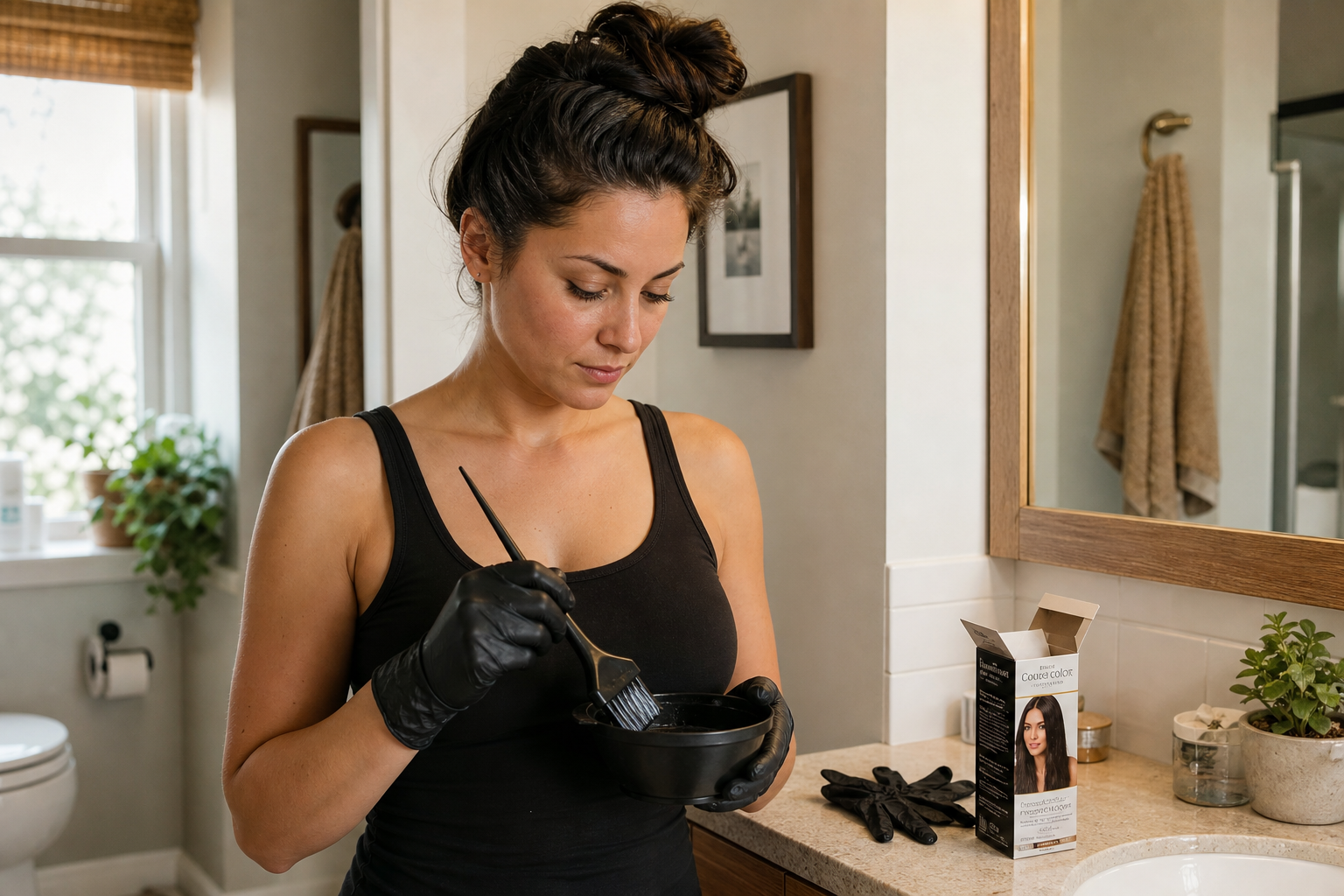
Anyone who has ever dyed their hair at home knows this situation. The box contains a simple set of instructions: apply, leave on, rinse. But as soon as you search for the same question online or ask it in a discussion, you get five different answers that contradict each other. One suggests washing your hair the day before, another says not to wash it for a whole week. One claims that gray hair needs to be prepped beforehand, while another says just to extend the processing time. And both describe experiences that the writers have genuinely had.
The explanation isn't that someone is lying. Coloring is a chemical process, and its outcome depends on the initial conditions—which can vary much more between two people than it seems at first glance. The same color from the same package can therefore create the exact shade on the box for one reader and end up two tones different for another.
The differences have several recurring sources:
- Initial color and its history. Hair that has never been dyed reacts differently than hair that has been colored, highlighted, or bleached multiple times. The product works with what is actually on your head, not what is pictured on the box.
- Hair porosity. Hair with a damaged outer layer absorbs pigment faster but also loses it just as quickly. That's why the same shade can last months for one person and fade after just a few washes for another.
- Type of product used. Permanent color, demi-permanent color, and toning products penetrate the hair at different depths. Advice that applies to one might be misleading for another—and this difference is almost never mentioned in discussions.
- Application conditions. Room temperature, the amount of color, the thickness of separated strands, and the speed of application all affect how evenly the reaction occurs. At home, these parameters change from coloring to coloring, whereas in a salon, they are more stable.
When two different combinations of these factors come together, two different results emerge. Both experiences are true, they just describe different starting conditions. The problem arises when an individual experience becomes a general rule and starts being passed on as fact—without the conditions under which it originally worked.
In the following sections, we will evaluate each statement using a simple criterion. We will try to categorize each piece of advice into one of three groups:
- Based on the chemistry of coloring. Applies regardless of hair type because it describes the basic principle of the reaction.
- Conditionally valid. Works only for certain porosity, a certain initial shade, or a certain type of product—and outside these conditions, it stops making sense.
- A tradition passed down. The statement is repeated over generations, but there is no verifiable support for it.
The goal is not to decide who was right in a particular discussion. It's more useful to give you a framework in which you can advise yourself next time: when you encounter conflicting advice, you'll know what to ask—what was the initial shade, what condition was the hair in, and what type of product was used. Without these three pieces of information, most advice on home hair coloring is just a shot in the dark.
What Really Happens to Hair During Coloring
Most misunderstandings about home hair coloring stem from one misconception: that color behaves like paint, applied to the surface and left to dry. In reality, it's a chemical reaction occurring within the hair fiber. Once you understand what's happening inside the hair, it's easy to discern which claims in discussions make sense and which are mere myths.
Hair Structure: Cuticle, Cortex, Pigment
The outer layer of the hair is the cuticle – scales that overlap like roof tiles, protecting the fiber's interior. Beneath it lies the cortex, the thickest layer containing natural pigment, melanin. Melanin determines whether hair is brown, blonde, or red. The color must penetrate the cuticle to reach the cortex; otherwise, it will last only a few washes.
Permanent color achieves this with two components mixed just before application. The alkaline component, usually ammonia-based, raises the pH and causes the cuticle scales to lift, allowing active ingredients inside. The oxidizing agent, typically hydrogen peroxide, then breaks down some natural pigment in the cortex and initiates a reaction that assembles larger colored molecules from small colorless ones. These molecules are too large to pass back out, which is why permanent color doesn't wash out but grows out.
Permanent Color, Demi-Permanent Color, Toning Product
Confusing these three categories accounts for much of the disappointment with home coloring. The difference lies in one thing – how deeply the product penetrates.
- Permanent color uses a higher concentration of oxidizing agent and an alkaline environment. It can lighten, cover grays, and significantly change the shade. It doesn't wash out, so there's a visible transition at the roots.
- Demi-permanent color, sometimes labeled as ammonia-free, contains a weaker oxidizing agent and milder alkaline component. The pigment penetrates the hair but holds less firmly and gradually washes out. It can't lighten the natural shade – it lacks the strength to break down melanin.
- Toning product, such as a toning shampoo, mask, or foam, deposits pigment mainly in the outer layers of the fiber. It doesn't alter the internal structure, so it washes out the fastest. It's used to refresh the shade and neutralize unwanted tones, typically the yellow undertone in lightened hair.
The practical conclusion is simple. If you expect a toning shampoo to take you from brown to blonde, you'll be disappointed – not because the product doesn't work, but because it doesn't have the tools for that job.
Why Lightening Strains Hair Differently Than Darkening
Lightening and darkening aren't two directions of the same path. When darkening, pigment is added to the hair – the cuticle opens, but the melanin largely remains. In lightening, however, pigment is broken down, and the more shades you want to lift, the longer and more intensely the mixture must work. Besides melanin, it also affects the keratin bonds that give hair strength and elasticity.
This explains the difference you notice in practice. Darkened hair usually loses only some shine, whereas significantly lightened hair tends to be porous, harder to comb, and more prone to breakage. The damaged cuticle doesn't close completely, so the fiber retains moisture and subsequently applied pigment less effectively. After significant lightening, it makes sense to consider different home care than after simply refreshing the tone.
This foundation also serves as a benchmark for the rest of the article. Whenever you encounter claims about washing hair, grays, or color over color, verify them with a single question: what must be true inside the hair for that advice to make sense?
Myths About Preparation: Washing Hair, Greasiness, Allergy Test
Preparation is the phase where home dyeing often follows advice passed down from generation to generation. Most of these once made sense – but the composition of dyes has since changed. Let's go through the three most common claims and the details that are often shortened in instructions.
"You must not wash your hair before dyeing"
This advice is one of the most frequently repeated and probably originates from a time when home dyes were more irritating than they are today. The assumption was that unwashed skin covered with sebum would reduce unpleasant burning. Today's creamy formulas work with different buffering and soothing ingredients, so the original reason no longer applies to the same extent.
The practical core of the advice remains, but for a different reason: most manufacturers state application on dry and unwashed hair because dry hair is easier to separate into strands and the dye doesn't slide off. A reasonable compromise is to wash your hair a day or two in advance.
"Grease protects the scalp"
Sebum is a very thin layer, not a protective barrier. One unwashed day won't change the result, but three days without washing won't protect the scalp from the oxidative mixture – it will only make the work harder. A stronger film from styling products, typically from hairspray, mousse, or dry shampoo, can actually prevent even application of the dye and result in uneven color.
So if you've used dry shampoo or heavy styling a few days before dyeing, it's better to wash your hair and dye it later, ideally the next day. Just before dyeing, skip rich masks, oil treatments, and leave-in products with a strong consistency – their film is more of a hindrance during application. Your regular care routine should resume after dyeing.
"An allergy test is an unnecessary formality"
This is the only preparation step where it's pointless to look for shortcuts. Manufacturers of oxidative dyes include a tolerance test in the instructions and recommend repeating it before each dyeing, even if you've used the same shade many times – sensitivity to some ingredients can manifest after years of use. The habit "same color, no need to test" doesn't cover this scenario.
The specific procedure always follows the instructions for the given dye. It usually involves a small amount of mixed product applied to the skin behind the ear or in the crook of the elbow, with a waiting period of about 48 hours. If redness, itching, burning, or swelling occurs, do not use the dye and consult a doctor.
Details That Instructions Omit
Besides the myths themselves, instructions often omit small details that determine how evenly the color will set:
- Combing in advance. Thoroughly comb your hair before mixing the dye. In tangled strands, there are spots where the mixture won't reach, and that's exactly where lighter spots will appear.
- Dividing into sections. Four sections – two front and two back – separated with clips provide a much more even result than applying "from top to bottom." Work with thin strands, not large sections.
- Protecting the hairline. A thin layer of greasy cream along the forehead, ears, and nape will prevent dark edges from remaining on the skin. Do not apply cream to the scalp.
- Gloves and timing. Gloves should be worn from the moment you start mixing the dye. Use the mixed product immediately, unless the instructions explicitly state otherwise.
- Monitoring processing time. Count from the completion of the application, not from the start. With longer hair, there can easily be a ten-minute difference between the first and last strand.
In summary: you can do without freshly washed hair, but not without careful combing and sectioning, and never skip the allergy test.
Coloring Results: Grey Hair, Henna, Color Over Color
Disappointment with home coloring usually doesn't occur during application, but when looking in the mirror three weeks later. The result is tied to many claims passed down from generation to generation – many of which describe formulations from twenty years ago rather than today's box contents.
"Color over color never matches." This statement is simplified. Color doesn't bleach artificial pigment already in the hair: if your lengths are dyed dark and you want a result several shades lighter, a cream color alone won't manage it. Recoloring to the same depth or a darker shade, on the other hand, is usually without problems. The most common consequence of repeated coloring is not "doesn't match," but unevenness – lengths saturated with pigment from previous colorings take the color differently than fresh regrowth. The solution isn't more color, but distribution of application: first the regrowth, then the lengths in the final minutes of processing.
"Henna and chemical color must not meet." There's a kernel of truth here, but not in the form the myth circulates. Problematic are composite hennas, to which metal salts are added for a richer color – these can react unpredictably with an oxidizing agent. Pure henna doesn't behave this way, yet color lays differently under it: it coats the hair, so the result of chemical coloring is often muted or uneven. If you don't know the exact composition of your henna, test the color first on a cut strand.
"Grey hair can't be covered at home." Grey hair lacks melanin, is usually coarser, and has a more tightly closed cuticle, so it absorbs pigment more slowly. However, this doesn't mean home coloring doesn't work – grey hair just needs permanent color, the correct processing time, and shades with a higher proportion of natural, neutral tones. Toning products and demi-permanent colors tend to lighten them to a warmer hue rather than fully cover them. For more resistant greys around the temples, it helps to start the application right there.
"Darker shades always last longer." It's not the darkness that matters, but the size and stability of pigment molecules. Red and copper pigments are among the bulkier ones and wash out of the hair more quickly, so vibrant red fades faster than dark brown. Cool, ashy shades lose their neutralizing component, revealing a warm undertone that was always in the hair. Factors contributing to color shift include hot water, frequent washing, sun, chlorinated water, and heat styling.
What can home care do about it? A toning mask contains direct pigments that deposit into the surface layers of the hair and correct the shade for several washes: a yellowish tint is countered by purple or pearl pigment, faded copper is revived by a copper variant. It's not a new color, but a temporary correction. A shampoo for colored hair uses gentler surfactants and a lower pH, so it doesn't open the cuticle as much; it won't stop fading, but it can extend the interval between colorings.
You can handle a large part of the work at home, but there are situations where visiting a hairdresser is more worthwhile than experimenting:
- lightening by more than two shades, especially from previously colored lengths,
- removing an unwanted shade, such as brassy or greenish,
- transitioning from henna or unknown composition color to chemical coloring,
- combining coloring with chemical straightening or perming,
- hair that is brittle and visibly porous from previous treatment.
It's not that home color is of lesser quality. It's about interventions where any potential mistake is harder and more expensive to correct than with regular regrowth recoloring.
Bonding Products like Fibreplex: What They Can and Can't Do
Bonding products are a topic where opinions vary widely. Sometimes they're talked about as a safeguard that makes bleaching harmless, other times as a marketing gimmick. The reality can be described objectively – it's just a matter of separating what manufacturers claim from what we assume ourselves.
How Bonding Technology Works
The shape and strength of the hair fiber are maintained, among other things, by cross-links between protein chains inside the hair. Chemical coloring, and especially bleaching, stress these bonds: the higher the lightening, the greater the impact. Bonding products – represented in professional ranges by lines like Schwarzkopf Professional Fibreplex – are added directly to the coloring or bleaching mixture, or applied as a separate step immediately after rinsing the color. Manufacturers state that they are supposed to act on these bonds during the chemical process, thereby reducing the stress on the fiber.
Bonding is not a treatment you add on top of finished coloring like a mask. Most systems are designed so that the first component is mixed into the mixture and the second is applied immediately after rinsing. Therefore, read the instructions before you start mixing the color – the order of steps plays a bigger role here than with regular hair cosmetics.
What Bonding Products Can Really Do
- They are designed as a supplement to the chemical process, not as a standalone treatment. They make sense mainly where lightening or highlighting is involved.
- The declared benefit is reduced stress on the fiber during coloring – meaning hair that breaks less and is easier to comb after the procedure.
- For darker shades, where only toning or root touch-ups without lightening are involved, the benefit is smaller.
What Bonding Products Can't Do
- They won't restore hair that is already damaged. They work during the procedure, not retroactively on previously damaged lengths.
- They are not a license to lighten hair by five tones at once. If your stylist recommends spreading the lightening over multiple visits, bonding won't change that.
- They don't guarantee the shade. The result still depends on the base, processing time, and how evenly you apply the color.
- You can't verify at home that it worked. You'll only judge it by how the hair behaves after coloring.
Post-Coloring Home Routine
Whether you use bonding or not, the outcome is mainly determined by subsequent care. Just three steps:
- Shampoo for colored hair. Cleanses more gently and is formulated to make the pigment last longer – like Wella Professionals SP Color Save Shampoo.
- Mask or leave-in treatment. A mask once or twice a week nourishes the hair, while a leave-in milk like Milk_Shake Incredible Milk is suitable for daily use. For lengths stressed by lightening, Wella Professionals SP Luxe Oil Keratin Restore Mask is a good choice.
- Toning product according to shade. Refreshes the color between colorings and postpones the next chemical procedure.
Guidelines by Shade
- Blonde and highlights. The main concern here is warm yellow tones. An anti-yellowing shampoo, such as Kemon Actyva Colore Brillante Anti-Yellow Shampoo, or a toning mask like Wella Professionals Color Fresh Mask Pearl Blonde can help. Alternate them with regular shampoo, otherwise, the shade may turn gray-blue.
- Dark and copper shades. Here, saturation is most often washed out. Color-refreshing lines like Lakmé Teknia Color Refresh balance the shade without reaching for another oxidative color.
Bonding products are thus a useful tool, not magic. Combined with a sensible approach and simple home care, they give hair a good starting position. However, they don't serve as an excuse for more daring lightening than the hair can handle.
Category
Recommended articles
"Give a girl the right shoes and she can conquer the world!" Marilyn Monroe