
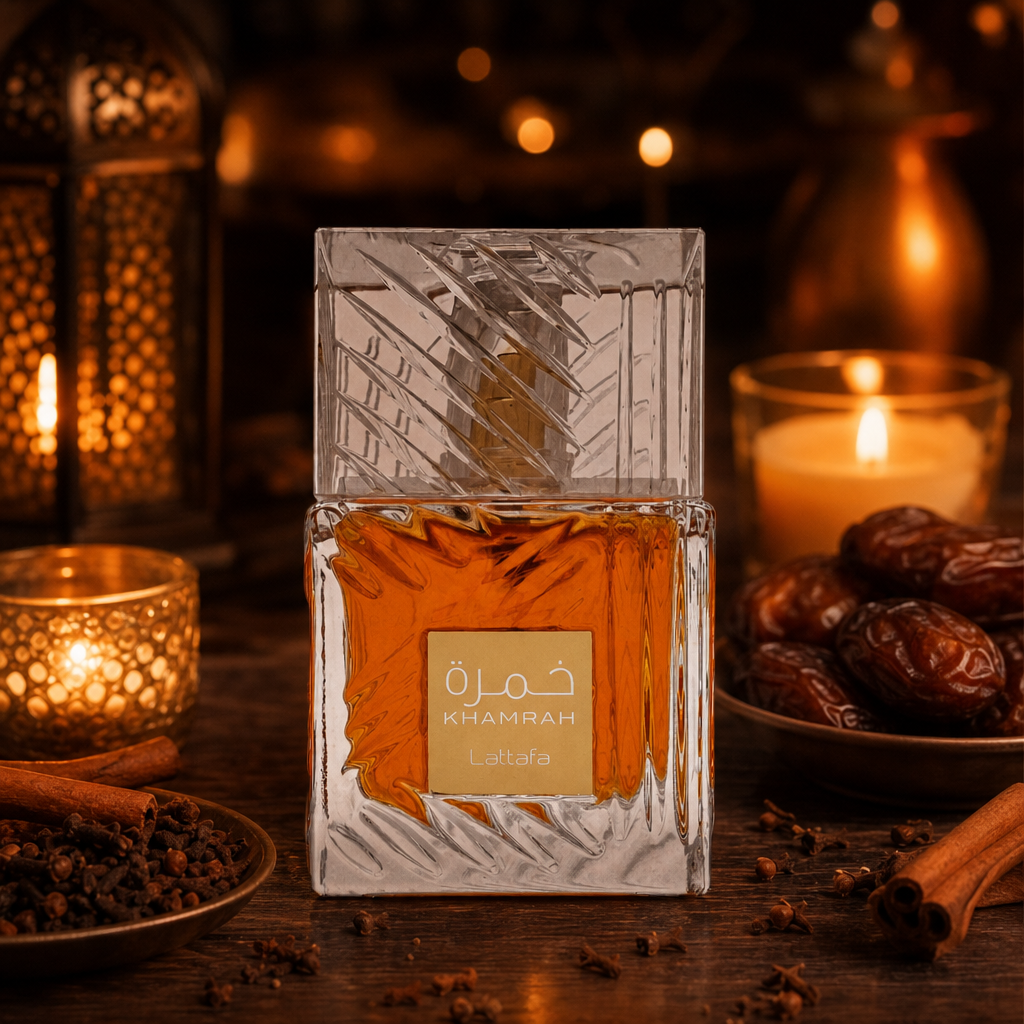

Lattafa Khamrah is one of Brasty's best-selling perfumes, but the catalog includes a whole range of related scents. We'll guide you through the differences between Khamrah, Khamrah Qahwa, and six other fragrances from the same family — and how to choose the right one according to the season and your taste.
Why Khamrah Has Become a Benchmark for Gourmand Perfumes
If you've ever been captivated by Arabian perfumery, you know the situation. You have a bottle of Lattafa Khamrah at home, it works perfectly, and you can't fault it. But then, while browsing the catalog, you come across a name that looks almost the same—just with one extra word. And suddenly, there's the question of whether it's the same fragrance in a different package or a composition that deserves a spot on the shelf next to the original.
Khamrah is not just a random item in the catalog. Lattafa is currently our strongest brand in perfumes by market share, and the Lattafa Khamrah Eau de Parfum (unisex, 100 ml) remains one of the best-selling perfumes in the entire Brasty portfolio. This alone isn't a reason to buy it—but it does explain why a whole family of related versions has gradually formed around this fragrance and why it's discussed as a benchmark to which other gourmand compositions are compared.
The gourmand fragrance family plays a part in this. These are perfumes that work with sweet, food-inspired notes—vanilla, caramel nuances, spices, tonka bean. Vanilla and tonka bean are notes that hold a consistently strong position in our perfume range, and Khamrah has managed to blend them with the warm, spicy character that is a native language in Arabian perfumery. The result is a fragrance that many people fall in love with at first spray, and it's distinctive enough for its wearers to be remembered by those around them.
However, with such recognizable fragrances, an interesting problem arises. When one composition is so characteristic, you wear it to work, dinner, and weddings—and after a few months, you start to feel that it suits some situations more than others. This article explores the option of choosing a related fragrance from the same family that retains the same olfactory DNA but shifts one or two parameters.
So the question isn't whether Khamrah is a good choice. It's this: is it worth having more than one fragrance from the same scent family on your shelf? Our experience with this range says yes—but only if you clarify in advance what criteria you're selecting by. In practice, it usually comes down to three axes:
- Intensity and sweetness — some variants of the same concept are richer and more syrupy, while others tone down the sweetness and let the spices or wood come through.
- Seasonality — a warm, heavy fragrance feels different on a freezing January evening than on a sweltering July afternoon.
- Occasion — one fragrance might be your everyday office choice, another exclusively for evenings.
These three axes will guide you in everything that follows. The differences between related fragrances from the same family tend to be subtler than they appear from the name on the bottle, yet significant enough that two similar compositions on your shelf don't serve the same purpose. The goal is clear: instead of two nearly identical bottles, end up with two fragrances that complement each other.
The Fragrant DNA of the Original Khamrah: Spices, Sweet Base, and Tonka Beans
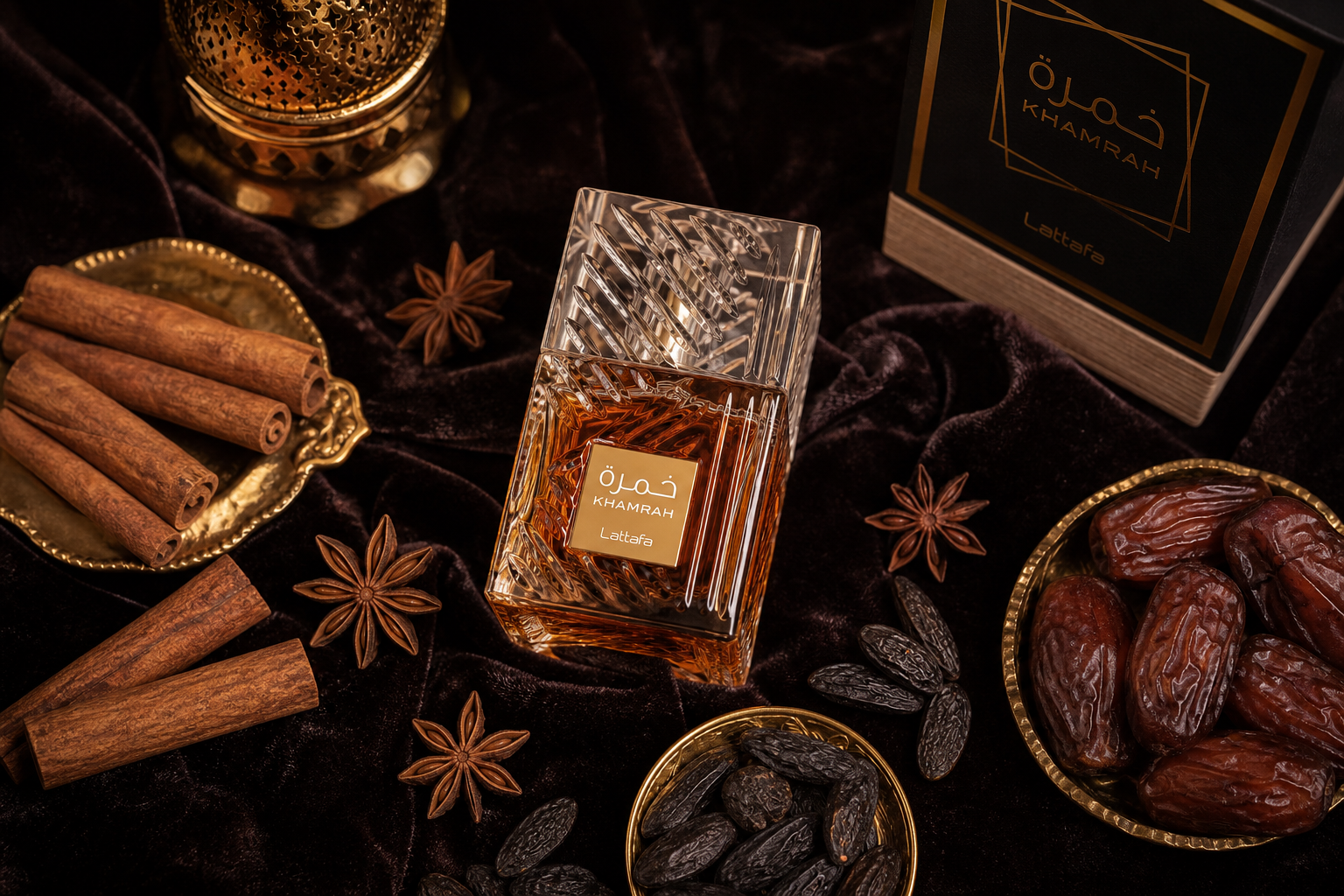
Before we start comparing the different variants, we need a common vocabulary. And the easiest way to acquire it is through the original Lattafa Khamrah Eau de Parfum — it sets the standard for what we will perceive as deviations, intensifications, or reductions in the other family members. If you remember its structure, you'll be able to describe each subsequent variant in a single sentence.
Khamrah stands at the crossroads of two fragrance families: oriental and gourmand. The oriental component brings spices, amber, and a resinous depth, while the gourmand aspect adds a sweetness reminiscent of dessert. This duality is key — it explains why Khamrah can feel both festive and comforting, and why it is worn by both men and women. In our catalog, we list it as a unisex perfume.
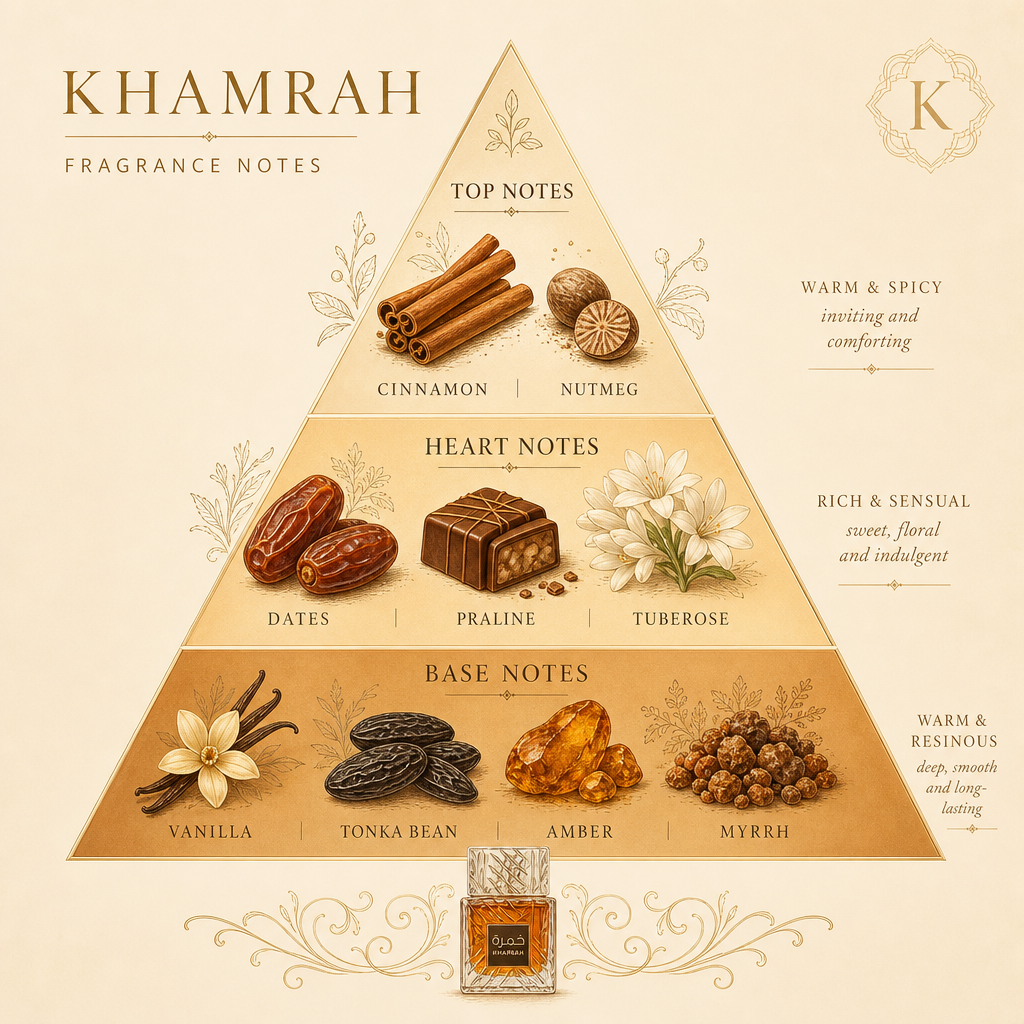
Top notes open with a spicy accord. Cinnamon and nutmeg give the first few minutes a clear, warm, and slightly spicy character, with bergamot adding a touch of brightness to prevent the opening from being too heavy. This is the part that will either immediately appeal to you or catch you off guard — a spicy start is common in Arabic perfumery, but not something we're used to in the European mainstream.
The heart is where Khamrah shifts into a dessert-like line. Dates bring a dark, syrupy sweetness, praline adds a nutty fullness, and tuberose with a woody undertone holds the entire composition together, preventing it from becoming one-dimensional in its sweetness. This is where you'll decide if the perfume suits you: those who prefer subtle floral compositions might find the heart's sweetness pronounced.
Base notes are Khamrah's signature and the reason it lasts long on both skin and clothing. They consist of:
- vanilla — the main carrier of sweetness, but in a darker, less sugary form than what you might know from purely gourmand perfumes;
- tonka beans — bringing a caramel-almond tone with a slight bitterness that rounds out the sweetness and gives it depth;
- amber and benzoin — a warm, resinous layer that thickens and extends the entire composition;
- myrrh and woody notes — a slightly balsamic, almost incense-like finish that maintains the oriental character even after several hours.
This base trio — vanilla, amber, and tonka beans — is the most interesting from a selection perspective. Looking at the notes that have consistently attracted interest in our perfume range, vanilla shows slight growth, while amber and tonka beans maintain stable interest across seasons. Khamrah didn't miss the mark: it built on a combination of ingredients that customers repeatedly choose, independent of any single fashion trend.
The last thing to keep in mind in your olfactory vocabulary is the perfume's behavior on the skin. Khamrah develops slowly — the spicy opening fades within the first half hour, the sweet heart lasts for several hours, and the base remains detectable until the end of the day. The projection is generous at first, so two to three sprays are usually sufficient; gradually, the perfume draws closer to the skin, transforming into a warm, enveloping trail. If you like this progression, here's some good news: most of the variants we'll discuss further work with the same base and primarily change the top and middle parts of the pyramid.
Khamrah Qahwa: What Changes When Coffee Enters the Composition
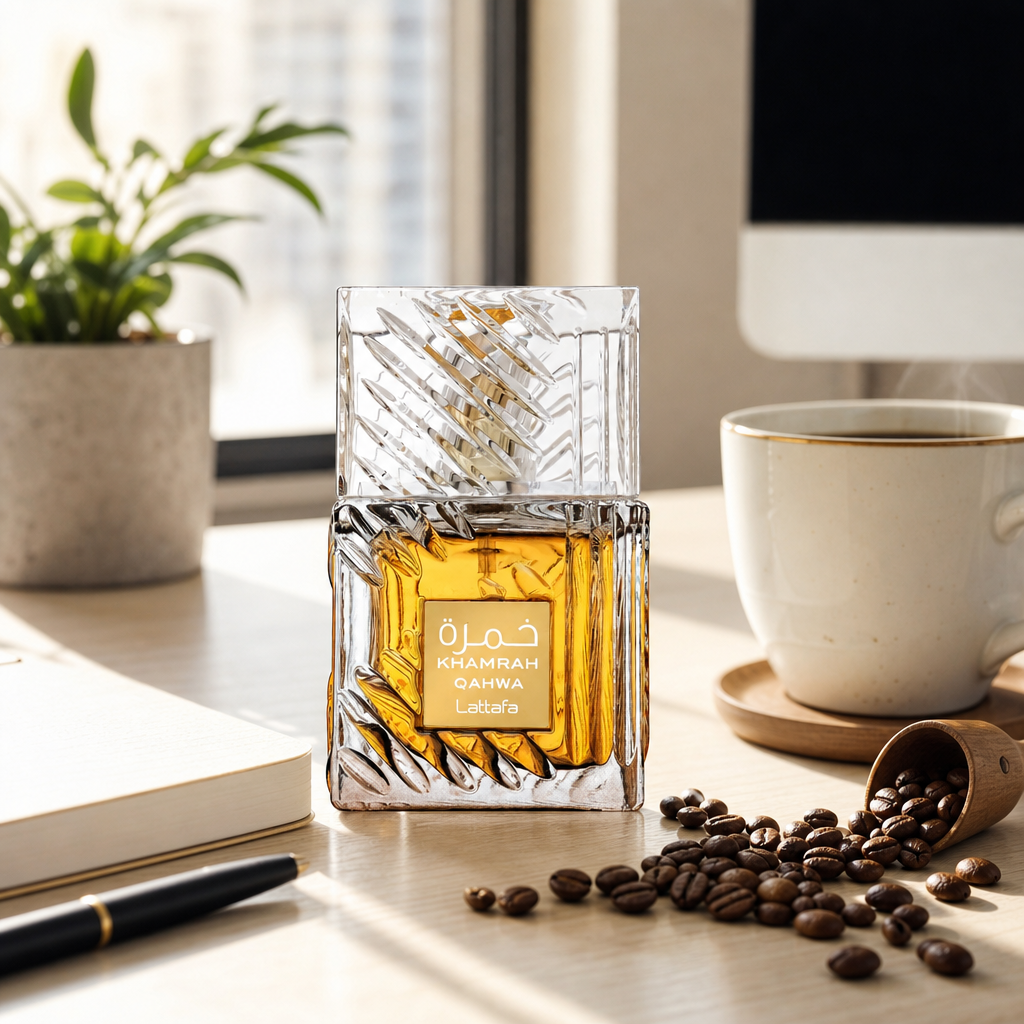
The Arabic word qahwa means coffee, and that's exactly where the difference lies between the original scent and the Lattafa Khamrah Qahwa variant. It's not a new perfume built from scratch, but a shift in the balance of a composition you already know. The structure remains: a spicy opening, dried fruits, and a rich sweet base. What changes is what gets the most spotlight within this structure. It's a unisex Eau de Parfum in a 100 ml bottle, and it's among our best-selling perfumes — and not by chance, because the coffee accord is a natural next step for lovers of gourmand fragrances.
The coffee accord here doesn't function like a fresh espresso in a morning café. It's more of a roasted, slightly bitter layer that sits above the spices and takes away some of the dessert-like sweetness from the composition. Where the original version resembles sweet pastries with spices, Qahwa has a darker, earthier character. The sweetness doesn't disappear — it just gets a counterbalance. This bittersweet balance is precisely why Qahwa often feels more restrained and less conspicuous, even though it's not a weaker scent.
The spices from the original composition don't go anywhere. The cardamom and cinnamon impression in the opening are still noticeable, but they no longer dominate the entire progression — after a few minutes, the coffee takes over and pushes them into the background. The base notes maintain the traditional gourmand line: tonka bean and vanilla give the composition depth and a warm finish, while amber and musk ensure the scent doesn't fade too quickly on the skin.
If you're interested in the practical differences you'll notice in everyday wear, they mainly include:
- Perceived Intensity: Qahwa feels more compact and less sweetly loud. This doesn't mean less longevity, but rather a less noticeable first impression — which is suitable for the office or daily wear.
- Opening: In the original version, you first smell spices and sweet fruits, while in Qahwa, the roasted tone comes through in the first few minutes, darkening the entire start.
- Throughout the Day: After several hours, both versions converge to a warm vanilla and tonka base. However, Qahwa retains its bitter edge for longer, so it doesn't shift into a purely dessert-like impression.
- Environment: The roasted component pairs well with cooler air, making Qahwa most sensible from autumn to the end of winter. In summer heat, the sweet base may come out more than one might desire.
Who will Qahwa suit better than the original? Primarily those who find the classic Khamrah a bit too sweet and are looking for something in the gourmand family with less sugar and more roasted bitterness. It also works well as an introduction to Arabic perfumery for someone who enjoys coffee and cocoa notes but rejects overtly dessert-like scents. Conversely, if what you love about the original version is precisely that dense, pastry-like sweetness, Qahwa will take some of that away.
And now for the verdict our customers ask us most often: you don't have to choose just one. Both versions don't compete on the shelf because they don't replace each other — they complement each other. The original Khamrah is a scent for the evening, for cold days, and for moments when you want to be noticeably fragrant. Qahwa is the version for everyday wear, for work, and for situations where you appreciate a spicy gourmand scent without a noticeable sweet signature. Those who wear both usually alternate them based on the occasion — and that's precisely why neither ends up forgotten in a drawer.
Six Related Fragrances from Lattafa and When to Choose Each One
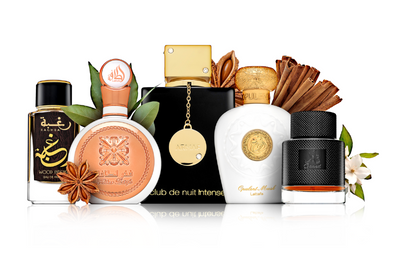
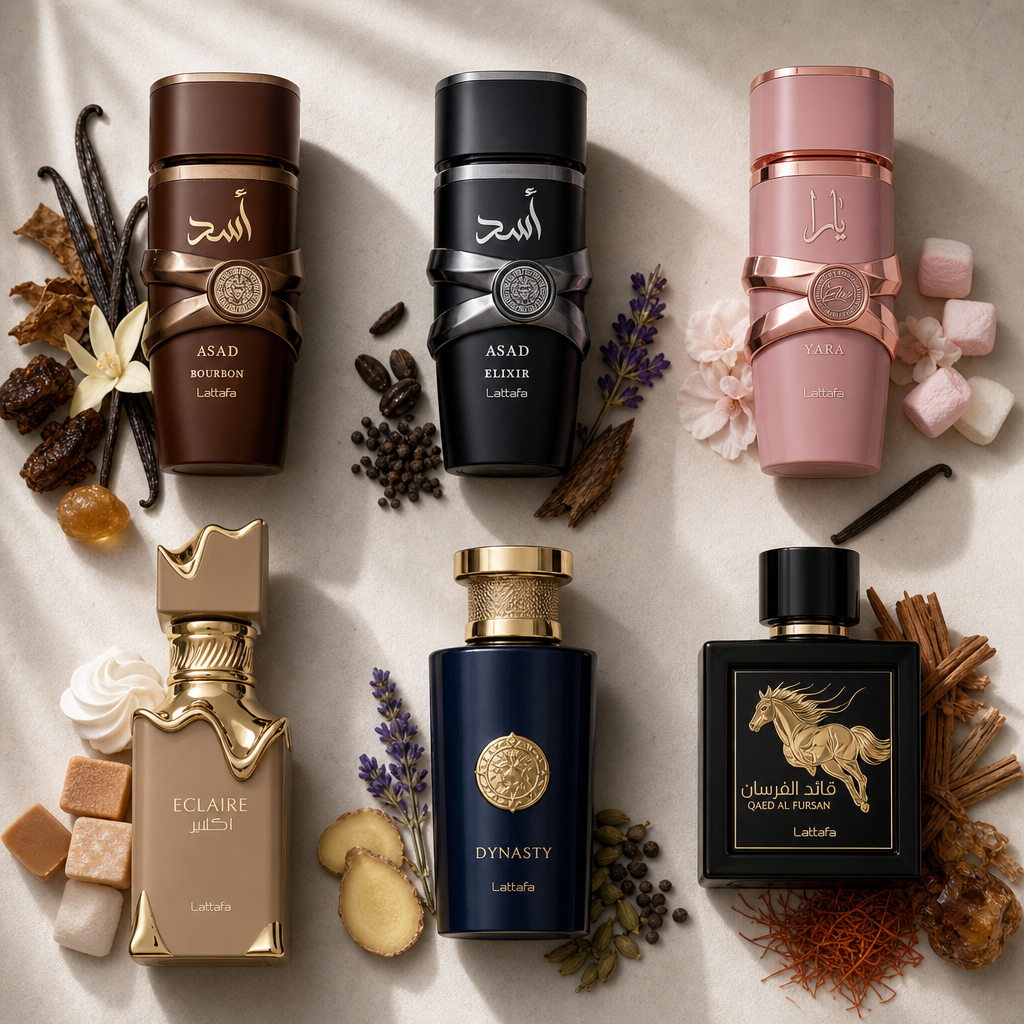
Khamrah is not alone in the Lattafa brand portfolio. The sweet-spicy and amber line it belongs to has several other interpretations of the same theme — and that's exactly where you should head if you find something appealing in Khamrah but something else doesn't quite fit. Consider the following six perfumes as neighboring variations, not replacements: each one shifts the balance between spices, roasted or coffee accords, and the sweet base slightly differently. We maintain the same perspective as in the previous comparison, so you can notice the differences at first spray.
Asad Bourbon (Eau de Parfum, for men, 100 ml) offers a darker and denser take on the sweet base. The spicy top notes recede into the background, giving way to a vanilla-tobacco impression with a roasted undertone, which feels more like a distillate than a dessert. Ideal if you're looking for less cinnamon sharpness and more calm, smoldering sweetness in Khamrah — and if you don't mind the result reading more distinctly as masculine.
Asad Elixir (Eau de Parfum, for men, 100 ml) follows the same direction but with even greater concentration. The sweet component is richer, the woody base note is denser, and the whole feels more compact than the branching composition of Khamrah. Suitable if you appreciate Khamrah's longevity and breadth but wish for a less dessert-like and more darkly balsamic expression — typically for evening and cooler months.
Yara Elixir (Eau de Parfum, for women, 100 ml) shifts the emphasis from spices to creamy sweetness. Where Khamrah has a peppery and cinnamon edge, here a milky vanilla, slightly powdery impression with a fruity hint at the start takes over. Perfect if you enjoy Khamrah's sweet base but find the spicy start too pronounced or too wintry. Yara Elixir is the most easily wearable for office and daily wear among the six.
Eclaire (Eau de Parfum, for women, 100 ml) is the most gourmand interpretation of this family. A caramel-cream accord takes center stage, with spices playing more of a seasoning role than a structural one. The roasted tone, which coffee provides in Khamrah Qahwa, here has a sweeter, patisserie-like character. Ideal if you're looking for a more playful and youthful expression in Khamrah and don't mind the fragrance being overtly sweet.
Dynasty (Eau de Parfum, unisex, 100 ml) is the most conciliatory choice among the six. The balance of spices, amber, and sweet base is such that no single component dominates — the whole remains within a warm amber framework but without a pronounced gourmand peak. Suitable if you find Khamrah too conspicuous for certain situations and want the same mood in a quieter, more universal form that can be worn year-round, regardless of whether you're looking for a feminine or masculine fragrance.
Qaed Al Fursan (Eau de Parfum, for men, 90 ml) interprets the same theme more dryly. Sweetness is subdued in favor of spices, a tobacco impression, and an apple freshness at the start, making the fragrance sharper and less dessert-like than the rest of the five. Ideal if you find Khamrah too syrupy and are looking for a spicy oriental scent that can be worn even on warmer days when sweet bases quickly become heavy.
When you compare the six side by side, a simple map emerges: Asad Bourbon and Asad Elixir lean towards darker, more masculine sweetness, Yara Elixir and Eclaire towards creamy and more playful renditions, Dynasty holds the middle ground, and Qaed Al Fursan veers towards dry spices. If you're unsure which direction to take, first consider what specifically you like about Khamrah and what you would tone down — this will lead to a much more reliable choice than a list of notes on the label.
How to Choose by Season and Taste: Specific Recommendations from Our Catalogue
Whether you're selecting your first perfume from this fragrance family or adding a second one, the decision can be simplified to two questions: when will you wear the perfume, and how sweet do you like your scents? Based on your answers, you can narrow down your choices from the entire family to one or two bottles.
By Season and Occasion
Rich spicy compositions with a sweet base perform best in the cold. Lower temperatures slow down evaporation, allowing the fragrance to develop gradually and last longer on the skin and outerwear.
- Cold months and evenings: roasted, spicy, and darker versions — those with prominent tonka bean, amber, and wood in the base notes. They pair well with a coat, a restaurant, or a social evening.
- Transitional periods and daytime wear: lighter and sweeter scents with fruity or creamy top notes. In spring and autumn, they maintain a gourmand character without overwhelming the space around you.
- Office and hot days: go lighter — one or two sprays on clothing instead of the neck. In the heat, gourmand compositions can feel heavy, so save them for the evening.
By Taste: Dessert Sweetness or Spicy Depth
Within this family, there's a clear divide. On one side, you have scents reminiscent of dessert — vanilla, caramelized sweetness, almond, and creamy notes. On the other, compositions where spices and roasted notes keep the sweetness in check.
- Do you like dessert fragrances? Look for options where vanilla and tonka bean are at the forefront, complemented by dried fruit or almonds. They are more accessible and easier to wear even without experience in Arabic perfumery.
- Want spicy depth without the sugar? Opt for versions with coffee, tobacco, cinnamon, or cardamom. The sweet base remains, but it's pushed to the background, giving the overall scent a more mature feel.
- Not sure? Start with a middle ground — the original composition of this family, which balances both sides. Depending on which side you notice more strongly on yourself after a few hours, you'll know where to move next.
Layering and Rotating Two to Three Perfumes
Gourmand compositions can be layered, but restraint is key. A proven method is to choose one fragrance as a base and use another just as an accent on the wrist — usually the lighter, sweeter one. If you combine two heavy spicy fragrances, the result can be confusing, and both lose their character.
For rotation, two to three perfumes that don't duplicate each other are sufficient. A practical division is one rich evening scent, one lighter daytime scent, and possibly one distinctly different — perhaps with a coffee or tobacco note.
Specific Selection from Our Catalogue
If you want direct tips for building a complete rotation, our suggestion looks like this:
- Lattafa Khamrah in Eau de Parfum as a base. It's the reference point for the entire family and a straightforward way to see if spicy-sweet scents suit you.
- Lattafa Khamrah Qahwa in Eau de Parfum as a second step. The coffee note shifts the composition to a roasted, less sugary direction — suitable for evenings and cold months.
- Lattafa Asad Bourbon in Eau de Parfum, if you're looking for an addition with a more pronounced spicy and beverage character that doesn't overlap with the previous two.
- Lattafa Yara Elixir in Eau de Parfum as a sweeter and creamier option for daytime wear, when you want to stay in the gourmand range but lighten the weight.
All mentioned perfumes can be found in the category of Arabic perfumes and most of them in the unisex section as well. And if you're still unsure, start with a single bottle, wear it for a few weeks, and make your second choice based on your own experience on the skin.
Category
Recommended articles

"Give a girl the right shoes and she can conquer the world!" Marilyn Monroe