


A guide for beginners who have heard of makeup primer but aren't sure if it's really necessary in their routine. We'll explain what a primer physically does in makeup and when you can safely skip it.
Primer: The Step Many Beginners Skip
Most of us have a set morning makeup routine. You cleanse your skin, let the moisturizer absorb, and then reach for your foundation or BB cream. But there's another product that fits between these two steps, often mentioned in makeup guides, yet many readers aren't quite sure about it — the primer. Maybe you have one tucked away since last Christmas and still don't know when to use it. Perhaps you've heard about it in a perfume shop or from a friend who's more skilled with makeup, leaving you with one lingering question: is a primer really necessary, or is it an extra step you can skip without consequences?
The answer isn't a straightforward yes or no — and that's actually good news because it means you can decide based on your specific situation. A primer is a distinct category of decorative cosmetics with a fairly specific function: it prepares the skin's surface for what comes next. It's not a moisturizer. It won't replace skincare, even if it contains moisturizing ingredients. And it's not foundation — it doesn't cover the skin or even out skin tone like a tinted base does. If you use it in place of one of these, you'll be disappointed because you've chosen the wrong tool for the job.
This confusion often arises because primers are sold in similar tubes to creams, applied in a similar motion, and are almost invisible on the skin once dry. It can easily seem like an unnecessary step that just adds two more minutes to your morning. Yet, it targets specific issues: foundation settling into wrinkles around the eyes, shine on the forehead after a few hours at the office, or enlarged pores that become prominent when you apply liquid foundation.
Whether you apply makeup every morning before work or only a few times a year for weddings, celebrations, and corporate events, the answer to "do I need a primer?" will differ in each case. Try to guess where you fit in:
- You wear makeup daily and want it to last from morning to afternoon without needing touch-ups.
- You wear makeup occasionally, but more thoroughly — and you want to ensure it lasts all day and withstands photography.
- You have specific skin concerns that complicate makeup application: oiliness in the T-zone, dryness and flakiness, prominent pores, or redness.
Your skin type and the season also play a role. What helps oily skin in the summer heat might dry out dry skin in a heated room even more. And of course, it depends on how many layers you actually apply: a primer will work differently with a light tinted cream and mascara than with a fuller makeup routine involving concealer, blush, and setting powder.
Later in the text, we'll explore what a primer physically does on the skin and why its effect can't be replaced by regular hydration, the types of primers available, and who they're suitable for, and finally, the specific situations when applying it pays off — and when you can safely skip it. The goal isn't to add another obligation to your routine but to provide enough information so you can decide for yourself and avoid buying a product that just takes up space in your makeup bag.
What a Makeup Primer Physically Does
The simplest way to understand the function of a primer is to see it as an intermediary layer. The skin is not a smooth surface: it has fine lines, pores of various sizes, areas that absorb moisture quickly, and areas where oil tends to accumulate. When you apply makeup directly to the skin, it mirrors this entire texture and behaves slightly differently on each part of the face. A primer places a thin film between the skin and the makeup, minimizing these differences, so the color component of the makeup has a more even base.
Manufacturers typically describe three effects for this category. It's worth knowing how they are intended because there's a difference between the word "smoothing" in a product description and its common meaning.
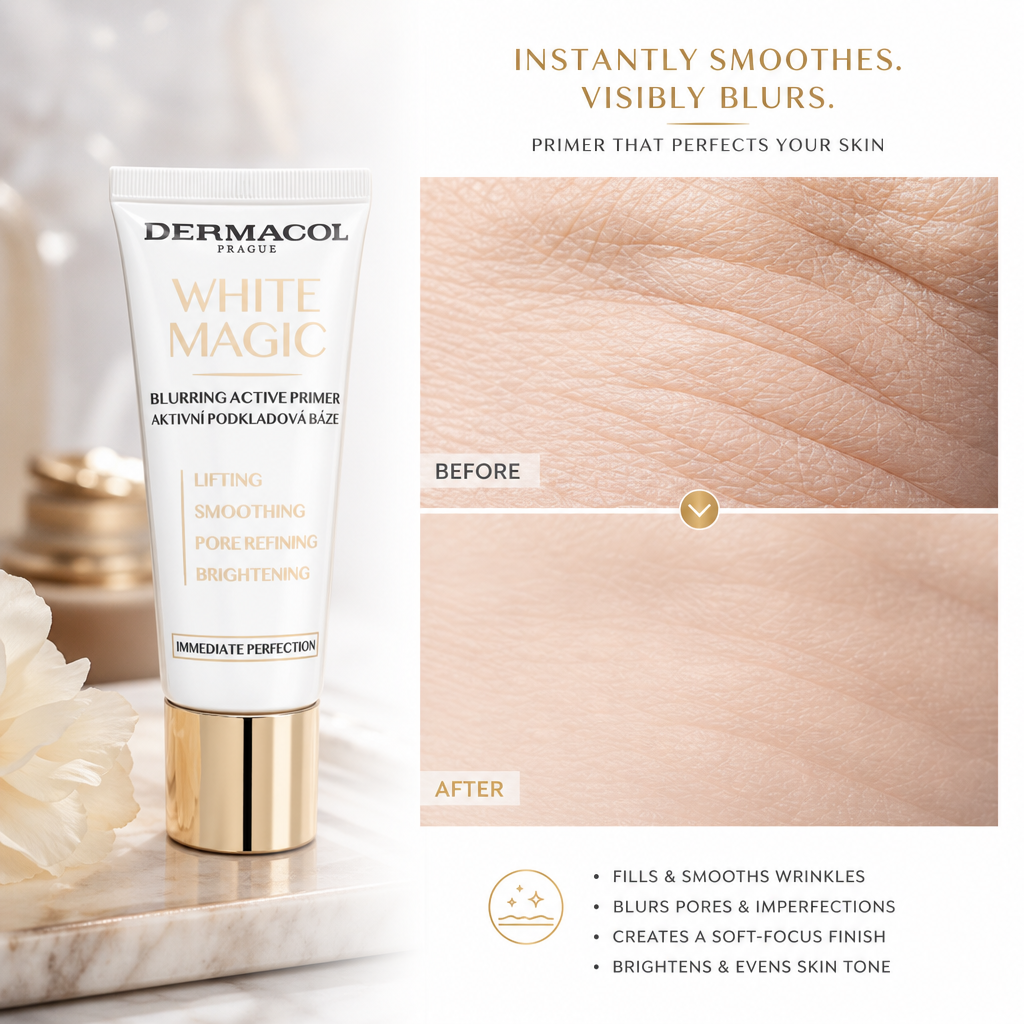
- Optical Smoothing of Irregularities. A primer does not remove enlarged pores or fine lines. It fills them in and softens their edges so that light doesn't reflect off them as sharply. The result is visual, not structural: the irregularity remains, but it's less noticeable at first glance.
- Evening Out the Base for the Color Component. Dry and oily areas absorb makeup at different rates and intensities. This is why the same shade can look darker on the nose than on the cheekbones. A primer evens out these absorption differences, allowing makeup to spread more smoothly, often with less product.
- Better Adhesion and Longevity. Makeup adheres more readily to the primer film than to the skin, which works with its own oils and sweat throughout the day. Therefore, makeup stays longer where you applied it and is less likely to settle into lines or creases around the nose. It's not a guarantee of all-day permanence, but rather that the first signs of settling appear later.
All three effects share one thing: a primer does not work with color or coverage. Imperfections are covered by makeup or concealer; the primer just prepares the surface. If you expect it to even out your skin tone on its own, the result will disappoint you.
Primer vs. Moisturizer
This is probably the most common source of uncertainty, yet the difference is quite clear once you ask yourself who each product speaks to. A moisturizer works with the skin — it provides moisture, helps maintain comfort, and is part of skincare regardless of whether you're wearing makeup that day. A primer primarily works with what comes after it — it's a step in decorative cosmetics that prepares the surface for makeup.
This also implies a practical consequence. A moisturizer fits into the routine at all times, while a primer makes sense on days when you actually apply makeup. They cannot be interchanged: while a moisturizer softens the skin, it does not create a layer for better makeup adherence, and some richer creams can even worsen adhesion. Therefore, in the order of steps, the moisturizer is applied first, allowed to absorb, and then the primer is applied.
Of course, there are borderline products that combine both roles, and hydrating primers are a good example. However, even with them, the main purpose remains preparing the base, while skincare is a bonus. If your skin has a specific need, address it with a cream or serum and consider the primer as a makeup tool, not a disguised skincare product.
Types of Primers and Which Skin They Suit
A primer is not a one-size-fits-all product. On the shelf, you'll find products that may look similar but address entirely different issues — one reduces shine, another adds moisture, a third smooths the skin's texture, and a fourth works with color. A good way to organize them is to choose based on what often goes wrong with your makeup.
Mattifying Primer — for Skin That Gets Shiny During the Day
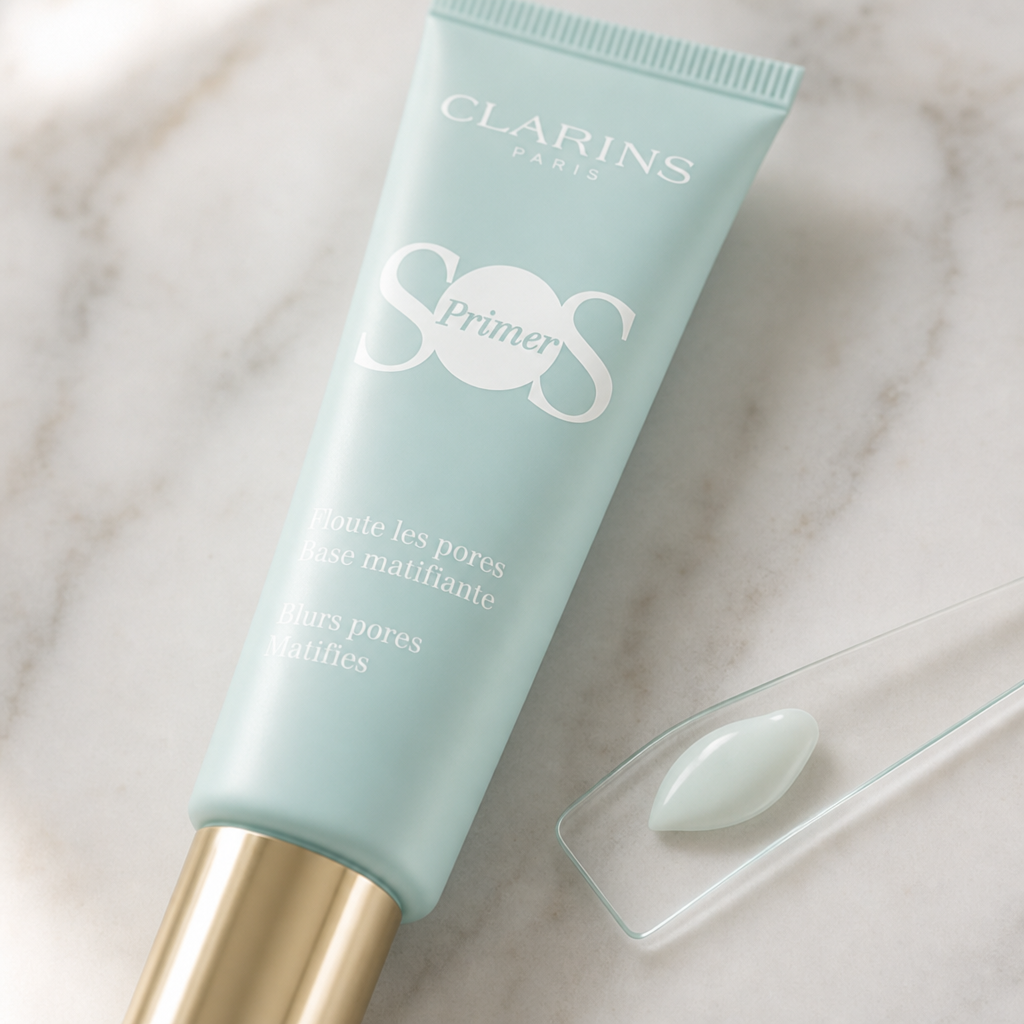
Mattifying primers usually have a slightly velvety, powdery texture and their job is to keep oiliness on the skin's surface under control. They are especially appreciated by combination and oily skin, where shine typically appears in the so-called T-zone — on the forehead, nose, and chin.
Who should avoid them: if you have dry skin or experience flaky areas, a strongly mattifying primer can worsen the result. Makeup can dry out more easily, settle into fine lines, and highlight dry spots. If your skin is only dry in certain areas, you can use a mattifying primer selectively — apply it only to the T-zone and leave the rest of the face without it.
Hydrating and Illuminating Primer — for Dry and Tired Skin
These primers have a creamier or gel-like consistency and tend to hydrate rather than dry out the skin before makeup. Illuminating versions also contain very fine light-reflecting particles, making the skin look more rested.
They are suitable for dry, dehydrated, and mature skin. For significantly oily skin, added moisture or stronger shine can shorten the makeup's longevity and enhance unwanted shine. The solution is often a combination: apply the illuminating primer only on the cheekbones and the mattifying one on the center of the face.
Smoothing Primer — for Pores and Uneven Texture
Smoothing primers target the skin's texture. Their texture is usually silicone-based, silky to waxy, and optically evens out enlarged pores, fine lines, or acne scars. Makeup then doesn't sink into pores and doesn't highlight them.
They are suitable for skin with more visible pores, usually combination to oily, and anywhere you want a smoother surface under foundation. If your skin is smooth and without significant irregularities, the benefit will be minimal and the primer will just add an extra layer.
Color Correcting Primer — for Redness and Uneven Tone
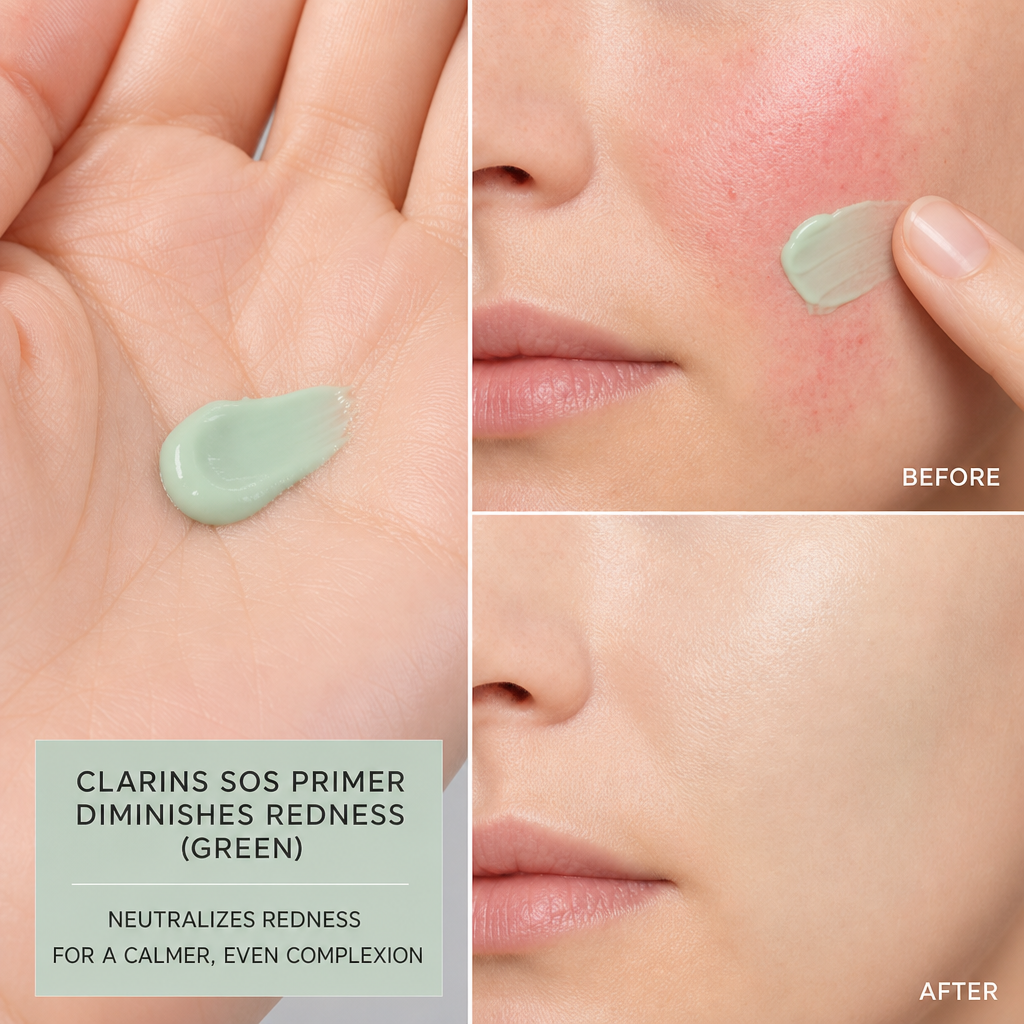
Color correcting primers work on the principle of complementary colors. Green-tinted ones reduce redness, for example, in sensitive skin or small inflammatory spots. Purple and lavender shades soften yellowish or grayish undertones, while apricot and salmon brighten darker under-eye areas. They are applied in a thin layer and often only locally, not all over the face.
The key is moderation: the more color correcting primer you apply, the greater the risk that the color will show through the makeup. If your skin tone is even, you won't need this type of primer.
Formats That Overlap with Primers
The step before makeup is not always clearly defined, and some products serve multiple roles at once. The two most commonly confused with primers are:
- BB and CC Creams — combine light care with low coverage. BB creams act more like tinted moisturizers, while CC creams focus on tone correction. They are used instead of foundation, not under it, and for very light makeup, they can replace a primer.
- Setting Powders — come into play after makeup and are meant to keep the result in place. They partially overlap with mattifying primers in effect but don't replace them: a primer adjusts the base, while powder seals the finished makeup.
If you're unsure which group you belong to, consider what bothers you most in your makeup — shine, dry spots, visible pores, or uneven tone. Based on that, choose the type of primer worth starting with.
When to Really Appreciate a Primer and When You Can Skip It
A primer isn't a step you need to follow every day. It's a tool for specific situations — sometimes it saves you from touching up your makeup twice a day, other times it's just an unnecessary layer and a minute you'd rather spend on coffee. Decide based on what you expect from your makeup that day, not on how many steps a "proper" routine should have.
Situations Where a Primer Makes Sense
The common denominator for the following occasions is duration and stress. Whenever your makeup needs to last significantly longer than a few hours or face heat, movement, and cameras, an extra step can make a noticeable difference:
- A long workday. Starting at eight in the morning, with a meeting or dinner in the evening. Without a primer, makeup often starts to fade after ten hours, especially in areas where the skin moves the most — around the nose, chin, and forehead.
- Weddings, celebrations, graduations. All-day events filled with emotions, hugs, and usually the warmth of a crowded hall. Here, a primer is worth it even for those who don't usually use it.
- Hot summer weather. In higher temperatures, skin sweats and oils more, and makeup tends to shift. A mattifying primer on such a day extends the time your makeup looks as it did when you applied it in the morning.
- Photography and video. The lens and bright lights highlight imperfections and small flaking edges of makeup. A smooth base shows more in photos than in the mirror.
- Skin where makeup doesn't last long. If your makeup reliably disappears every day regardless of the weather, a primer is a more logical solution than applying more makeup.
When a Primer is an Extra Step
It's equally important to know when you can skip it without affecting the result:
- Quick daily makeup with light coverage. When you opt for a tinted moisturizer or just a light foundation and don't want full coverage, a primer usually doesn't have much to improve.
- Just concealer and mascara. For spot coverage on small areas, durability is handled by the concealer itself, not a full base.
- Days at home. Without makeup or with minimal makeup, there's nothing to fix or smooth out.
- Skin that benefits from a moisturizer. If your makeup holds all day and spreads evenly on your usual skincare, adding another product won't bring any benefit.
More Layers Don't Automatically Mean Better Results
This is a point worth remembering. Layering too many products can cause exactly what you wanted to avoid — makeup starts to crumble, form clumps, or settle into fine lines. Typically, several factors are critical: incompatible skincare and primer compositions, insufficiently dried cream under the primer, and too much product.
Practical approach: add steps one at a time and check the result after five to six hours, not immediately after application. If makeup with a primer holds worse than without it, the issue isn't with your skin — it's just that the specific combination of products didn't work well together, and it's worth trying a different type of primer or skipping it for lighter makeup.
How to Apply Primer Correctly and What to Choose for Starters
Applying a primer takes less than a minute, but it's this minute that makes the difference between makeup that lasts and makeup that settles into wrinkles by lunchtime. Let's go through the process step by step so you don't miss anything.
- Cleanse your skin. Primer won't adhere as well to leftover makeup from yesterday or oily skin. In the morning, a gentle gel or foam cleanser followed by towel drying is sufficient.
- Apply a moisturizer. Primer doesn't replace skincare; it works on top of it. Skin that's dry on the outside will flake under makeup, no matter what primer you use.
- Give the moisturizer a moment to dry. This is the step most often skipped. Two to three minutes is the minimum, five is more comfortable. Meanwhile, feel free to brush your teeth or prepare your brushes.
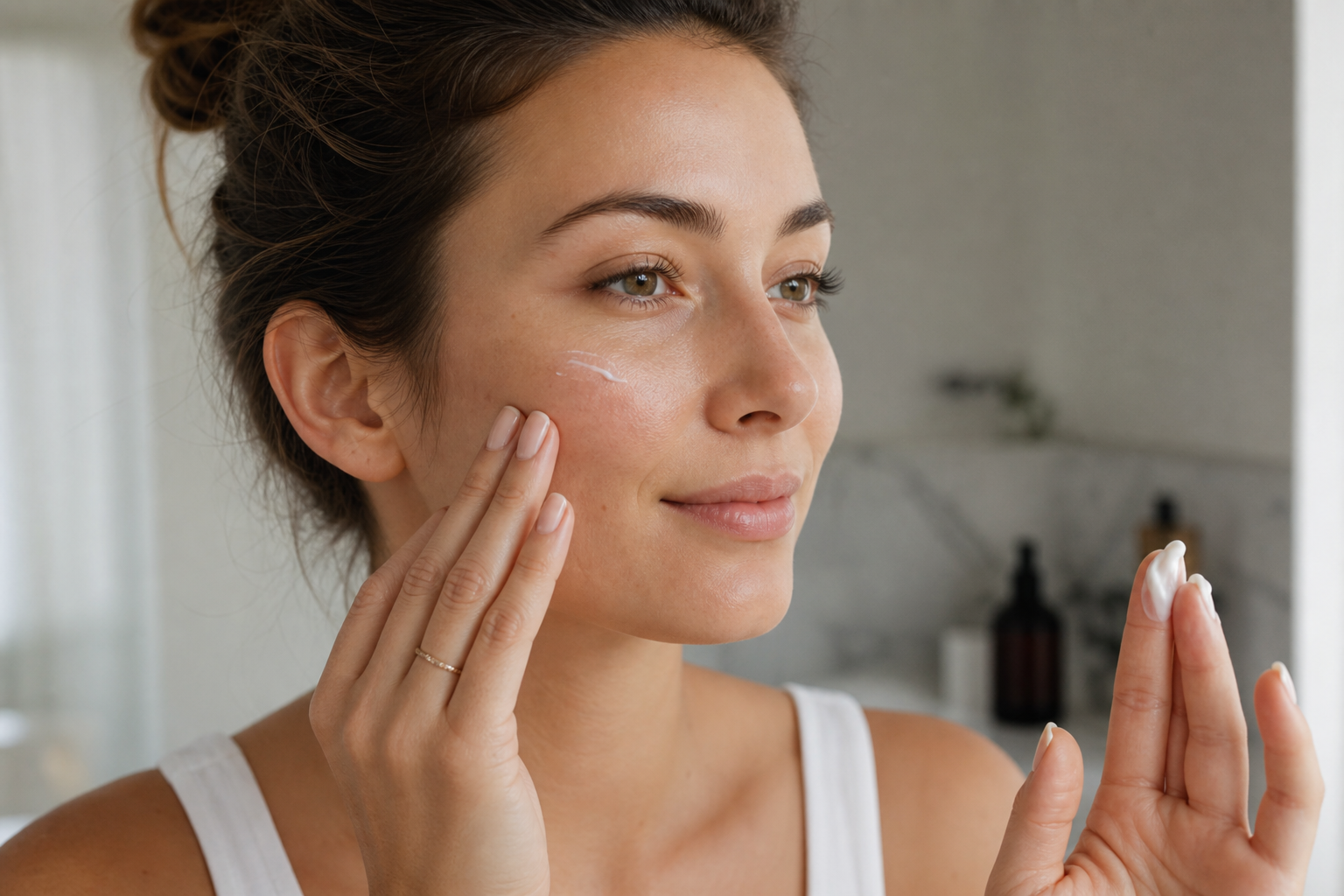
- Use a very small amount. For the entire face, a pea-sized amount is enough, and even less for thicker smoothing primers. First, warm it up on your fingertips.
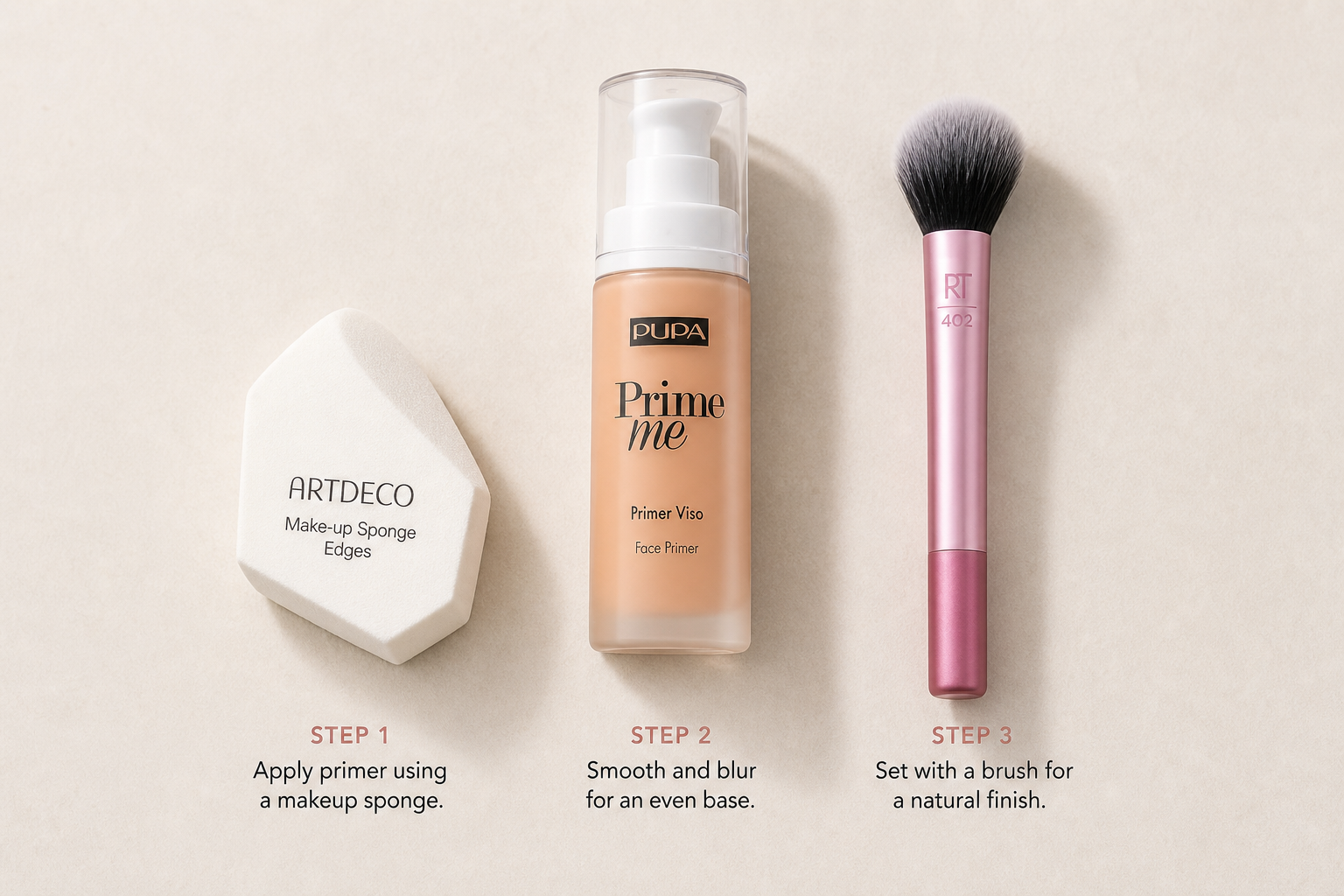
- Apply it specifically where needed. For most people, this isn't the whole face. It's usually the nose, forehead, and chin area, or under the eyes where makeup tends to gather. Spread it with gentle strokes from the center of the face, using your fingers or a damp sponge.
- Wait a moment before applying makeup. Primer needs a few seconds to settle on the skin. If you touch it immediately, you'll mix both layers together and lose the effect.
Three Mistakes to Avoid
- Using too much product. The most common mistake. Primer isn't a moisturizer; you don't need to massage it into the entire face. A thick layer will slide, makeup won't hold, and it will start to roll off during the day.
- Applying on undried moisturizer. When primer meets a wet layer of skincare, both dissolve into each other. The skin then looks more shiny than smooth, and the longevity of the makeup isn't increased.
- Combining incompatible textures. A silicone-based primer and a water-based foundation (or vice versa) sometimes don't get along and clump into small lumps on the skin. If your makeup pills after applying primer, it's not your technique but a matter of choosing the right pair. Test the combination on a small area of your face before heading out.
What to Buy as Your First Primer
To start, you don't need a collection. Just one universal primer that matches your skin type — mattifying if your face gets shiny during the day, hydrating or illuminating if your skin is more dry and dull.
In the primer and makeup category at Brasty, you'll find options in both price ranges. Among the more affordable and easily accessible choices are Dermacol, Maybelline, and Max Factor — a solid entry point where you won't regret a potential mistake in texture choice. If you want to step up, go for L'Oréal Paris or Artdeco, where the textures are more refined and the shade range is broader. A sponge or flat brush is suitable for application; Real Techniques remains a long-standing favorite for its sponges and brush sets, which are among the most sought after here.
And if you're still unsure after reading, try reversing the approach: start with what has bothered you most about your makeup so far. Quickly disappearing makeup, visible pores, or conversely, dull and gray skin? The answer will determine the type of primer faster than any product list.

Category
Recommended articles

"Give a girl the right shoes and she can conquer the world!" Marilyn Monroe