


Do you always need to rinse micellar water, and does toner dry out the skin? We'll go through the most common claims about cleansing facial waters, separate facts from speculation, and summarize what this means for your skincare routine at home.
Why So Many Myths Surround Cleansing Facial Waters
A situation almost everyone knows: a friend swears that micellar water must always be rinsed off, otherwise, it leaves a film on the skin. A short video on social media advises the exact opposite – claiming that rinsing unnecessarily washes away what should remain on the skin. And the text on the bottle of toner says something different altogether, confirming neither of the two pieces of advice. Three sources, three recommendations, and one face that needs to resolve it all.
Most of these contradictions are not due to ill will or an attempt to confuse anyone. They usually stem from two quite ordinary mechanisms. The first is the generalization of a personal experience: what worked for someone becomes a rule for everyone when retold. However, skin that reacts with irritation to a strongly degreasing product and skin that is finally relieved from shine by the same product each need something different. Personal experience is valuable, but it cannot be turned into a universally valid guide.
The second source is the shorthand adoption of phrases from advertising messages. Formulations like "deep cleans" or "no need to rinse" are on the packaging to briefly summarize one feature of a specific product. In everyday conversation, they become statements about an entire category – and at that moment, even what originally applied ceases to hold true. Add to that inconsistent terminology, where the same word on two packages refers to two different products, and confusion arises.
That's why we structured this article differently than a list of verdicts. For each widespread claim, we go through three steps:
- first, we precisely identify the claim, including how it is usually passed on;
- we separate the part that can be supported by the product's composition and manufacturer's instructions from the part that is mere speculation;
- finally, we summarize what this practically means for your home routine.
What you won't find in the article are universal verdicts like "always do this." The answer in cleansing cosmetics almost always depends on three things: what type of skin you have, what exactly is in the composition of the product, and how the manufacturer recommends using it. When you separate these three layers, most conflicting advice breaks down into a clear distinction between what applies generally and what applies only to a certain skin type or formulation.
Before we dive into individual myths, it's worth being clear about what each bottle on the shelf actually does. Without this foundation, it's impossible to discuss rinsing, skin drying, or the correct order of steps factually – and it's in this fog that myths thrive best.
Three Facial Cleansing Formats: Micellar Water, Toner, Oil
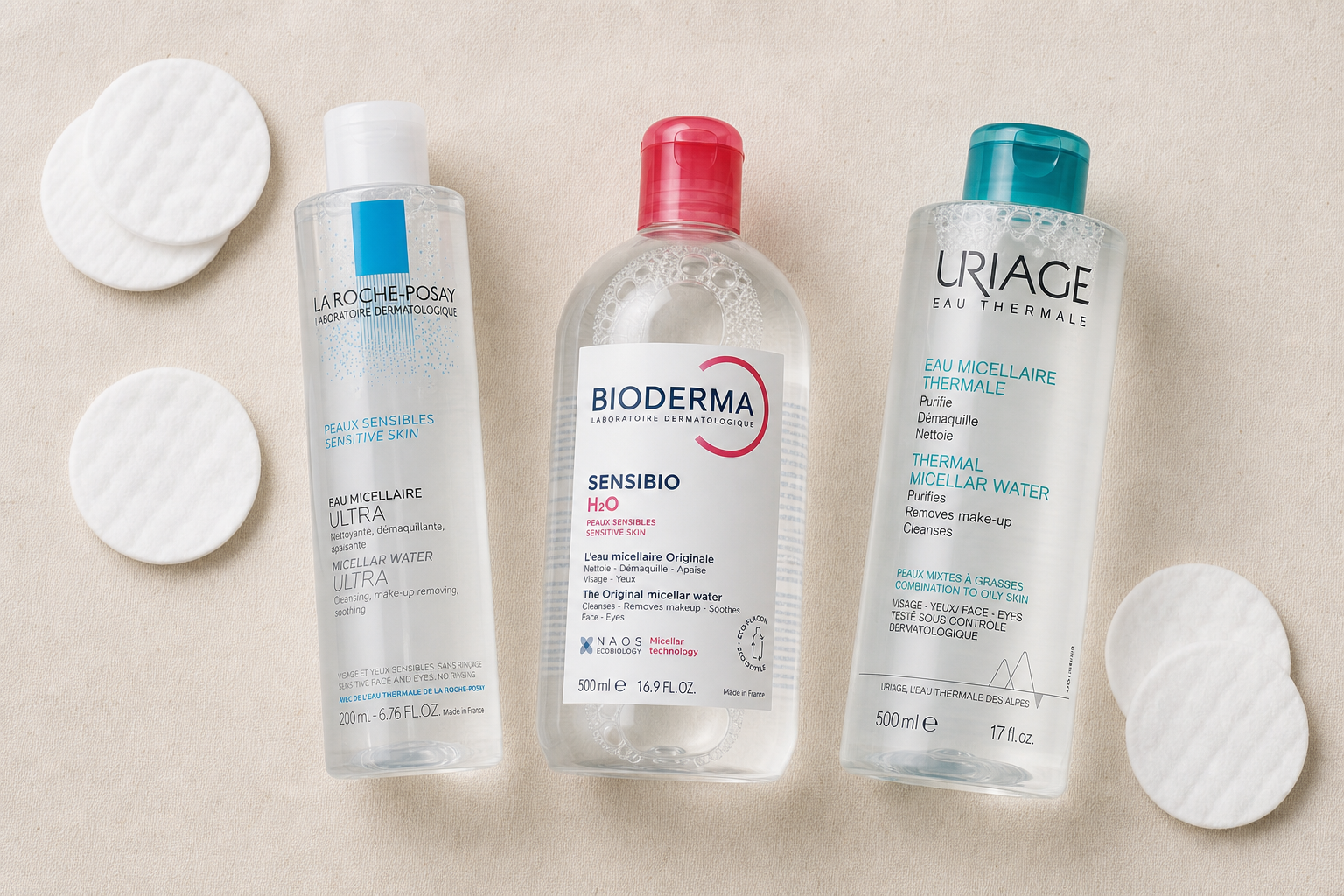
Place three transparent bottles from your bathroom shelf side by side, and at first glance, they look almost identical. Yet, each one serves a different purpose and holds a different place in your routine. Most misunderstandings about facial cleansing arise here: products are either confused with one another or expected to do things they aren't designed for. Before diving into each claim, it's worth creating a simple map of the formats.
Micellar Water: Micelles That Capture Impurities
Micellar water looks like ordinary water but contains micelles – tiny clusters of molecules with one part attracted to water and the other to fats. This allows them to capture makeup, sebum, dust residues, and other impurities that water alone cannot wash away. When you swipe a dampened cotton pad over your skin, the micelles envelop the impurities and carry them away.
Micellar water is practical for daily removal of light makeup and for refreshing the skin in the morning when you mainly need to remove the sebum produced overnight. However, it hits its limits with strongly waterproof products – micelles are more suited for everyday impurities than layers designed to resist water.
Oil Cleansers: Oil Dissolves Oil
Cleansing oils work on a simple principle: oil dissolves oil. Waterproof mascaras, long-lasting makeup, and sunscreens are intentionally formulated to withstand water and sweat. Oil binds to them, loosens them, and they are then washed away with water – emulsifying oils turn into a milky emulsion upon contact with water, which can simply be rinsed off.
In the same cleansing phase are cleansing gels and foams. They are not cleansers in the strict sense but complement them: they remove oil residues and excess sebum, and the skin is then rinsed with clean water. They are typically used in the evening, after a day with makeup or sun protection.
Toner: Refining the Skin, Not a Cleansing Step
Toner comes into play once the skin is washed and rinsed. It is not a substitute for cleansing but an intermediate step between it and skincare: it evens out the skin's surface, replenishes moisture, and prepares the skin for serum and cream, which are better applied to slightly damp skin. Many toners also contain hydrating or soothing ingredients, making them the first thin layer of care.
Misunderstandings arise when toner replaces makeup removal. It is not designed for makeup or sunscreen, and the skin will only appear clean.
Why Labels Confuse More Than They Should
Confusion is not only caused by the similar appearance of bottles but also by terminology. Brands use the same terms for different products:
- Facial Water – an overarching Czech term that includes micellar water, toner, and cleansing water without rinsing. The label itself does not indicate whether the product is for makeup removal or applied after washing.
- Toner – for one brand, a refreshing step after washing, for another, a product with a higher concentration of active ingredients, closer to skincare than cleansing.
- Lotion – an English and French term that can mean several things on labels: liquid toner, cleansing milk, or a light body moisturizer.
The practical conclusion is simple: consider the name on the front of the package as a guide, not a description of function. The decisive factor is the short instructions on the back label. Keep the map of the three formats – micelles, oil, toner – in mind. Most widespread claims about cleansing facial waters fall apart once you realize which one is actually being discussed.
Should Micellar Water Always Be Rinsed Off?
The claim that micellar water always leaves a film on the skin that needs to be rinsed off is one of the most frequently repeated statements in discussions about skin cleansing. It sounds logical – micelles must remain somewhere – and that's why it spreads further. The real answer is more boring yet more useful: it depends on what's in the bottle.
A micelle is a tiny structure with one part attracted to water and the other to fats. This allows it to bind makeup, sebum, and impurities and be removed along with the cotton pad. If the proportion of cleansing agents is low and the formulation is designed as a no-rinse product, only minimal residues remain on the skin, and the next step in your routine is not disrupted. However, if the manufacturer adds more surfactants to tackle heavier makeup or more pronounced oiliness, such micellar water behaves more like a cleansing product – and that is rinsed off the skin. So, the difference is not in the format but in the specific formulation.
When Rinsing Makes Sense
- Oily and combination skin. Micellar waters intended for these skin types are usually more potent, and rinsing is often mentioned directly in the instructions. Their task is to remove excess oil, not to leave a moisturizing layer on the skin.
- Heavier makeup. When you follow makeup removal with a cleansing gel or foam, rinsing happens naturally, and you also deal with the residues from the first step.
- Unpleasant feeling on the skin. If you feel stickiness or tightness after drying, rinsing with lukewarm water is a legitimate response regardless of what the packaging promises.
Conversely, for normal, resilient skin that doesn't protest after makeup removal, there's no point in adding an extra step just because of a general rule from the internet.
Sensitive Skin and Eye Area
For sensitive skin and around the eyes, there's another factor often forgotten in the rinsing debate – mechanical friction. Repeatedly rubbing with a cotton pad can irritate the thin skin of the eyelids more than the product residues themselves. It's helpful to hold the pad in place for a few seconds to allow the makeup to dissolve, then wipe it off in one stroke. Residues of makeup remover around the eyes can also cause burning or temporarily blurred vision for some people, so rinsing with lukewarm water is often worthwhile – even with water that doesn't formally require it.
Similarly, it's good to proceed cautiously with skin prone to redness and tightness. It's not that micellar water is inherently aggressive; it's the accumulation of minor stimuli throughout the day.
What This Means for Your Routine
There is no universal rule, and searching for one in discussions is a dead end. The manufacturer's instructions on the packaging are decisive because they correspond to the formulation you have at home – supplemented by your own experience with how your skin reacts. If the packaging states that rinsing is not necessary, you really don't need to rinse. If rinsing is mentioned in the instructions, it's not a formality but part of the recommended procedure. And if the information is missing, rinsing with lukewarm water won't hurt.


Does toner dry out the skin? Let's look at the ingredients
The idea that toner dries out the skin didn't come from nowhere. Facial toners designed for oily and problematic skin have long relied primarily on alcohol: it quickly dissolved excess oil and left a cooling, tightened feeling, which was easily interpreted as proof of perfect cleanliness. Those who used such a product several times a day might eventually notice redness or an uncomfortable tightness. This personal experience then generalized to the entire category – and persists to this day, even though formulations have since moved in a completely different direction.
Today's toners have a different focus in their composition. Most products intended for daily care are free of ethanol and are based on a water base supplemented with moisturizing and soothing ingredients. Alcohol hasn't disappeared entirely from formulations – in products targeted at very oily skin, it acts as a solvent and helps with spreadability – but it has ceased to be the main active ingredient. This is why today's toner is usually not the cause of dry skin, even if you use it morning and evening.
You will commonly encounter these groups of substances in the composition:
- Moisturizing ingredients – glycerin, hyaluronic acid, or panthenol. They bind water in the upper layers of the skin, so the toner doesn't leave a feeling of tightness after application.
- Soothing ingredients – such as niacinamide, allantoin, or plant extracts. They are used in formulations for sensitive and reactive skin.
- Thermal and mineral waters – form the base of many toners for sensitive skin instead of the classic water base.
- Exfoliating acids – fruit acids or salicylic acid. These toners are a separate discipline: they are not automatically part of the daily routine, and their frequency is determined by the manufacturer's instructions.
The myth of drying is closely related to another widespread belief: that tight skin after washing is proof that you've cleansed well. Tightness is more of a signal of the opposite. It means that the product has removed not only impurities and makeup but also some of the skin's lipids, which help the skin retain moisture. Well-tolerated cleansing usually leaves no significant feeling – the skin is simply clean, not tight.
The third claim from the same family is that the more often you cleanse your skin, the better. However, the skin barrier is a thin layer that needs to be restored after each cleansing. If you don't give it time to recover, it typically results in sensitivity, peeling, or conversely, the impression that the skin becomes oily faster than before. The usual recommendation is to cleanse the skin twice a day – morning and evening – and in between, at most, rinse with lukewarm water.
So, if you want to form your own opinion, it's worth looking at a few specific details. A guide is the order of ingredients on the label: what is listed first makes up a substantial part of the product. The designation Alcohol Denat. refers to a drying type of alcohol, while fatty alcohols with names like Cetyl Alcohol or Stearyl Alcohol work oppositely – they soften and help retain moisture. It's also useful to know for which skin type the product is intended and whether it is fragrance-free; both are stated directly on the label by the manufacturer.
The answer to the question in the title is neither yes nor no – it depends on the composition. The category as a whole cannot be blamed for dry skin, but specific formulations in a specific routine can.
Practical Summary: A Skincare Routine That Works
When you put together the findings from the previous sections, the conclusion is simpler than it initially seemed. Skincare doesn't require many steps, but it does need steps that don't contradict each other. In the morning, you're dealing mainly with oil and remnants of nighttime care, while in the evening, it's makeup, SPF products, and impurities from the entire day. The difference between morning and evening is therefore more significant than the difference between individual bottles.
Morning Steps, Evening Steps
Morning cleansing can be really simple. Overnight, oil, sweat, and remnants of evening care settle on the skin, so usually, one gentle product is enough to remove them. The evening is different: besides oil, you need to remove makeup, SPF products, and dust from the environment.
- Morning: gentle cleansing (micellar water or a mild cleansing gel with rinsing), alcohol-free toner, serum, cream, and sun protection.
- Evening: makeup removal, full face cleansing, toner, serum, night cream or balm.
The order remains the same regardless of how many products you use: proceed from the lightest texture to the thickest. Toner comes after rinsing, serum on still damp skin, and cream as the final layer to keep the previous steps in place.
When Two-Step Cleansing Makes Sense
Two-step evening cleansing means you first use an oil-based product and then a water-based product. This makes sense when you have something on your skin that water or micellar water alone won't reliably dissolve:
- waterproof mascara, long-lasting makeup, or a more pronounced foundation layer,
- daily use of SPF products,
- working in a dusty environment or spending extended time in the city.
If you don't wear makeup and don't use waterproof products during the day, the second phase is usually unnecessary – one well-chosen product will clean the skin without additional burden. More steps don't necessarily mean cleaner skin.
Recommendations by Skin Type
- Sensitive Skin: fragrance-free micellar water, alcohol-free toner, and minimal rubbing. Place the makeup remover pad on the eye for a few seconds instead of scrubbing.
- Dry Skin: cleansing oil or milk in the evening, toner with moisturizing ingredients, and cream applied immediately after cleansing while the skin is still damp.
- Combination Skin: gentle cleansing gel for the entire face, or a more thorough product just in the T-zone. Cheeks can tolerate less than the forehead and nose.
- Oily Skin: foaming cleansing gel with rinsing in the morning and evening, alcohol-free toner, and careful consideration of frequency – cleansing three times a day is more likely to disrupt the barrier than help.
Whether you're building a routine from scratch or just fine-tuning what you already have, give changes time. Skin reacts over weeks, not days: it's wise to allow three to four weeks to assess whether a new product suits you, and change only one thing at a time. If you switch three products at once, you won't know which one is responsible for the result.
If you want to rebuild your routine, browse the Cleansing and Makeup Removal category on Brasty. You'll find micellar waters, cleansing oils, and toners from dermocosmetic brands like Bioderma, La Roche-Posay, or Uriage. These ranges often have the skin type and recommended usage method listed directly on the packaging, which is usually more helpful information when assembling a routine than the product name itself.
Category
Recommended articles
"Give a girl the right shoes and she can conquer the world!" Marilyn Monroe