

Standing in front of the hair care aisle, you're often unsure whether a volumizing shampoo should be paired with a conditioner and mask, or if they'll just weigh down your fine hair. We'll guide you on how to create a combination that works, based on the condition of your hair and scalp.
Why the trio of shampoo, conditioner, and mask doesn't automatically apply to fine hair
You're standing in front of the hair care aisle, holding a volumizing shampoo in one hand and hesitating with the other. Does it go with a conditioner, or will that ruin the volume you're trying to achieve? And what about a mask — is it the nourishment that fine hair needs, or a burden that will weigh your hair down by evening? Almost everyone with fine hair knows this uncertainty, and the answer isn't a simple yes or no.
The common belief is that proper care involves three steps: wash, condition, and add a mask once a week. For thick or chemically treated hair, this usually works without much thought. However, fine hair has a smaller fiber diameter, so it can carry significantly less. A creamy film that strong hair doesn't even notice can weigh down fine hair — and weight is exactly what reduces volume at the roots.
This is where the feeling comes from that you have to choose: either volume or hydration. In reality, you don't have to choose. For fine hair, it's not about how many products you use, but three other things:
- Texture weight — a milky, lightly flowing conditioner behaves differently than a thick balm, even if both promise hydration.
- Application location — the same mask can save your hair if applied only to the ends, and weigh it down if spread from the roots.
- Frequency — care that works for fine hair once a week can create buildup if used with every wash.
When you look at it this way, the question stops being "do I need both a conditioner and a mask?" and becomes "what texture, where, and how often?" And that question can be answered.
It's no coincidence that shampoos, masks, and conditioners are among the most sought-after parts of hair care. These three categories offer such a wide range that they can be combined practically any way — from very light formulations for hair lacking volume to rich nourishment for stressed lengths. Fine hair is not an exception for which nothing fits. It's a case where it's worth combining consciously rather than automatically.
So whether your hair falls flat at the roots an hour after blow-drying, or you have good volume but are troubled by dry, split ends, we'll go through each step and arrive at a specific combination for your hair condition. Not a universal recommendation that works for everything — such a thing doesn't exist for hair.
And one more thing to clarify at the start, because it will save a lot of searching: the choice isn't between brands, but between specific products. In professional lines like Wella Professionals, Milk_Shake, or Davines, you'll find within one brand both volumizing and very light options, as well as rich nourishing masks for dry lengths. The difference between what lifts fine hair and what weighs it down isn't played out at the logo level on the packaging, but at the level of the specific line and its texture. The brand indicates the price range and how it's used in the salon; the result on your head is determined by the specific piece you choose from it.
First, the Diagnosis: Hair and Scalp Condition Determines the Entire Combination
Fine hair describes the diameter of the strand, not its condition. Two women with equally fine hair may need completely different sets of products — one with healthy hair that just needs support at the roots, the other with repeatedly dyed hair, where fineness is compounded by damage. Before you start choosing a specific shampoo or mask, it's worth spending two minutes on a quick self-diagnosis. This will save you from buying care that only partially suits your hair.
Try answering three questions. How soon after washing do your roots get greasy? If it's by the next day, the scalp plays the main role, not the lengths. How do the ends behave when the hair dries naturally without a hairdryer? If they split, dull, and tangle, the lengths are dry. Does your scalp react to products with itching, tightness, or flakiness? Then it's sensitive, and you need calmness from your shampoo first, volume second. Your answers will usually guide you to one of three scenarios.
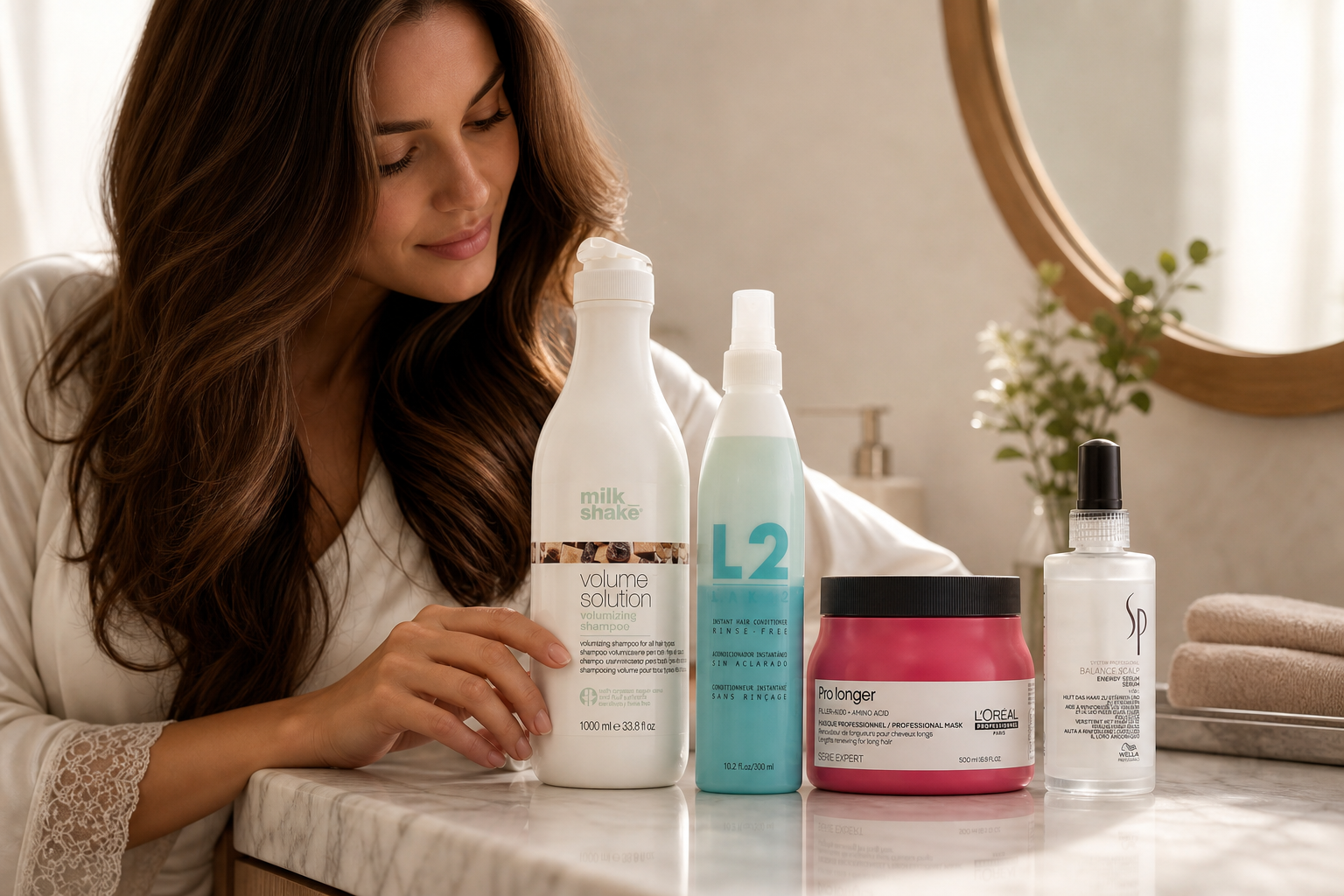
- Fine hair without volume, but healthy. The hair shines, the ends are fine, but the hairstyle falls flat by evening. The main product in the combination is a volumizing shampoo; conditioner and mask play a supplementary role and come in light textures. This includes ranges focused on density and volume — like Alfaparf Milano Semi Di Lino Density or Milk_Shake Volume Solution.
- Fine hair with greasy roots. Volume disappears quickly because the hair at the root is weighed down by sebum. Here, the shampoo for the scalp is key, not volumizing styling. Suitable ranges are those targeted specifically at the scalp, such as Wella Professionals SP Balance Scalp Shampoo 1000 ml or the dermatologically focused Vichy Dercos line. Conditioner and mask remain exclusively on the lengths.
- Fine hair with dry lengths. Typically after coloring, highlighting, or frequent straightening. Roots are usually fine, but the last third of the hair is coarse and breaks. The main product in this case is a mask or treatment for the lengths, and you choose a shampoo that won't further dry out the lengths.
This division is based on one practical insight: ranges focused on the scalp and ranges focused on density and volume address two different issues. Scalp care works with the environment in which the hair grows — with sebum, itching, and a feeling of tightness. Volumizing and strengthening ranges work with the strand itself, usually by giving it body and slightly increasing its apparent diameter. If you choose a volumizing shampoo and have irritation or very quickly greasy scalp, you won't solve the cause, you'll just cover it for a day. The reverse is also true: a shampoo for a calm scalp won't bring you volume on its own.
Diagnosis has another layer that's often forgotten — how often you wash your hair. Those who wash daily can tolerate a gentler and less degreasing shampoo; those who wash twice a week will appreciate a shampoo with a more pronounced cleansing effect, as more sebum and styling products accumulate on the hair between washes. The frequency of washing also determines how often to use a mask: for fine hair, it's more about one application a week to ten days rather than a regular part of every wash.
Whichever of the three scenarios you identify with, take one rule from this section that applies across the entire selection: the finer the hair, the more important the lightness of texture over the intensity of nourishment. A rich creamy conditioner can weigh down fine hair even if it has an excellent formulation and would work great on thicker hair. For fine hair, we start with the lightest option the range offers, and move to richer care only where it's really needed — usually in the last few centimeters of the lengths.
Volumizing Shampoo as a Foundation: What to Look for in Ingredients and Which Lines Work
For fine hair, shampoo is the product that most determines the outcome. It stays on the hair for only a short time but dictates how much weight remains on it. If you choose a shampoo that weighs the hair down, no other care can compensate for it.
The most common mistake is reaching for a thick, restorative shampoo for damaged hair. These are formulated to deposit as many nourishing ingredients onto the hair structure as possible, typically with a higher content of oils and conditioning additives. This works for strong or chemically treated hair, but fine hair can't handle that much weight and will stick to the scalp once dry. Similarly, be cautious with shampoos labeled as intensely hydrating or smoothing unless your hair suffers from obvious dryness.
Three Types of Shampoos That Confuse Fine Hair
- Volumizing Shampoo — works with a light texture and a lower proportion of heavy conditioning ingredients. The goal is to thoroughly clean the hair and lift it at the roots without coating it. It often contains additives like light polymers or hydrolyzed proteins that provide support to the hair, not greasiness.
- Density Shampoo — doesn't aim for immediate volume but rather to make each hair strand appear thicker. These lines are based on protein components and often include scalp care. You'll notice the difference over time: volume is visible right after blow-drying, while density is more about the impression after several weeks.
- Scalp Cleansing Shampoo — addresses sebum production, irritation, or styling residue. It's useful when hair gets greasy faster than every two days or when your roots fall flat during the day.
Four Lines and the Situations They Suit
- Milk_Shake Volume Solution Volumizing Shampoo 1000 ml — a classic volumizing choice for hair that is healthy but lacks fullness. Light texture and economical one-liter packaging. A good starting point if you're new to volumizing care.
- Alfaparf Milano Semi Di Lino Density Thickening Low Shampoo 1000 ml — a line focused on density, ideal when you perceive your hair as thinner than before. It's worth using for several months, not just one wash.
- Davines OI Shampoo 1000 ml — a luxurious choice for fine hair that is also slightly dry or colored. It's more supple than purely volumizing shampoos, so we recommend it for those whose hair feels frizzy and unmanageable after using volumizing lines.
- Wella Professionals SP Balance Scalp Shampoo 1000 ml — reach for this when your concern is the scalp: sensitivity, quick greasiness, or discomfort after washing. It doesn't create volume but provides a clean base on which volumizing care can work effectively.
Washing Frequency and Why Two Shampoos Are Beneficial
Fine hair can usually tolerate more frequent washing than thick and coarse hair. The advice to "wash your hair less often" comes from a different world — with fine hair, sebum quickly spreads along the length, and the hairstyle falls flat even when the hair is technically clean. If you wash your hair daily or every other day, opt for a shampoo with a gentle cleansing base.
This is why it's beneficial for fine hair to have two shampoos at home and alternate them. Most washes can be handled by the volumizing one, and once a week, switch to the other — a scalp cleansing one, or a more nourishing one if your hair ends feel dry after a series of volumizing washes. This combination offers more than searching for a single shampoo that can do it all.


Light Conditioner and Mask Only for Lengths: How to Layer Without Weighing Down Your Hair
The most common reason people with fine hair skip the second and third steps of hair care is due to a single bad experience: hair becomes limp and loses volume after washing. However, the conditioner or mask is rarely to blame — it all depends on where and how much product you apply and how thoroughly you rinse it out. On fine hair, any leftover cream shows up more quickly than on coarse hair.
Application Technique: From Mid-Lengths Down and Rinse Thoroughly
Conditioner and mask should not be applied to the scalp. The roots produce their own natural oils, and the ends — the oldest and most stressed part of the hair — need the extra care. Here's how to do it:
- Squeeze out excess water from your hair with your hands after washing, or gently press it with a towel. Product will dilute on dripping wet hair, leading you to use more than necessary.
- Rub the product between your palms and apply from mid-lengths to ends, or for very fine hair, from the level of your earlobes down.
- Use sparingly — for medium-length hair, a small amount the size of an almond is usually enough, with a bit more for a mask. Excess won't improve the effect, it just makes rinsing harder.
- Rinse longer than you think is necessary. Most "weighed down" hair is simply not rinsed thoroughly enough.
Let the conditioner work briefly, for about a minute or two as per instructions. A mask deserves a longer time, but even here, leaving it on for half an hour doesn't make sense — for fine hair, longer time doesn't increase benefits, it just raises the risk of limp hair.
Conditioner: Light Instant or Richer Repair?
Light Instant Type is designed to quickly detangle hair, smooth the surface, and leave it as free as possible. This includes products like Lakmé Lak-2 Instant Hair Conditioner 300 ml — an instant treatment that works quickly and doesn't leave a film. A sensible choice if your hair is fine but basically healthy, uncolored, and just difficult to detangle.
Richer Repair Conditioner has a different job: to replenish moisture and softness in lengths where hair is damaged by coloring or hot tools. This is where Moroccanoil Repair Moisture Repair Conditioner 1000 ml from the line aimed at damaged hair or the creamy Wella Professionals SP Luxe Oil Conditioning Creme 1000 ml from the SP Luxe Oil line comes in. Liter-sized bottles are salon format.
Fine hair doesn't exclude richer conditioners, but all the above applies more strictly: smaller amounts, only on lengths, longer rinsing.
Mask: Smoothing, Length Renewal, or Protein
- Smoothing and Detangling — Davines Essential Haircare Love Smoothing Instant Mask is a smoothing mask with a short application time, suitable when your fine hair is mainly frizzy and unruly.
- Lengths and Ends — L'Oréal Professionnel Série Expert Pro Longer Lengths Renewing Mask 500 ml is from a line targeting hair that thins towards the ends and struggles to grow.
- Protein Support — L'Oréal Professionnel Série Expert Absolut Repair Gold Quinoa + Protein Masque 500 ml is aimed at significantly damaged hair. Consider it a treatment for post-coloring or after summer sun, not as a year-round standard.
How Often: Once a Week, Not Every Day
Using a mask once a week is a reasonable setting for most fine hair; for severely damaged lengths, try twice a week. Daily use isn't justified — hair can't absorb unlimited care, and the excess remains on the surface as a burden. A practical compromise: on wash days when you use a mask, skip the conditioner. Layering both products is sensible for thick and dry hair, but for fine hair, it's usually an extra layer more than needed.
When to Choose a Serum or Leave-In Treatment Instead of a Mask
There is a group of hair types for which even a mask applied only to the lengths is too much. You can easily recognize them: the day after washing, the hair looks more tired than nourished, stays flat at the roots, and the hairstyle falls apart. If you've reduced the application time and amount of the mask and the result hasn't changed, the solution isn't a different mask, but a different care texture. This is where serums and leave-in treatments make sense — they provide nourishment in a form that doesn't weigh the hair down.
Scalp Serum is applied to damp or dry scalp after washing and is not rinsed out. It works where the hair originates, so no film is left on the lengths. This group includes products like Wella Professionals SP Balance Scalp Energy Serum 100 ml, which targets scalps prone to oiliness and sensitivity. If your fine hair is mainly troubled by what's happening at the roots, this is a more logical choice than any mask.
Molecular Serum for the Hair Itself addresses the opposite situation — the hair is weak along its entire length, but the scalp is fine. Wella Professionals SP Liquid Hair Molecular Hair Refiller 100 ml is a watery serum applied to damp hair and used in small amounts. The texture is thin, closer to water than cream, so for fine hair, it can replace the mask phase without losing volume.
Leave-In Treatment is the most versatile of the three and often the easiest way to add suppleness to fine hair. There are three different formats:
- Milk_Shake Incredible Milk 150 ml — a spray milk for damp hair that combines care with detangling and blow-dry preparation. A good start if you're unsure how much care your hair can handle.
- Milk_Shake Leave In Conditioner 350 ml — a leave-in conditioner in a larger package, suitable when hair needs more than just detangling, but a mask is still too much.
- K18 Professional Molecular Repair Hair Mist 300 ml — a mist with a very light texture, often chosen by those who have colored or bleached hair. It's in the luxury segment, so bear that in mind.
The dosing rule is the same for all: start with half of what you would use for normal hair and add more based on the results. Apply leave-in treatments from chin level down, never to the roots.
To save you from starting from scratch, here are three ready-made combinations:
- Basic Light — Milk_Shake Volume Solution Volumizing Shampoo 1000 ml plus Milk_Shake Incredible Milk 150 ml as a leave-in treatment instead of a mask. Two items, minimal decision-making.
- For Oily Scalp — Wella Professionals SP Balance Scalp Shampoo 1000 ml, Wella Professionals SP Balance Scalp Energy Serum 100 ml for the scalp, and Milk_Shake Leave In Conditioner 350 ml for the lengths.
- For Fine Colored Hair — Wella Professionals SP Color Save Shampoo 1000 ml, Wella Professionals SP Liquid Hair Molecular Hair Refiller 100 ml, and K18 Professional Molecular Repair Hair Mist 300 ml as a final light layer.
If you want to create your own variant, browse our categories of shampoos, conditioners, hair masks, and leave-in treatments. And stick to the principle that always applies to fine hair: less product, lighter texture, and away from the roots.
Category
Recommended articles

"Give a girl the right shoes and she can conquer the world!" Marilyn Monroe