
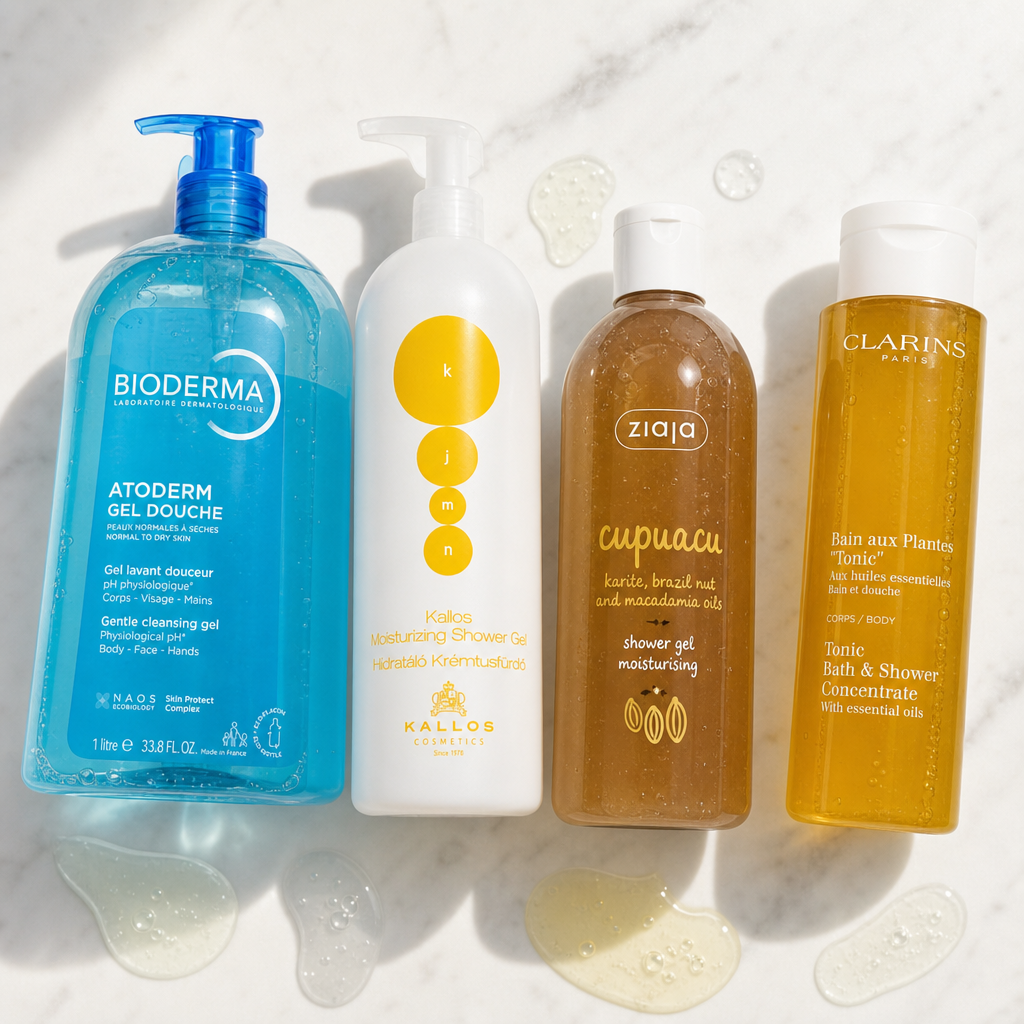
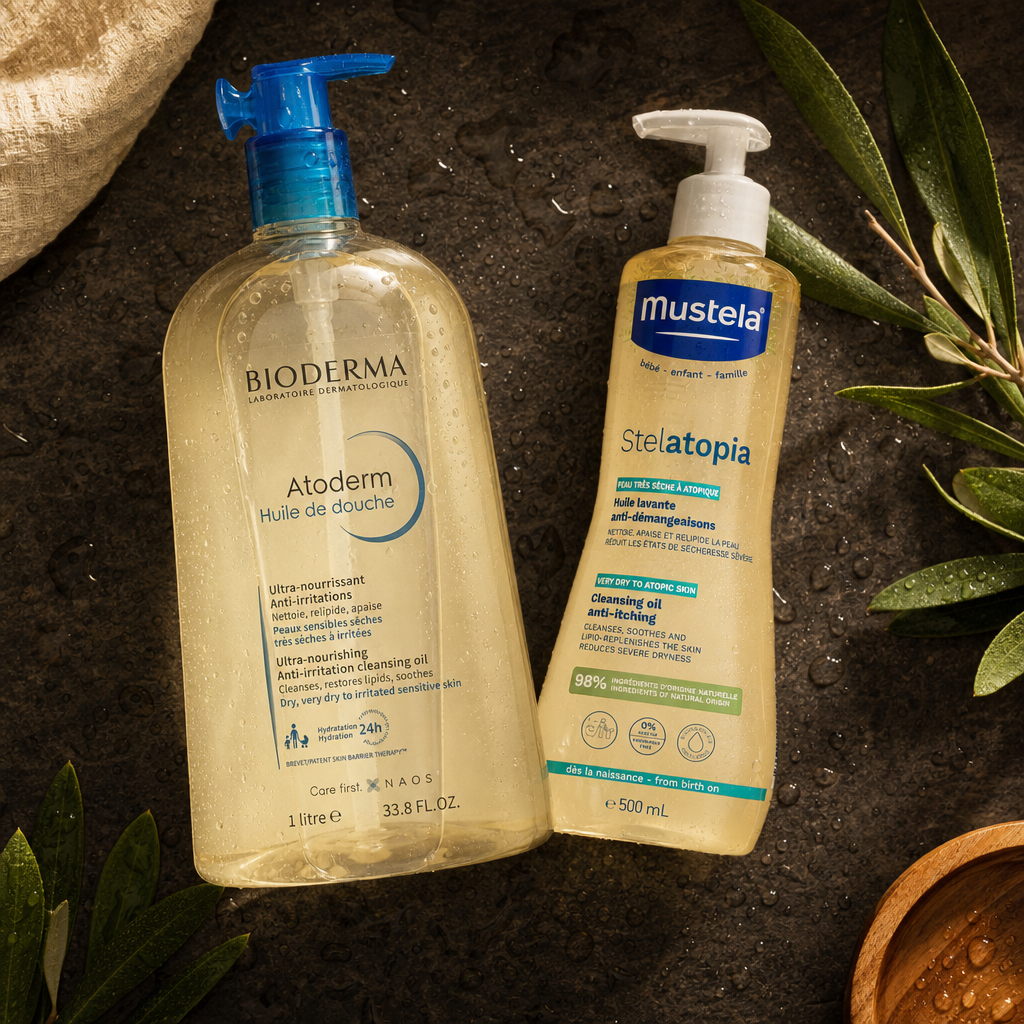

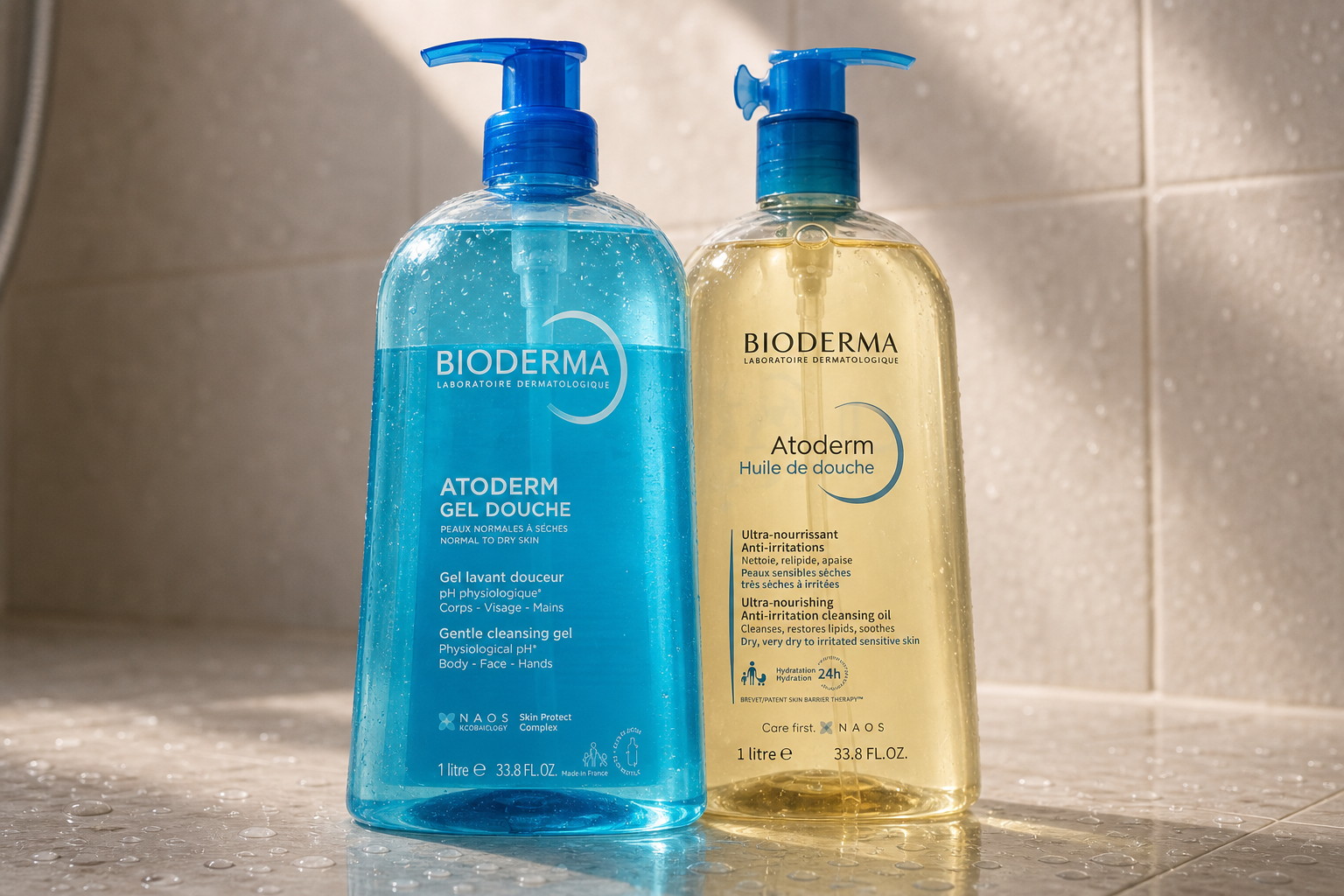
A comparison of the two most common shower care formats for anyone who is undecided. We describe the difference in texture, how they behave on the skin, and who typically prefers oil over the classic gel.
Gel or Oil? Why Shower Care Is More Than Just About Fragrance
You're standing in front of the body care aisle, holding two bottles from the same brand. They have a comparable volume, similar design, and price, but one is labeled shower gel and the other shower oil. When you tilt them, you'll notice the first difference: the gel is transparent and thick, while the oil flows more slowly and leaves a greasier trail on the bottle walls. At this point, most of us choose based on which one smells better or which one we've used before. However, the decision can be a bit more informed.
The difference between shower gel and shower oil isn't just a marketing gimmick or a matter of fragrance. They are two distinct cleaning technologies. The gel is water-based with cleansing agents that bind to oils and dirt so they can be rinsed away with water. The oil is based on an oil base supplemented with emulsifiers: when in contact with water, it transforms into a gentle milk that binds impurities in a similar way but leaves a thin film of lipids on the skin after rinsing. Both clean – just in different ways and with different resulting sensations on the skin.
It's precisely this sensation that makes it worth considering the formats. If your skin regularly feels tight on your calves or forearms after showering, if you can't do without body lotion in winter, or if your skin starts itching during a long bath, it's not necessarily a fault of your post-shower care. Often, it's a sign that the chosen cleansing format is unnecessarily stripping for your skin type. Conversely, those who shower after sports, have oily backs in summer, or simply need a feeling of freshness might miss what they expect from a shower when using oil.
In this guide, we will explore four aspects to consider when choosing:
- Texture and Behavior in Water – how the format lathers, how it's dispensed, and how it behaves when rinsing.
- Feeling on the Skin After Showering – when "squeaky clean" is desirable and when it signals a disrupted skin barrier.
- Skin Type and Season – dry, sensitive, atopic, and oily skin react differently to both formats, and their needs change throughout the year.
- Practical Aspects – dispensing, packaging size, refills, and how the format behaves in a typical home bathroom.
Let's get one thing straight right away, so you don't search for a winner in the text: neither format is universally better. Shower oil isn't a more advanced version of gel, and gel isn't a cheaper substitute for oil. They are two solutions built on different needs – and they complement each other quite well. Many people use both and alternate them based on the season, daily demands, or how their skin is behaving at the moment. The goal of the following chapters is to provide you with enough information to recognize which of the two bottles your skin needs right now when you're standing in front of the shelf.
Shower Gel Up Close – Texture, Foam, Feeling After Rinsing
A classic shower gel is essentially a water-based solution with cleansing agents, known as surfactants, dissolved in it. These molecules have two ends: one binds to water, the other to grease. When you spread the gel on damp skin, the surfactants envelop skin oils, cosmetic residues, and impurities, holding them in small clusters and carrying them away with the water when rinsed. This explains the gel's behavior: it cleans quickly, rinses off without residue, and leaves almost nothing on the skin.
The texture is more of a technical feature than a manufacturer's whim. Thickeners give the gel a consistency that doesn't run off your hand before you can apply it. A transparent thick gel and a milky creamy gel mainly differ in how they spread – their cleansing principle is the same.
Why Gel Foams and What Foam Really Means
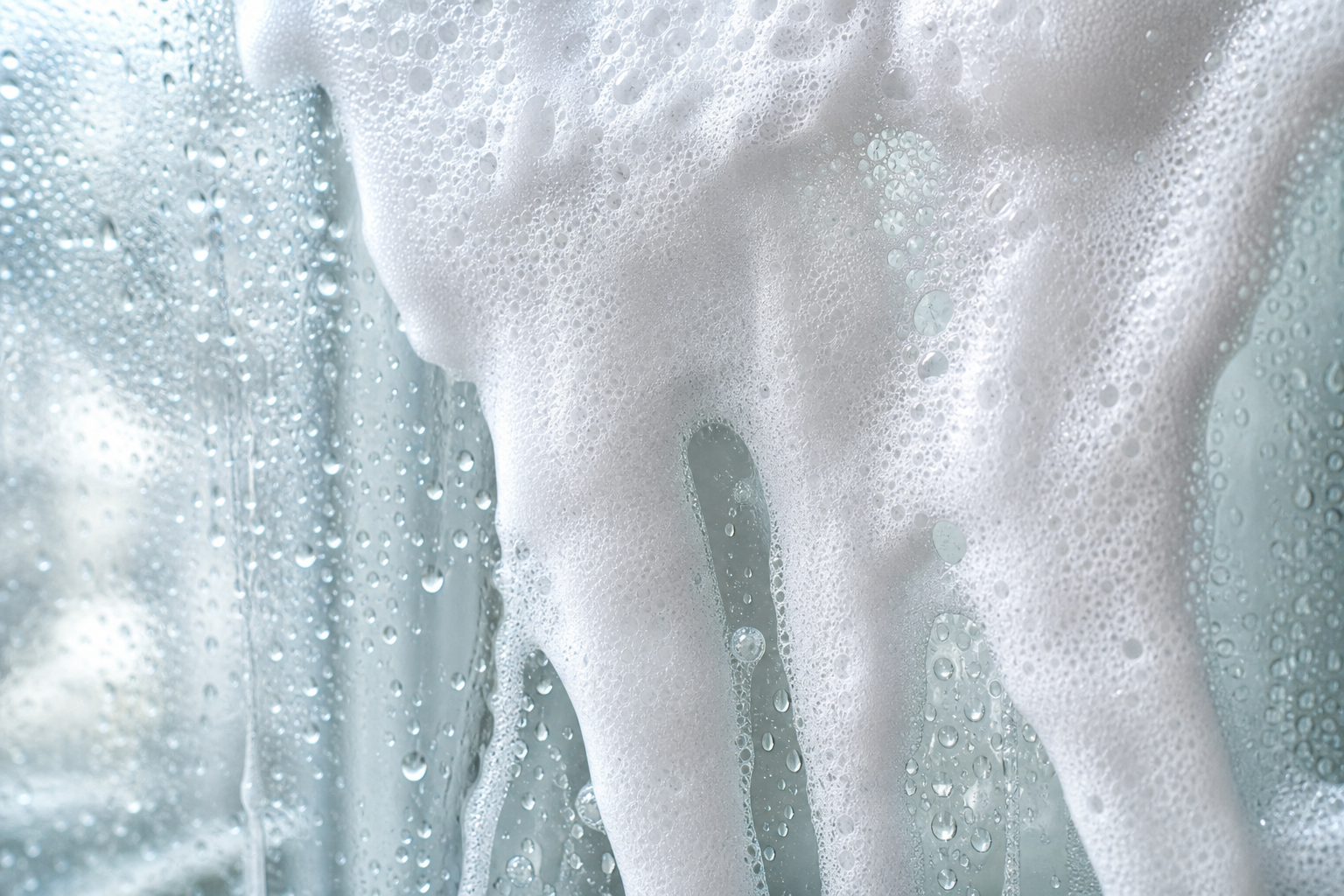
Foam forms when surfactants reduce the surface tension of water, and you work air into the mixture by rubbing it between your palms or with a washcloth. It's a pleasant sensory signal because we subconsciously associate rich foam with cleanliness. However, the amount of foam doesn't necessarily indicate how thoroughly the gel cleans – many gentle formulations foam only slightly yet remove impurities just as effectively. If a gentler product seems to "do nothing," it's often due to a habit of more pronounced foaming.
Squeaky Clean Skin – When It's Okay and When It's Not
The feeling when skin literally squeaks under your fingers after drying arises because, along with impurities, some natural lipids and the water film on the surface have also been removed. For skin prone to oiliness, such a result can be pleasant and temporarily desirable. The problem arises when tension, dryness, or itching accompany it.
A simple guideline: observe how your skin behaves a few minutes after drying. If it's calm, supple, and you don't immediately need body lotion, the formulation suits you. Conversely, if it tightens or starts to itch, it's unnecessarily stripping for your skin. Water temperature and shower duration also play a role – skin dries out faster in hot water.
Regular Cleansing Gel and Gentle Soap-Free Variants
Traditional soap has an alkaline pH, whereas healthy skin's surface is slightly acidic. This difference is why skin tends to be drier after using soap-based products compared to modern gels. Soap-free gels, also known as syndets in cosmetics, rely on milder surfactants and are often adjusted to a pH close to that of the skin. In practice, you can recognize them by several features:
- they foam more creamily than richly, and the foam dissipates more quickly,
- they are often intended for sensitive, dry, or atopic skin,
- they contain soothing and moisturizing ingredients to mitigate drying,
- they are often available in larger volumes because they are used daily and on the entire body.
The difference between regular and soap-free gel is not that one cleans and the other doesn't. They differ in the strength with which they affect the natural lipid film.
When Gel Makes the Most Sense
Shower gel is a practical choice wherever you want a quick and fresh wash without feeling like something is left on your skin. It's typically suitable:
- after sports and physical work, when you need to reliably wash away sweat and grease,
- in summer and on hot days, when you shower more frequently and appreciate refreshment,
- for skin prone to oiliness, which prefers a lighter result without a film,
- during morning showers, when washing also serves as a wake-up function.
Additionally, gel has one subtle advantage: it's easy to dispense and spreads easily even with a washcloth. If your skin remains comfortable after using it, there's no reason to look for something else – and if tension arises, it's worth comparing different textures.
Shower Oil: How the Lipid Film Works on Your Skin
You can recognize shower oil by its behavior in the bottle – it's thicker and flows noticeably slower when tilted. The key difference, however, becomes apparent when it meets water. Instead of forming an immediate lather, it first adheres to the skin as a continuous oily layer and only turns into a light milk after adding water. This process is called emulsification – and it's the entire principle of this format.
From Oil to Milk: The Role of Emulsifiers
The oil base itself wouldn't wash off with water; instead, it would remain on the skin as a greasy film. That's why emulsifiers are added to shower oils, substances capable of combining oil and water into one stable mixture. Once you add water in the shower, the oil layer disperses into microscopic droplets, forming a milky emulsion. This emulsion binds impurities, sweat residues, and sebum, allowing them to be rinsed away – achieving the same result as foam, just by a different method.
This is where the most common misunderstanding arises. Foam signals to us that cleaning is happening, so a format that only shows a hint of it seems insufficient. However, the amount of foam doesn't indicate cleansing ability – it's a side effect of certain types of surfactants, not a measure of effectiveness. Shower oil does indeed clean the skin, even if it doesn't turn into a thick foam cap in your hands.
What Remains on the Skin After Rinsing
For this format, what happens at the end is most defining. Some lipids from the oil base aren't completely rinsed away by the emulsion and remain on the skin surface as a very thin film. It's not visible and, with proper dosing, not greasy either, but it changes the feeling after drying: the skin doesn't feel tight and doesn't immediately call for body lotion as soon as you step out of the shower.
This relates to the structure of the skin barrier. Its outermost layer holds together partly thanks to lipids, which fill the space between dead cells and reduce water evaporation. Every wash disrupts it to some extent. For skin in good condition, the balance quickly restores, but for dry or irritated skin, it takes longer. The oil base works in the opposite way – it returns some lipids during washing. This explains why shower oils are mainly found in product lines intended for dry and itchy skin and why people with sensitive skin often perceive them as a gentler option.
Practical Drawbacks That Are Less Talked About
Shower oil also has its "buts," and it's worth knowing them in advance. Most disappointments with this format stem from using it the same way as gel.
- Slippery Bathtub and Shower. Lipids don't just settle on the skin but also on the bathtub surface. In the tub, especially when seniors or small children are showering, a non-slip mat and more frequent cleaning of the surface are advisable.
- Different Dosing. Oils are often concentrated, so a dose equivalent to gel is unnecessarily large. Start with a significantly smaller amount and add more only if it doesn't cover the entire body.
- Different Application Method. Oil belongs on damp, not soaked skin. If you massage it briefly into the skin before adding water, emulsification occurs evenly, and the format shows what it can do.
- Getting Used to a Different Feel. In the first few days, the skin may feel "unclean" after drying – in reality, it's the mentioned lipid film. If this feeling bothers you even after two weeks, it's not a failure; the format just doesn't suit you.
- Stains on Textiles. Washcloths and towels may absorb oil residue over time; washing at a higher temperature or using a dedicated washcloth for showering solves this.
Therefore, shower oil is most beneficial where a slight difference in gentleness adds up – during daily full-body washing.


Dry, Sensitive, or Oily Skin – Which Format Suits Whom
The difference between gel and oil becomes apparent only when applied to specific skin types. The same formulation that leaves one person feeling pleasantly refreshed may leave another with tight, itchy skin. The following overview considers skin types one by one and suggests which format usually works best – and why that is.
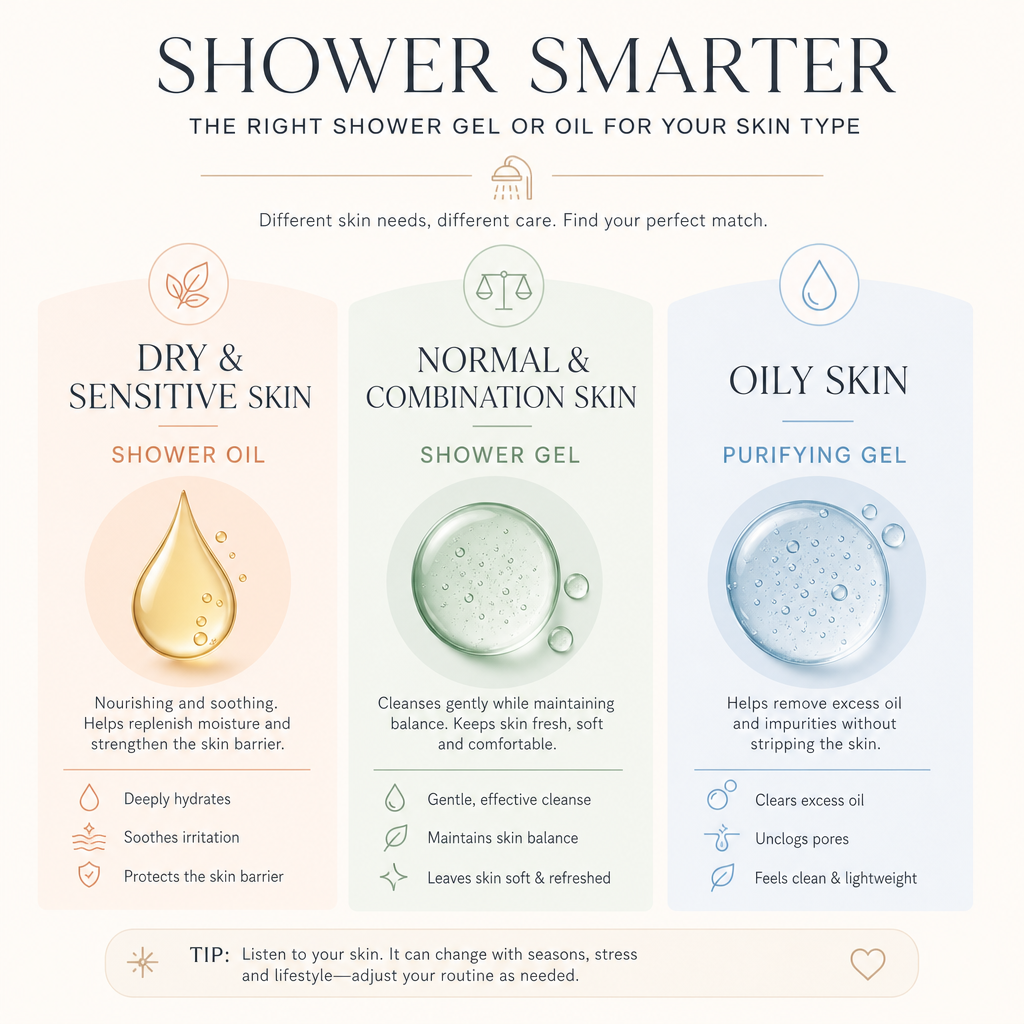
Normal and combination skin have the most freedom of choice. The skin barrier functions well, sebaceous glands work evenly, and you can generally tolerate both. The deciding factor here is the feeling after a shower: if the gel leaves your skin feeling pleasantly fresh and you don't need to reach for body lotion after every shower, there's no reason to change anything. However, if dry patches start appearing on your shins or arms at the end of winter, oil is a logical next step.
Oily skin and backs prone to imperfections usually benefit from gel. A water-based formula with surfactants handles sebum and sweat without leaving a film on the skin, which some people find unnecessary on their backs or décolletage. The goal is not to strip the skin of every last bit of oil – overly aggressive cleansing can cause sebaceous glands to react even more vigorously. Therefore, a milder cleansing gel used daily is often wiser than a harsh formulation.
Sensitive skin most often reacts to two things: fragrance and the strength of surfactants. Both options are open here. You can either choose a gentle soap-free gel with low fragrance or switch directly to oil, which cleanses the skin more gently by its very nature. A practical guide: if your skin itches in thin areas after a shower, try an oil format before reaching for another gel.
Dry, itchy, and atopic skin is a group for which oil or oil balm is most often recommended. The reason is simple: such skin has a permanently disrupted lipid layer, and each wash weakens it further. An oil base returns some of the lipids, so after rinsing, there is no feeling of tightness, and subsequent body care has a foundation to build on. However, for atopic skin, choosing a cleansing product is just one piece of broader care – follow your doctor's or pharmacist's recommendations, as a magazine text cannot replace them.
Seasonal Changes and Shower Frequency
Skin type is not the only variable. The season and how often you shower also play a significant role. In winter, several factors converge: heated interiors dry out the air, we shower warmer than we should, and the skin is wrapped in layers of clothing all day. The need for oil care increases in cold months even for those who manage with regular gel in summer. In summer, the situation is reversed – sweat, sunscreen, and more frequent showers call for a fresher gel that rinses off quickly and leaves nothing extra on the skin.
- Reach for oil when your skin feels tight, itchy, or flaky after a shower, and generally during the heating season.
- Gel makes sense after sports, on hot days, and whenever you need to reliably wash off sweat and sunscreen residue.
- If you shower more than once a day, consider using oil for at least one of the washes – repeated showering stresses the barrier the most.
And a final note: choosing a format is not a lifelong commitment. There's nothing wrong with having both bottles in the shower and alternating them according to the day, weather, and how your skin is behaving. Gel in the morning after a workout, oil in the evening in December – such a regime is legitimate and often more effective than searching for a single universal product for the whole year.
How to Choose – Specific Tips for Everyday Showering
The theory about surfactants and lipids is useful, but when you're at the shelf, you need to decide quickly. It helps to break down your choice into a few questions and go through them one by one.
Five Questions to Guide You to the Right Choice
- How does your skin feel shortly after a shower? If about ten minutes after drying off you feel the need to reach for body lotion because your skin feels tight or slightly itchy, that's a strong argument for an oil-based option. If you feel comfortable and don't need to add anything, the gel is doing its job.
- What is the season? The heating season, dry office air, and frost outside shift the need towards oil. In summer, when you shower more often and mainly want to refresh, a lighter gel is usually more pleasant.
- How often and how long do you shower? A short lukewarm shower once a day can handle almost any formulation. Two hot showers a day put much more strain on the skin barrier, and in such a routine, a gentler oil or soap-free gel pays off.
- How much product do you actually use? Estimate how long your current bottle will last. If a 200ml bottle disappears in three weeks, a larger volume is more practical and cheaper per use.
- Does the brand offer a refill? In dermocosmetic lines, refills are often a standard part of the range. This means less plastic in the bathroom and usually a lower price per milliliter than a new bottle with a pump.
What to Look for on the Label
You don't need to read the composition down to the last line. Just a few pointers:
- Format designation. French lines use the term gel douche for shower gel and huile de douche for shower oil. This helps you distinguish between both options of the same line, even if they have almost identical packaging.
- Soap-free base or skin-friendly pH. This is often a sign of a gentler cleansing formulation, typically in lines for sensitive and dry skin.
- Fragrance. If you react to scents with irritation, look for fragrance-free options. The product may stay on the skin briefly, but with daily use, the difference becomes noticeable.
- Volume and refill availability. Always compare the volume information along with the price per milliliter, not just the shelf price.
When Larger Sizes Are Worth It
Shower care is consumed much faster than skincare. While a serum lasts for months, shower gel or oil is often used by the whole household daily. That's why liter sizes are commonly sold in this category, which wouldn't make sense for skincare. A large volume costs more upfront, but the price per wash drops significantly below that of small bottles. With a refill, the difference becomes even more pronounced.
How to Try the Format Before Buying a Liter
Switching to shower oil doesn't have to start with buying the largest size. It's wiser to get the smallest available size, ideally travel-sized, and use it for two to three weeks in a regular routine. That's the time after which you'll know if your skin has stopped feeling tight after a shower and if you prefer the different dosage and less pronounced lathering. Only then does it make sense to switch to a large bottle with a refill.
Combining both formats also proves effective: gel in the morning for a quick refresh, oil in the evening or on days when the skin is irritated. Two bottles in the bathroom are not a luxury but a way to respond to current needs.
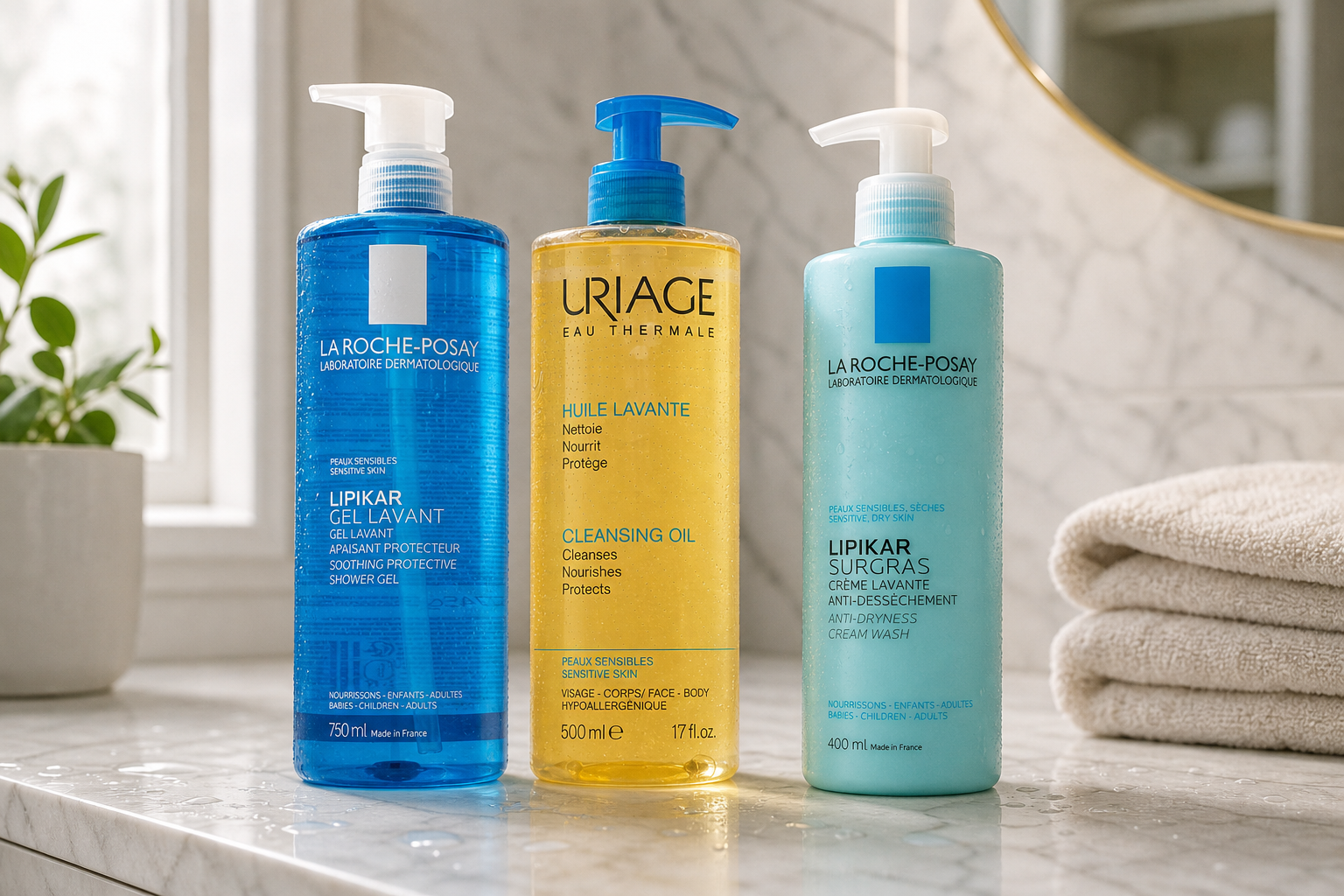
In the body care category, you'll usually find both options side by side, often within the same product line. This is especially true for dermocosmetic brands like Bioderma, Uriage, or La Roche-Posay, where both shower gel and shower oil are available in large volumes and often with a refill option. When you choose one line and stick with it, it's easier to recognize what works well for your skin.

Category
Recommended articles

"Give a girl the right shoes and she can conquer the world!" Marilyn Monroe