


Fine hair may start the day with volume but often falls flat by evening – and it's not by chance. In this article, we explore what truly boosts volume and what detracts from it, from shampoo choices to drying techniques.
Why Fine Hair Falls Flat Before the Day Ends
You probably know this well: you leave the bathroom in the morning with a voluminous hairstyle, roots holding strong, and your hair looking thicker than it actually is. But by noon, the volume starts to fade, and by afternoon, your hair is flat against your head with a lackluster crown. It's not because you're making a major mistake in your hair care routine – fine hair simply behaves differently than thick hair and holds its shape for a shorter time.
The difference lies in the diameter of each hair strand. Fine hair is thinner, has less mass, and lower stiffness, making it bend more easily and struggle to return to its original shape. This doesn't mean there are fewer hairs – fine hair and thin hair are two different things, and many people have a full head of very thin hair. That's why your hairstyle looks full right after blow-drying but gradually falls flat throughout the day: as soon as moisture in the air, the weight of the lengths, scalp oils, and product residues start affecting the roots, the fine hair can't hold up.
Volume Starts at the Scalp
Here's a crucial shift in thinking. Volume doesn't originate in the lengths, but in the first few centimeters at the roots. If the hair grows out of the scalp pressed against it, applying care to the ends won't fix it. Conversely, if the root area remains light and clean, the hair naturally lifts from the scalp, making the style appear fuller, even if the hair itself is thin. Therefore, volume is largely a matter of what happens at the scalp – how often and with what you wash, how much residual care remains on the hair, and the direction in which you dry your hair.
This relates to another surprising fact: fine hair can handle significantly less care than thick hair. The same amount of conditioner that benefits coarse hair will weigh down fine hair and pull it towards the scalp. Volume can't be "applied" – more product usually adds weight, not fullness. The habit of reaching for another dose when your hairstyle falls flat often deepens the problem instead of solving it.
Throughout this article, we'll focus on three levers that matter most for fine hair:
- Choice of cleansing care – selecting a lightweight formula to keep hair clean and roots free.
- Drying technique – the way you dry your hair affects volume more than any single product.
- Appropriate dosing – where to apply the product, how much to use, and what to avoid with fine hair.
The good news is that volumizing care is no longer a niche concern. You can find lines designed for fine hair across categories like Shampoos, Hair Mousses, and Styling Sprays, allowing you to create a complete routine from washing to final fixation without resorting to heavy products meant for other hair types. In the following sections, we'll explore what makes sense to choose and why.
Cleansing Care as the Foundation of Volume: Lightweight Shampoos and Conditioners
Volume isn't determined at the blow-dryer, but in the shower. Fine hair has a smaller diameter than thick hair, so it can only carry a limited amount of conditioning substances – anything extra left on after rinsing will weigh it down. That's why those with fine hair often feel that their care products aren't working: the cleansing product is chosen based on preference, not on what the hair can actually handle.
Why Dense Cleansing Care Weighs Down Roots
Intensely nourishing shampoos and conditioners contain a higher proportion of conditioning ingredients. These are deliberately deposited on the hair's surface, and some remain after rinsing – for coarse, porous, or chemically treated hair, this is exactly what's expected. However, for fine hair, the same layer means the strands stick together, lose friction, and fall flat against the head. You'll notice it right after washing: the style looks clean but flat.
The scalp also plays a role. Fine hair is often dense in number but thin in diameter, so more sebum and styling residues can easily accumulate at the roots than they can handle. Therefore, the shampoo should really cleanse them, not just superficially refresh.
What to Look for on the Label
- Labels like volume, volumizing, or plumping – these lines are formulated lighter than nourishing variants and aim to make the hair appear thicker, rather than coating it.
- Shampoos for the scalp – they focus on roots and styling residues. It's worth including them in an otherwise volumizing routine.
- The position of oils and butters in the ingredients – the higher they are listed, the greater their proportion in the formulation, and the more likely fine hair will feel them.
Specific Choices from Our Range
Whether volume is your main concern or you have a more sensitive scalp, these clearly profiled shampoos make sense for fine hair:
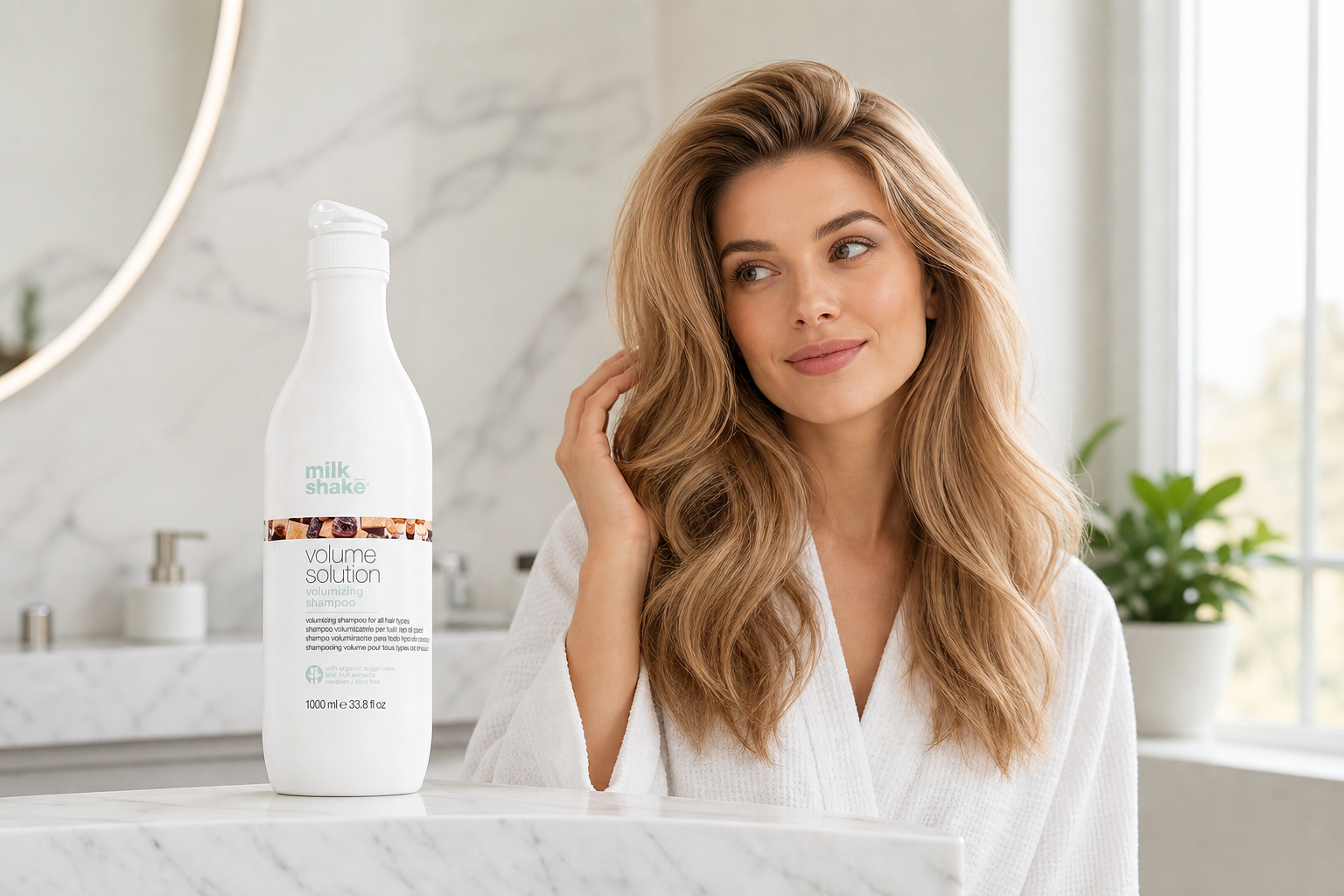
- Milk_Shake Volume Solution Volumizing Shampoo – a straightforward volumizing choice for regular washing. Suitable when hair isn't damaged and you're just looking for a lighter everyday base.
- Kevin Murphy Plumping.Wash – a line designed for hair that appears thin and lacking body. Opt for it when you want not only cleanliness from washing but also a feeling of thicker hair.
- Wella Professionals SP Balance Scalp Shampoo – an option for when a sensitive scalp is the main issue and volume is a secondary concern.
Conditioner Yes, but Elsewhere
Skipping conditioner entirely can be counterproductive: dry lengths are harder to comb, become static, and you won't gain volume from them anyway. The difference lies in which conditioner you choose and where you apply it.
For fine hair, a light, fast-acting option applied exclusively to the lengths and ends, such as Lakmé Lak-2 Instant Hair Conditioner, works well. Avoid the roots completely – that's where lift is created or not, and a conditioning layer will reliably flatten it. A practical guide is to apply conditioner from chin level downwards and comb it through with your fingers.
Washing Frequency and Thorough Rinsing
For fine hair, frequent washing is fine – even every other day if the roots require it. Base it on when the hair starts to feel heavy at the roots, not the calendar. If you want to ensure the roots are truly clean, apply shampoo twice: the first dose dissolves sebum and styling, the second washes clean hair and requires less time.
The last, easily overlooked step is rinsing. Any leftover shampoo or conditioner at the roots will manifest as a greasy stripe along the parting after drying, and a hairstyle that holds its shape only until lunchtime. Rinse with lukewarm water longer than you think necessary, and run your fingers through the roots all over the head, including the nape, where shower water doesn't naturally reach.
What Weighs Down Hair: Oils, Masks, and Heavy Smoothers
Fine hair rarely becomes limp due to a single bad product. More often, it's a combination of steps that aren't mistakes on their own – a rich restorative mask, a few drops of oil for shine, and a leave-in milk for easier detangling. Each adds a thin layer to the hair, and when combined, they create a film that the hair simply can't support. Your hairstyle falls flat before you even make it to work.
This doesn't mean fine hair should forgo care. It just means that application location and amount play a bigger role than they do for thicker hair. The same product can help one type of hair and take away volume from another – the difference often lies in where it's applied.
Restorative Masks Belong on Lengths, Not Roots
Thick masks are designed to stay on the hair for a while and replenish what damaged lengths lack. Wella Professionals SP Luxe Oil Keratin Restore Mask is exactly the type of care appreciated by dry ends after coloring or a summer by the water – and at the same time, it's the type that reduces volume the most at the roots of fine hair. If you spread it over your entire head, you're applying a rich texture to parts of the hair that don't need regeneration.
The guideline is simple: start the mask about halfway down the length and continue to the ends. For fine hair, shorter exposure and lower frequency work better – once a week is usually enough, every other day and the burden starts to add up. If your hair feels smooth after the mask but limp at the roots, the issue isn't the formula, but how high it was applied.
Not All Oils Behave the Same
The difference between variants of the same line is most often underestimated with oils. Moroccanoil Treatment Light behaves differently than the classic full version – it's designed for lighter and finer hair and spreads into a much thinner layer. Conversely, Wella Professionals SP Luxe Oil Reconstructive Elixir is more concentrated and for fine hair, it should only be applied to the ends.
Dosage is equally important for both. For fine shoulder-length hair, one to two drops are enough, first rubbed in the palms and then applied to the ends. If you apply the oil directly to the hair, it remains concentrated in one spot and creates a greasy streak that no amount of combing can distribute.
Leave-In Care: Where It's Easiest to Overdo the Dose
Leave-in products stay on the hair all day, so mistakes in quantity show up the fastest. Selective Professional OnCare Smooth Hair Cuticle Smoothing Milk or Revlon Professional Uniq One All In One Treatment work well on fine hair – but in a really small dose and applied from the ears down.
- Smoothing Milk – for fine hair, about the size of a pea for the whole head, apply to damp lengths, never to the roots.
- Leave-In Spray – two to three sprays from about 20 cm away, aimed at the lower half of the hair, not from top to bottom.
- Oil – one to two drops, just the ends, as the last step in the routine.
- Mask – from the middle of the length to the ends, preferably once a week rather than every other day.
The purpose of smoothing milks and creams is to smooth and calm the hair – the exact opposite of what you need at the roots. Smoothing is therefore meant for where the hair splits and frizzes, in the lower part of the lengths.
A Simple Rule Worth Remembering
The more nourishing a product is, the lower it belongs on the hair – and the less frequently it should be used. Roots can only handle a light watery texture, the middle part of the lengths can handle conditioner and milk, and the ends can take a mask and oil. If you're unsure about a new product, start with half the dose and apply it a level lower than you would expect. You can always add more, but you can only remove it with another wash.
Drying and Styling: Techniques to Maintain Volume
For fine hair, volume often depends more on technique than on the amount of product used. A hairdryer can both create and flatten shape – it all depends on when you start drying, where you direct the airflow, and how you finish the process.
Start with Towel-Dried Hair
First, squeeze excess water from your hair into a towel – don’t rub, just press it with your hands. On soaking wet hair, styling products dilute and the hairdryer spends unnecessarily long drying time. The right moment to apply product is when the hair is noticeably damp but no longer dripping.
Apply mousse specifically to the roots, not along the entire length. Wella Professionals EIMI Volume Extra Volume is a classic volumizing mousse that supports the roots without needing to coat the entire length. For fine hair, usually one or two pumps around the crown area and distributing the product with your fingers into partings is enough.
If you plan to use a flat iron or curling iron, add heat protection – such as Sebastian Professional Trilliant Spray, which is applied before heat styling. Over-dried hair becomes frizzy, and the rougher surface looks more disordered than voluminous.
Roots Up, Head Down
Volume is created in the first few centimeters at the scalp, so that's where most of the blow-drying time should be spent. Bend your head forward, run your fingers freely through the roots, and direct the airflow from above, from roots to ends – this smooths the cuticles and keeps the hair shinier.
When the hair is about eighty percent dry, straighten up and finish drying into shape. A small trick helps: flip your parting to the opposite side from where you usually wear it, and then flip it back. The roots will stand slightly against the direction, giving the crown height that straight drying wouldn't achieve.
Cold Air Instead of Extra Hairspray
Dedicate the last minute of drying to cold air. Heat shapes the hair, while cold air sets the shape – that's why it makes sense to blow each strand with a cold stream after drying and let it cool down for a while, ideally without further touching. For fine hair, this is the cheapest way to extend the hairstyle's longevity and often replaces one layer of hairspray.
Tools That Make a Difference for Fine Hair
- Olivia Garden Ceramic+Ion Thermal Brush 55 mm – the ceramic body heats up from the dryer and shapes the strand from the inside. The 55 mm diameter is suitable for medium to long hair: it lifts the roots and gently curls the ends.
- Tangle Teezer Wet Detangler – for detangling wet hair, which is most vulnerable. Gentle detangling before drying means fewer broken hairs, and thus fewer short, sticking-out ends that detract from the neatness of fine hair.
Finishing Touches and Choosing Hairspray
For finishing touches, a product with a texturizing effect is suitable, like Wella Professionals EIMI Texture Pearl Styler. Rub a small amount between your palms and run it only over the surface and ends – the strands will separate, and the hairstyle will look fuller. Do not apply it to the roots, as it would weigh them down.
Choose hairspray based on what you expect from the hairstyle. For a regular day, a light misting from about thirty centimeters away is enough, giving the hair just a light veil and keeping it movable. If the shape needs to last all day or for an evening event, opt for stronger hold: Goldwell Salon Only Hair Lacquer Mega Hold or Schwarzkopf Professional Silhouette Super Hold Hairspray.
In general, use less hairspray than you might expect: fine hair clumps into flat strands under a heavy layer, and the volume disappears quickly. A thin layer is more practical, which you can repeat after it dries if necessary.
Routine for Fine Hair: What to Choose from Our Range
In summary, caring for fine hair doesn't rely on a single miracle product but on a routine that makes sense. Volume is maintained through a combination of gentle washing, targeted care just for the lengths, patient drying, and an additional styling product for days when your hairstyle needs to last from morning till night. Below, you'll find the routine broken down into simple steps along with specific products from our range to help you create a starter kit.
Simple Weekly Plan
- Wash two to three times a week. Determine the exact frequency based on how quickly your scalp gets oily. Apply volumizing shampoo mainly to the roots; the lengths will rinse themselves during washing.
- Conditioner only on lengths and ends. Leave about a palm's width from the roots to keep hair soft without flattening at the scalp.
- Preparation for drying. On damp hair, apply a thin layer of mousse to the roots and heat protection to the lengths, in this order.
- Drying as part of styling. Dry the roots first while the hair is still damp and moldable.
- Extra days. On the second and third day, refresh the hairstyle mainly at the roots rather than the entire length, and use styling products selectively, not broadly.
Starter Kit from Our Range
Four products that work together and cover the entire week. We selected them so their effects don't overlap and none of them unnecessarily weigh down the hair.
- Milk_Shake Volume Solution Volumizing Shampoo as the foundation of your washing care. A volumizing shampoo for fine hair that rinses out well, leaving no residue on the roots.
- Lakmé Lak-2 Instant Hair Conditioner as a leave-in treatment. It is sprayed onto the lengths, detangles them, and requires no rinsing, allowing you to control the amount used.
- Wella Professionals EIMI Volume Extra Volume as a mousse for the roots. A classic mousse that supports the hair before drying; usually, two to three pumps are sufficient.
- Sebastian Professional Trilliant Spray as heat protection. Spray on the lengths before blow-drying or straightening, enabling styling at a lower temperature.
Options According to Budget
You don't have to purchase the entire routine at once. If you're unsure where to start, begin with the shampoo and mousse, as they determine how the hair looks at the roots.
- Economical option. Wella Professionals EIMI Volume Extra Volume mousse complemented by Revlon Professional Intercosmo Il Magnifico 10 Multibenefits Intense Mask Spray as a leave-in spray. Finish with Wella Professionals Performance Extra Strong Hold Hairspray, applied from a greater distance.
- Balanced option. The set described above, or with Tigi Bed Head Small Talk Thickening Cream instead of mousse if you prefer a creamy texture.
- Premium option. Kevin Murphy Plumping.Wash shampoo for those who want to invest more in washing care, with no changes to the rest of the routine.
Finally, a small note on expectations: volume for fine hair is built over weeks, not after a single wash. Try the routine for a month and then assess what worked for you and what didn't. You can assemble the rest of your routine from the categories Shampoos, Hair Mousses, and Leave-In Treatments, where you'll also find smaller sizes to test the care at your leisure.


Category
Recommended articles
"Give a girl the right shoes and she can conquer the world!" Marilyn Monroe