

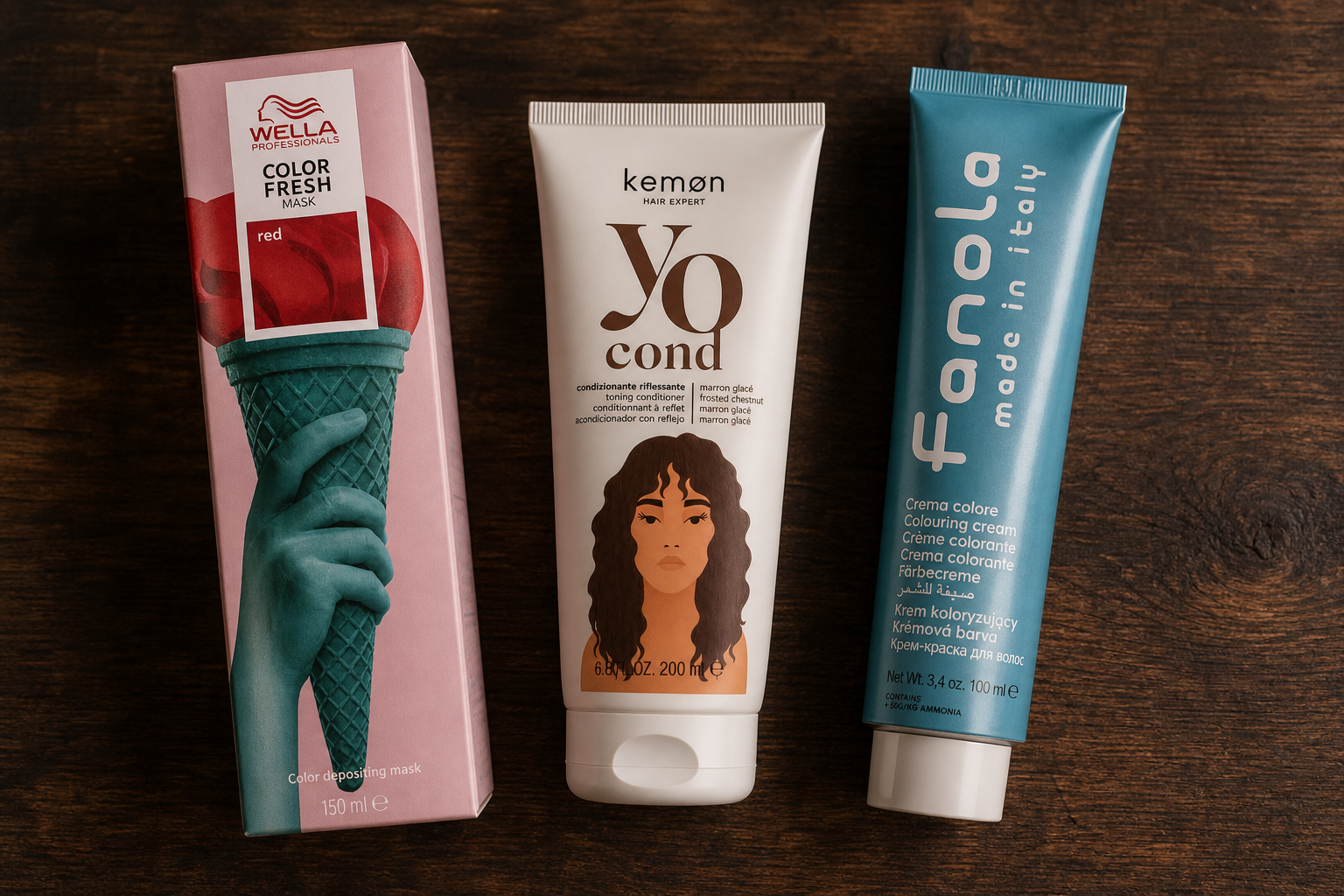
A guide for readers looking to transition into warm shades this autumn and seeking specific product pathways. We'll explore five professional brands – Wella Professionals, Schwarzkopf Professional, Kemon, L'Oréal Professionnel, and Fanola – and highlight how each approaches red, copper, and chestnut differently.
Wella Professionals: Copper Tones with Tonal Masks and Coloring Creams
Autumn is the perfect time to shift your hair color into the warm spectrum. Summer often strips some pigment from your hair, roots become more noticeable than in spring, and your skin gradually loses its tan – cool ash tones can appear flat in the greyer light. A warm shade, on the other hand, maintains contrast, brings color back to your face, and is more forgiving on roots than a bold cool blonde. But before you reach for a specific product, it's worth clarifying which shade you're actually aiming for.
The warm spectrum isn't just one color, but three quite distinct tones:
- Red is the most vibrant and striking of the trio. It uses a large pigment molecule that tends to stay on the hair's surface, making it the most demanding in terms of maintenance.
- Copper is based on an orange undertone. It shines on light brown and darker blonde bases without going to extremes, and acts as a natural midpoint between red and brown.
- Chestnut is a brown with a warm reddish hue. It's the most subdued, handles regrowth best, and is often the easiest first step if you haven't changed your color before.
Copper is where Wella Professionals really shines. In Brasty's hair care range, it's the most prominently featured professional brand – with over nine hundred items in the catalog, it holds the largest share of total hair care sales. Practically, this means you can find the entire path to your desired shade, not just a single product: toning, coloring cream, and subsequent care all from the same brand.
Two Paths to a Copper Shade
The brand's approach to warm tones is based on gradually warming the color. Instead of a single leap from a cool shade to a vibrant copper, the shade progresses in steps, which makes sense especially if you're unsure how a warm undertone will suit you.
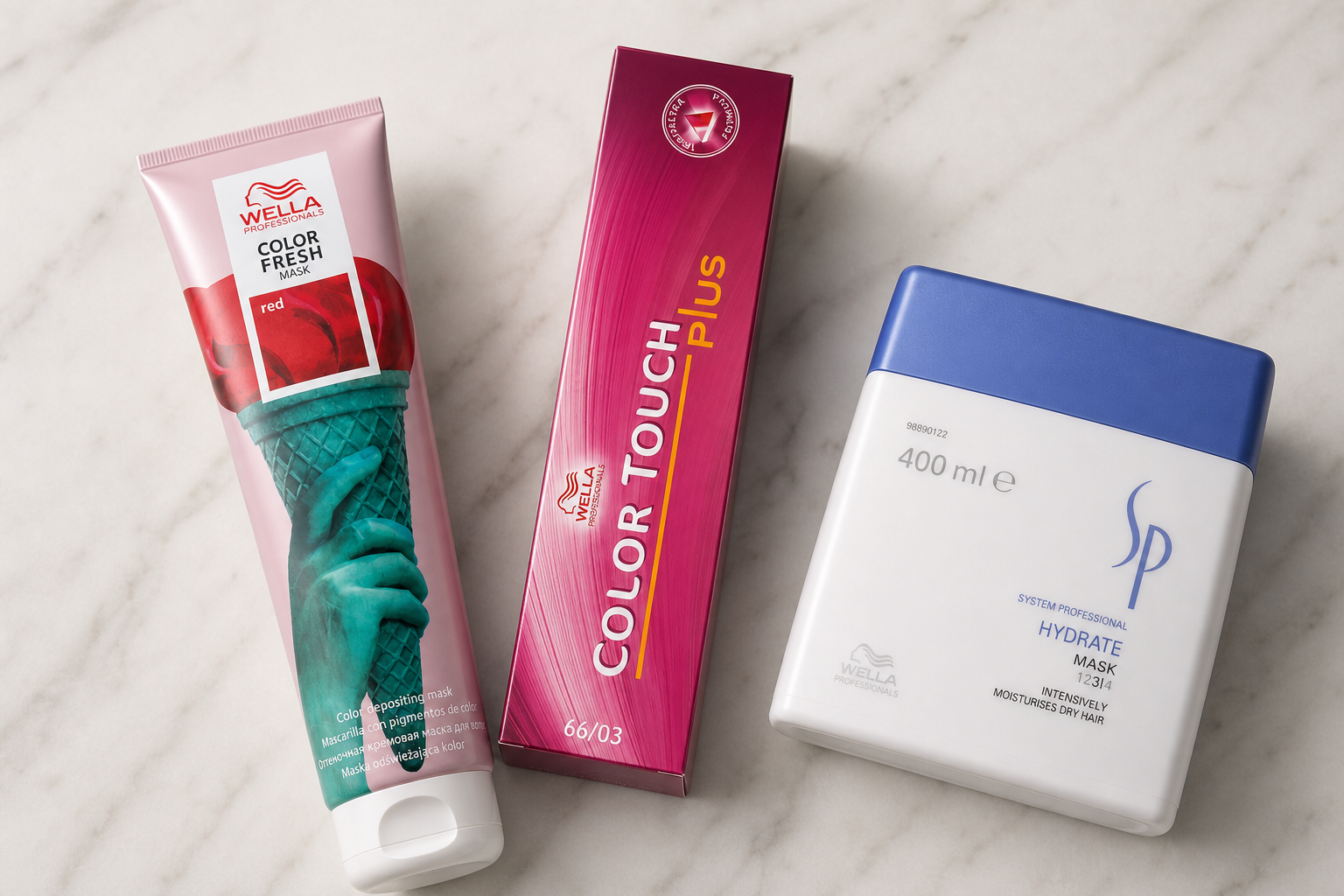
- Toning Masks – The Color Fresh Mask line combines pigment with the texture of a mask. You apply it to washed hair, leave it on briefly, and rinse it out; the pigment settles on the hair's surface and gradually fades with subsequent washes. This way, you can try out the shade without committing to it.
- Coloring Creams – The Color Touch line works as a demi-permanent tint. It mixes with an emulsion, lasts longer than a mask, and can shift the shade significantly, but it's still not a permanent color with a sharp regrowth line. The individual warm nuances can also be mixed together, allowing you to gradually adjust the warmth.
The difference between the two paths lies mainly in longevity and how much risk you're willing to take. A mask is a reversible experiment, while a coloring cream is a decision that lasts several weeks.
Who Benefits from a Cautious Path to Copper
Gradual warming is ideal for those who have already lightened or long-term colored hair and don't want to subject it to another strong treatment. It also works well on dark blonde and light brown natural hair, where you just need to add pigment without lightening. Conversely, if you have very dark hair and want a striking copper, mere toning won't get you there – without lightening, the result will be just a subtle warm hue in the light.
Along with a warm shade, opt for care that keeps your hair supple. Copper looks best on smooth hair that reflects light; on dry and split ends, it appears dull regardless of the color quality. From Wella Professionals' portfolio, you can choose a regenerating mask and oil from the SP Luxe Oil line or the SP Hydrate moisturizing shampoo, or the Fusion intense mask for hair that's been through more coloring. The combination of a toning mask and nourishing care is also the most cautious way to try out a warm shade.

Schwarzkopf Professional: Vibrant Red with Hair Fiber Protection
Vibrant red demands more preparation than other warm shades. While copper tones can often be hinted at on a darker base and chestnut can be addressed by darkening, striking red needs a base where it can shine. For darker hair, this usually involves lightening first – and that's when the hair's structure is affected. The lightening process opens the hair cuticle and impacts the internal fiber structure; after washing, hair may feel rougher to the touch, be harder to detangle, and split ends may occur more easily.
Schwarzkopf Professional approaches this as a single integrated step. Strengthening care isn't added after coloring as a rescue operation, but is mixed directly into the coloring or lightening mixture, so the hair receives support at the exact moment it's under the most stress. In practice, this is most evident in the Fibreplex line – the Schwarzkopf Professional Fibreplex N°1 Bond Booster 500 ml is specifically designed to be mixed into the mixture to help support the hair's internal bonds during the chemical process. It's not a miraculous repair for damaged hair, but an effort to limit the extent of stress during coloring.
The difference is most noticeable in how the hair behaves in the following days: it's more manageable when detangling, less prone to static, and the color holds more evenly because it doesn't settle into unevenly damaged areas. This is particularly important for red – red pigments have smaller molecules than most other shades and wash out of porous hair more quickly. The less porous your hair is after coloring, the calmer the following period will be.
The bond-supporting system makes sense especially in these situations:
- You're transitioning from a natural dark or previously dyed base to a bright red, and lightening precedes the coloring.
- You've lightened your hair once or more in the past year, or you have highlights.
- You have fine or naturally dry hair that reacts more sensitively to chemical processes.
- You want to regularly refresh your red and are concerned about the condition of your hair after several repetitions.
It's also worthwhile even if you're only going two shades warmer and don't plan on lightening. Every coloring is a chemical intervention, even the so-called gentle ones – the difference is in degree, not principle. If you color your hair several times a year, the minor stress accumulates and manifests gradually rather than suddenly. Support during the coloring itself is cheaper and simpler than later intensive reconstruction.
Coloring is logically followed by home washing, which doesn't further burden the hair. In the brand's portfolio, this role is fulfilled by the BC Bonacure line, specifically the Repair Rescue variant focused on mechanically and chemically stressed hair. Consider it a supplement, not a replacement for salon care – the shampoo works on the fiber's surface and the feel of the hair to the touch, while the essential part has already occurred during the coloring itself.
Who benefits most from this system? Primarily those who want vibrant red as a long-term solution, not a one-time experiment, and at the same time have hair that's been through a lot. If you have virgin dark hair and are going red for the first time, you can manage with a less equipped approach. However, once you combine lightening, repeated coloring, and heat styling, bond support is the part of the process where it's not worth skimping.
Kemon: Chestnut from Toning Conditioners and Home Maintenance
Kemon is an Italian professional brand that holds about a six percent share of sales in the mid-price range within Brasty's hair portfolio. However, more interesting than its share is its pace: nearly a third of its offerings are new products, which is above average among hair brands. Kemon approaches warm shades subtly – not through colors that need to be mixed, but through toning conditioners that simply fine-tune the chestnut hue.
A toning conditioner works differently than a dye. It doesn't contain an oxidative component, so it doesn't alter the hair structure or change the depth of the shade – pigments settle on the surface of the hair fiber and gradually wash out with each shampoo. The result isn't a new color, but a revitalization of the existing one: the chestnut retains its warmth and richness even when it might otherwise start to look flatter and cooler. If you're used to coloring as a major change, this is more about maintenance than transformation.
In practice, this means that toning care doesn't replace salon visits. It won't cover grown-out roots or lighten hair, as it doesn't have the tools for that. Its role is different: to bridge the weeks between salon appointments so that the color doesn't look tired, especially during a time when you're surrounded by warm autumn tones and want your hair to match.
Reaching for a toning conditioner makes sense in several situations:
- the chestnut loses warmth and looks duller after several washes,
- there are several weeks left until your next salon appointment,
- you want a warmer tint without altering the base color,
- you color at home and just need to even out the shade, not recolor.
Among Kemon's new products, the Kemon Yo Cond Color System Toning Cond Frosted Chestnut 200 ml directly targets the chestnut register. The name suggests its character: a chestnut with a softened, slightly misty tint, not distinctly red or chocolate dark. Such shades are ideal when you don't want to change the base color and just miss the depth your hair had freshly from the salon. On darker hair, it appears subtle, while on lighter or porous areas, it shows more prominently – so it's worth starting with a shorter application time and extending it next time if needed.
Home application then becomes a matter of a few habits. Apply the conditioner to washed and towel-dried hair, distribute it evenly along the lengths, leave it on as per the instructions on the packaging, and rinse with lukewarm water. Use gloves, as the pigments can stain skin and nails. Set the frequency according to how quickly your shade fades – some may need it once every two washes, others once every two weeks. If you're unsure about the intensity, first try it on a less noticeable section of hair.
However, to keep the color vibrant even after several washes, toning alone isn't enough. The condition of the hair also plays a role: a smooth, nourished cuticle reflects light better, making the same shade appear deeper and warmer than on dry hair. Kemon offers the Actyva nutrition line for this purpose, such as the Kemon Actyva Nutrizione Set, which you can incorporate alongside toning care. Our best-selling product from the brand is the Kemon Actyva Colore Brillante Anti-Yellow Shampoo 250 ml, but it targets cool blonde shades and neutralizes yellow tones – it doesn't suit chestnut, even though it belongs to the same family of color care products.
So, Kemon is the choice for those of you who want to maintain a warm autumn shade gradually and without dramatic interventions. You won't get an instant transformation, but a chestnut that remains rich and warm longer than it would on its own.


L'Oréal Professionnel: Warm Shades and Their Longevity
Color fades from hair subtly. In the first week after coloring, the copper looks exactly as you imagined, the second week it's a bit quieter, and around the third wash, you notice that the vibrant red has shifted to a faded orange. Nothing went wrong – it just shows that warm shades have their own rules.
The reason is physical. Pigments in the warm spectrum – red, copper, mahogany – have larger molecules than cool brown tones and settle closer to the surface of the hair fiber. Each wash, blow-drying with hot air, and summer sun therefore remove them faster than pigments stored deeper. Hence, a simple conclusion: with warm shades, it's not just the quality of the color that matters, but mainly what you do with your hair in the following weeks.
This is exactly where L'Oréal Professionnel has a strong position, and that's why it's among the fastest-growing professional brands in our hair cosmetics range. Its Série Expert line is designed as a salon system: specific lines for specific hair conditions, not one universal care for everything.
For colored hair, the key line in this range is Vitamino Color Spectrum. Consider it as everyday maintenance that aims to slow down pigment washout – not stop it:
- Vitamino Color Spectrum Shampoo – cleans more gently than regular cleansing shampoos, so less color washes out with each wash. For vibrant copper, larger packaging makes sense because colored hair is washed frequently and over the long term.
- Vitamino Color Spectrum Mask – completes the care after every second to third wash and restores the smoothness that coloring disrupted. A smooth cuticle also reflects light, making the shade appear richer, even if it's a bit older.
- Leave-in Care and Heat Protection – a must if you blow-dry or use a straightener. Heat removes color from hair as reliably as hot water.
If you had to work your way to copper or red through highlights or lightening, the fiber is mechanically weakened, and color care alone is not enough. In such cases, it makes sense to combine it with the Série Expert Absolut Repair mask, which targets damaged structure. Alternating usually works well: one week of regeneration, the next week of color-focused care.
The rest is routine, for which you don't need to buy anything extra. Wash with lukewarm, not hot water – hot water opens the cuticle and pigment leaves faster. Try reducing the frequency of washing by one to two washes per week. Always apply heat protection before blow-drying, and in summer or in the mountains, be aware that the sun pulls warm shades into a rusty tone.
Let's be honest: no care will ensure that copper lasts unchanged for half a year. A realistic goal is to extend the visit to the hairdresser from five weeks to eight or nine and keep the shade readable, not faded, the entire time. With an investment in professional coloring, that's a difference that counts.
Fanola: An Affordable Entry into Warm Shades and Final Recommendations
If you're still unsure about trying out a warm shade, Fanola is a brand that allows you to experiment without a significant investment. In our range, it is one of the most affordable professional brands – most of its products are priced at an entry-level, so your first experiment with copper or chestnut won't strain your budget as much as luxury lines would. This is a practical argument, especially for the first transition when you're not yet sure if a warm undertone will suit you or if you'll get used to its maintenance.
The transition to red, copper, or chestnut has one common complication: warm pigment is never applied to a blank canvas. Under the natural hair color lies an undertone that is gradually revealed during lightening – typically orange and copper for darker hair, and more yellow for lighter hair. That's why working with unwanted tones is often discussed with warm shades. It's not always about removing them, but deciding which ones will work in your favor and which need to be subdued.
Fanola is quite understandable in this regard, even for someone new to coloring. Its portfolio is based on two pillars that meet in warm shades – lightening and toning.
- Lightening as the first step. Rich copper and red require a lighter base than dark brown hair offers. Lightening powders from the Coloring category handle this step, but the rule of proportion applies: the more significant the lightening, the higher the demands on subsequent care.
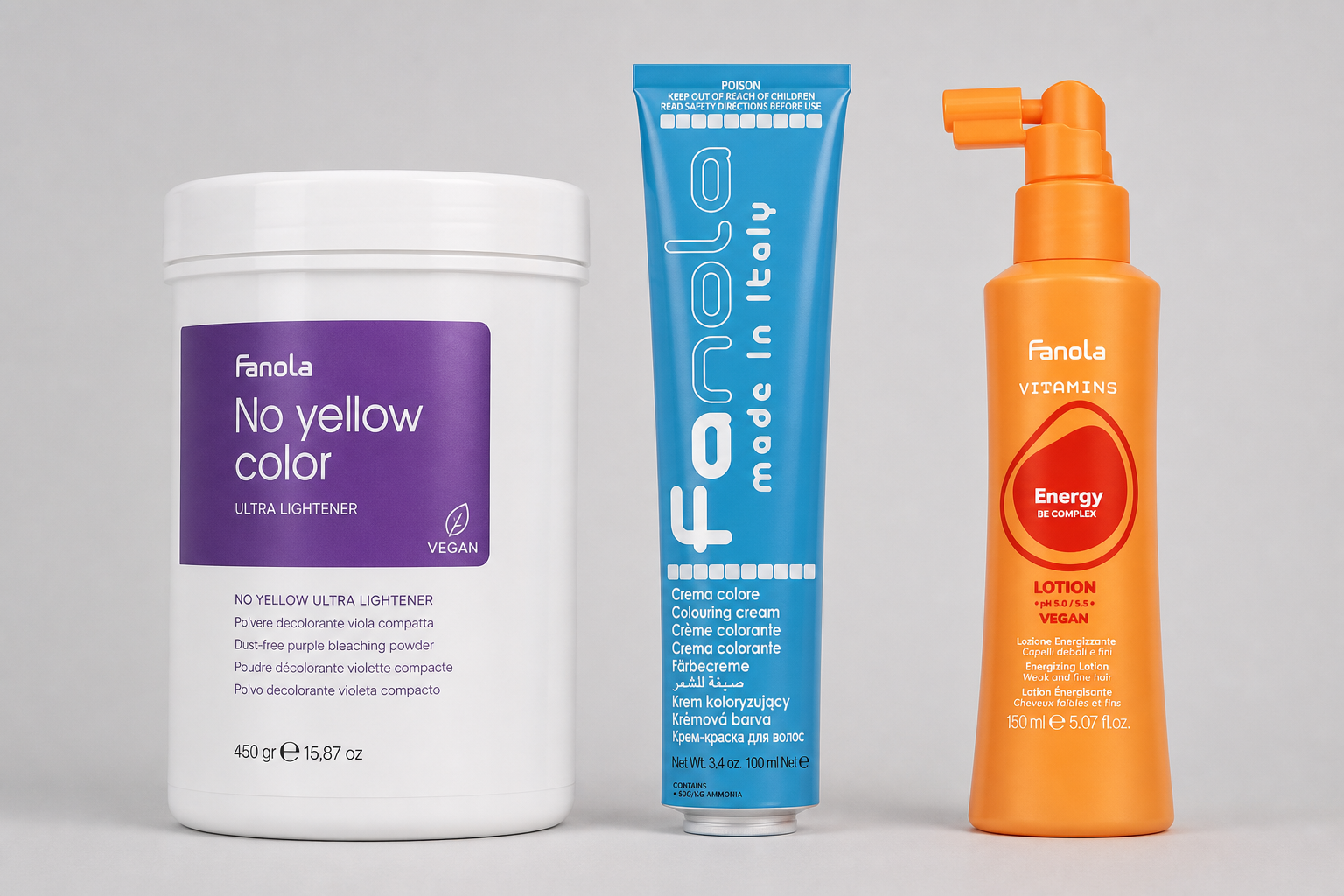
- Undertone correction. Fanola's most well-known line is No Yellow, aimed at neutralizing yellow tones. For warm shades, you'll use it mainly where you want to calm the base so that the resulting copper doesn't slip into a brassy impression. The No Yellow Color Ultra Lightener, which combines both roles, is particularly popular.
- Maintaining the shade between colorings. Warm pigments wash out of hair faster than cool ones. Therefore, plan for accompanying care for colored hair – with shampoo, mask, or leave-in treatment that keeps the shade fresh longer.
Don't expect the same comfort from entry-level pricing as from the most expensive salon lines – the consistency and accompanying care are usually simpler. However, for a first attempt with a warm shade, it's a fair compromise.
Guide: Which Brand for Which Case
- Wella Professionals – for a cautious start, when you want to try a copper tint first with a toning method and only then reach for a coloring cream.
- Schwarzkopf Professional – for vibrant red and for hair that has been through a lot; it combines a striking shade with hair fiber protection during coloring.
- Kemon – for chestnut and for readers who want to adjust the shade at home gradually, in small steps, through toning care instead of recoloring.
- L'Oréal Professionnel – for those who want to keep the shade as consistent as possible and are willing to invest in colored hair care as a separate routine.
- Fanola – for an entry-level budget and for situations where lightening and undertone correction are addressed before the final shade itself.
Once you've made your choice, look for specific products in two categories. In the Coloring category, you'll find coloring creams, lighteners, and toning products that make up the warm shade. Care for colored hair is then covered by shampoos, masks, and leave-in products designed for colored hair – without them, warm pigment lasts significantly shorter. If you're unsure about the extent of the change, start with toning; you can switch to more intense coloring at any time later.

Category
Recommended articles

"Give a girl the right shoes and she can conquer the world!" Marilyn Monroe